What is Sound?
Sound is a form of energy which travels in the form of waves. The waves are created when molecules in air undergo compression and rarefaction alternately. Sound waves move outward from the vibrating source.
Hence, they weaken with the distance from the source.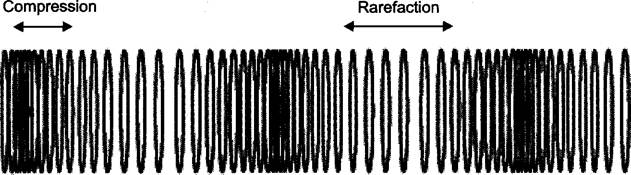
Fig 11.1: Compression and Rarefaction
There are several physical properties associated with sound of which ‘frequency’ and ‘intensity’ are very important. Frequency (or pitch) is a measure of how low or how high a sound is. It is measured in terms of waves per seconds or cycles per second (cps). It also represents the number of compressions which pass a given point per second. Cycles per second (cps) are commonly known as hertz (Hz), after the name of the physicist Heinrich Rudolf Hertz.
The human ear is sensitive to the frequency range of 20 Hz to 20,000 Hz. Sounds with frequency below 20 Hz are not detected by the human ear and are called infrasonic whereas sounds having frequency above 20,000 Hz is called ultrasound. Frequencies between 2000 Hz and 8000 Hz are considered most annoying whereas those below 500 Hz or above 10000 Hz are less annoying. The ‘intensity’ of sound or its loudness is the energy delivered by sound per unit area. It is expressed in decibel (dB) units.
11.4
More on the topic What is Sound?:
- THE FIRST UNIVERSAL SOUND
- Sound and Noise
- Taking Action: 'Closing the Gap" and 'Breaking the Sound Barrier"
- The Decibel Scale
- THE IDEAL NATURE OF HUMAN EXISTENCE
- 3 The Natural Conscience
- Introduction
- THE SUPERFLUID VACUUM
- THE IMMORTAL KABBALAH
- THE SILENT DARKNESS OF THE HALF MEASURE