As coronavirus spreads, can the EU afford to close its borders?
Raffaella Meninno and Guntram Wolff1
Bruegel
Coronavirus crisis has triggered intense debate about border closings in the Schengen area as a way to contain the spread of the epidemic.
Austria stopped some trains from Italy and as the virus spreads the open border policy will be further tested. Whether or not such a measure makes sense from an epidemiological point of view is beyond the expertise of the authors. The Schengen regulation in any case does allow travel restrictions in case of a threat to public health (Article 2(21) an 6(1e) of Regulation (EU) 2016/399). This chapter looks at some of the possible economic consequences of border closings. Many workers rely on the Schengen agreement, which allows them to cross the border without any ID controls. More than 1.9 million residents from Schengen countries crossed the border to go to work in 2018. As can be seen in the chart below, 0.9% of the employed citizens living in Schengen countries work across the border. The share of cross-border commuters is particularly high in Slovakia (5.5%), Luxembourg (2.7%), Croatia, Estonia and Belgium.The Schengen agreement’s relevance stretches beyond cross-border commuting to work. In 2018, EU27 citizens made almost 320 million trips of one night and over to other EU27 countries, more than 39 million (12%) of those were for business purposes.
1 This chapter first appeared as a blog on the Bruegel website.
Figure 1 Cross-border commuters as a share of employed population (2018)
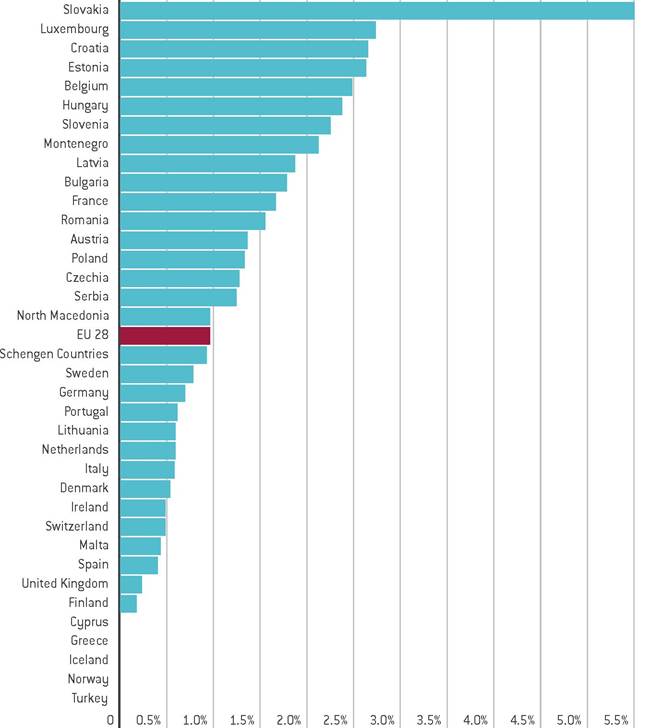
Source: Eurostat [lfst_r_lfe2emp] and [lfst_r_lfe2ecomm] Note: these figures represent the share of a country's employed residents who commute out of the country to go to work. Data for Cyprus, Greece, Iceland, Norway, Turkey was not available.
Figure 2 Number of outbound trips of one night and over from EU27 citizens to EU27 countries (2018)
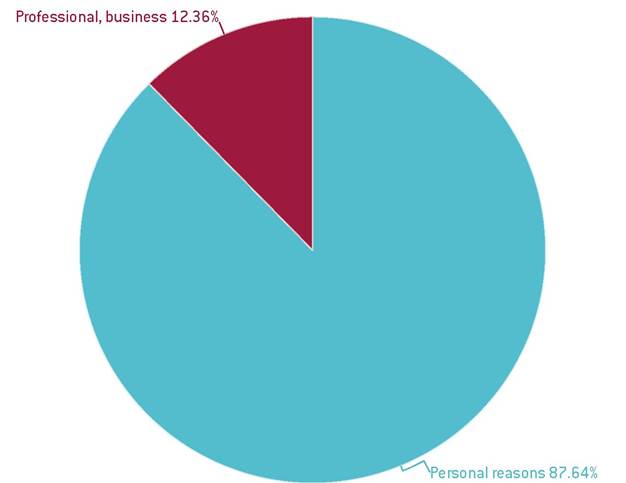
Note: 100% = 319,960,265 trips Source: Eurostat [tour_dem_ttpur]
When, back in 2015,[34] we looked at the effects of border controls in the context of the migration crisis, we argued that the direct economic effects of additional border controls were likely to be relatively limited. The assessment now would be different: stopping cross-border travel would lead to a major disruption of economic activity.
It is therefore no surprise that the EU for the time being has decided not to close borders.[35]Figure 3 Number of outbound trips of one night or over from EU 27 countries in millions (2012-2018)
a) Personal reasons
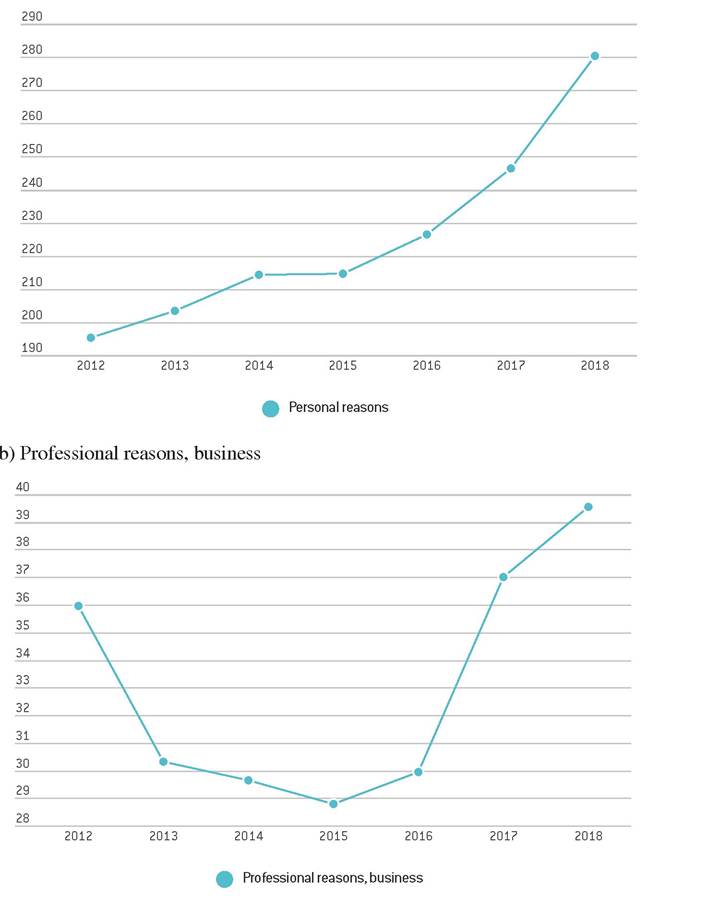
Source: Eurostat [tour_dem_ttpur] Note: Data for Poland (2018), Romania (2018) and Sweden (2012-2013) are not available. Data for the United Kingdom have been excluded.
About the authors
Raffaella works at Bruegel as a Research Assistant Intern. Raffaella is a third-year student in Economics and Social Sciences at Bocconi University in Milan, where she is expected to graduate in 2020. Her studies are mainly focused on quantitative methods and their application in economic research. She previously worked as Research Assistant at the Carlo F. Dondena Centre for Research on Social Dynamics and Public Policy (Dondena), working on a project that aimed at explaining the gender gap in the electorate of far-right and populist parties. Raffaella has been Member of the Board as HR Officer at the Italian Section of the European Youth Parliament (EYP). Raffaella has also worked as a trainer of the Understanding Europe program of the Schwarzkopf- Stiftung Foundation.
Guntram Wolff is the Director of Bruegel. He regularly testifies at the European Finance Ministers’ informal ECOFIN meeting, the European Parliament, the German Parliament (Bundestag) and the French Parliament (Assemblee Nationale). From 2012-16, he was a member of the French prime minister’s Conseil d’Analyse Economique. He joined Bruegel from the European Commission, where he worked on the macroeconomics of the euro area and the reform of euro area governance. Prior to joining the Commission, he was coordinating the research team on fiscal policy at Deutsche Bundesbank. He also worked as an adviser to the International Monetary Fund. He holds a PhD in economics from the University of Bonn and has published in leading academic and policy outlets.
10