Productivity and labour skills
The above account points to the importance of capital intensity in enhancing productivity. Of course the productivity of a nation also depends on the skills of its management and workforce in making the best use of whatever resources are available.
Management is responsible for selecting projects, organizing the flow of work and the utilization of resources, so that effective management is a ‘necessary’ condition for good productivity performance. It is not, however, ‘sufficient’ since a labour force which possesses inappropriate skills, or which refuses to adapt its work practices and manning levels to new technology, will prevent advances in productivity, whatever the merits of management. A major issue in many industries is workers’ lack of flexibility between tasks, resulting in overmanning and also acting as a disincentive to innovation. Lack of flexibility can result from union restrictive practices, but is also caused by badly trained workers and managers who are unable to cope with change. There is evidence of low standards in UK education which mean that many school leavers are ill-equipped for the growing complexity of work.British industry has periodically placed less emphasis on training than in other countries. Only around 52% of 18-year-olds in the UK were in fulltime or part-time education or training in 1999, much less than the 80% figure for Germany, France, the Netherlands and Belgium, suggesting that young people as a group in the UK are among the least educated and trained in Europe. When considering the whole labour force, that is the stock of human capital rather than the flow, the situation is probably even worse. Davies and Caves (1987) had pointed out that British managers were only marginally better qualified than the population at large: for example, very few production managers were graduate engineers.
Amongst production workers only a quarter in Britain had completed an apprenticeship compared with about half in Germany. Very few British foremen had formal qualifications for their job, but in Germany foremen were trained as craftsmen and then took the further qualification of Meister. In fact only 14% of UK technicians and 3% of UK foremen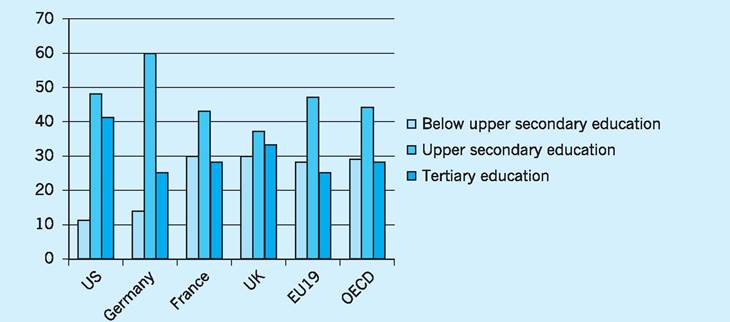
Fig. 1.1 Distribution of highest completed level of education, 2008. Source: OECD (2010b) Education at a Glance 2010: OECD Indicators.
possessed higher intermediate qualifications, compared to 36% of German technicians and 64% of German foremen (Steedman et al. 1991).
Figure 1.1 provides some comparative international insight into current labour qualifications showing the distribution of the population aged 25-64 years arranged by their highest level of educational attainment. The UK, together with France, has a relatively high percentage of the population (30%) whose highest level of qualifications attained is below upper secondary education level (i.e. qualification attained before the age of 15/16 years). However, the UK performs relatively well in tertiary education with some 33% of the age group having completed tertiary or higher education as compared to only 25% in Germany and 28% in France. It is at the upper secondary education level that the UK is most disadvantaged, with only 37% of the age group having this level of qualification, yet it is at this level that intermediate technician/craftsmen and other similar skills are located - the skill/educational level at which Germany has excelled. For the UK there is a need to shift the attainment level of a significant proportion of its population from below upper secondary to upper secondary, as is also the case for France and many other European economies. Finally, it should be noted that the US has only 11% of its population in the lowest educational attainment category, with particular strengths in the tertiary or higher education sector where 41% of its population has attained at least this level of education.
The US arguably exhibits the link between educational knowledge, skills and higher productivity!Of course workforce training is one way in which the UK and other EU countries could help improve their productivity outside the formal education levels noted in Fig. 1.1. Data in 2009 (Department for Business, Enterprise and Regulatory Reform 2009) shows that 67% of UK employers provide some form of training to 63% of the workforce and that 9.8 training days per worker was allocated with a training spend per worker of £1,725. This area of training is essential if the weakness of sub-tertiary education noted above is to be alleviated.
Overall, some progress has been made in narrowing the productivity gaps previously identified for the UK vis-a-vis its major competitors. However, the UK is still at a considerable productivity disadvantage in terms of many of its competitors. A similar picture emerges from our review of capital intensity and the quality of the workforce.
Nevertheless it is important to remember that the whole question of productivity differences is much more complex than might at first appear. For example, a NIESR research project investigated the reasons for observed differences in productivity between the US and Europe in two quite different sectors, namely the biscuit sector and the precision industry sector (Mason and Finegold 1997). The survey did find that some of the reasons for the higher US productivity could be related to higher physical capital investment per worker in these sectors in the US as compared to Europe. However, the most important factor underlying the productivity gap was found to be the greater economies of scale available in the US sectors compared to the European sectors, a factor which is often overlooked in studies comparing productivity performances. That the reasons for productivity differences are complex is apparent from comparisons in 1998 between Nissan’s Sunderland plant, which produced 98 cars per employee per year, and the former Rover Group plant at Longbridge, which produced 33 cars per employee per year.
Investigations revealed that, compared to Nissan’s Sunderland plant, the Long- bridge plant was older, had a more complex layout, and suffered from a lower demand for its product range, suggesting that simplistic conclusions from productivity comparisons must be treated with some caution. Certainly the existence of relatively inefficient car plants is by no means a British phenomenon. For example, the Renault plant at Sandouville, France, produced only 36 cars per employee per year and the Volkswagen plant at Emden, Germany, produced only 28 cars per employee per year in the late 1990s.We have now completed our analysis of the relative performance of the UK vis-a-vis its main competitors in terms of various factors such as labour and total factor productivities, capital intensity and skill levels. To complete this analysis, it might be useful to summarize the results of research into the main causes of the relative labour productivity differences in the market economies of the US, UK, France and Germany noted earlier in Table 1.8.
Studies such as Broadberry and O’Mahony (2004) have suggested that the gap between the UK and the US in terms of labour productivity was due mainly to the total factor productivity (TFP) element, which reflects the efficiency with which the US uses all its resources. Subsequent research (see Table 1.9, p. 13) has also emphasized the contribution of TFP (expressed also as multifactor productivity (MFP)) as a key variable influencing the growth of the market economy. Van Ark et al. found that the US market economy grew by 3.0% per year between 1995 and 2004, with a significant amount of that growth (i.e. 1.4%) attributable to improvements in MFP. Over the same period Europe’s market economy grew by 1.5% per year, but the contribution of MFP was a much lower 0.3%. As far as the UK was concerned, the growth of its market economy over the same period was 2.7% per year, with a sizeable 0.7% contribution from MFP. The UK’s efficiency in the use of all its resources was better than that in many European countries but still lagged behind that of the US (van Ark et al. 2008).