Properties for Multidimensional Poverty Measures
In selecting one poverty measurement methodology from a set of options, a policymaker thinks through how a poverty measure should behave in different situations in order to be a ‘good' measure of poverty and support policy goals.
Then she asks which measure meets these requirements. For example, should the poverty measure increase or decrease if the achievement of a poor person rises while the achievements of other people remain unchanged? Should poverty comparisons change when achievements are expressed in different units of measurement? Should the measure of poverty in a more populous country with a larger number of poor people be higher than the poverty measure in a small country with a smaller number of, but proportionally more, poor people?A policymaker seeking to ameliorate poverty should have a good understanding of the various normative principles that her chosen poverty measure embodies, just as a pilot of a plane must have a sound understanding of how a particular plane responds to different operations. If the policymaker has a good understanding of the principles embodied by alternative measures then she will be able to choose the measure most closely reflecting publicly desirable ethical principles and most appropriate for the application—just as a pilot will choose the best way to fly the plane for a particular journey.
The normative judgements embodied by a poverty measure are reflected in its mathematical properties, including its structure and its response to changes in its argument. The axiomatic method, formally introduced to this field by Sen (1976),[62] refers to measures that have been designed based on principles that are taken by the researcher as axioms, i.e. as statements that are accepted as true without proof.[63] In this section, we define and discuss the various properties proposed in the literature on multidimensional poverty measures.
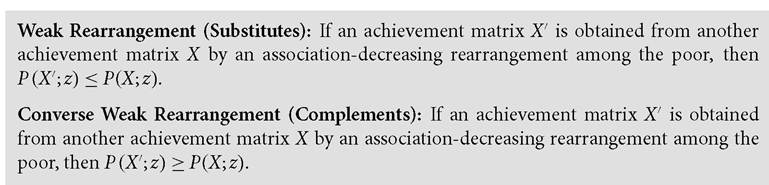
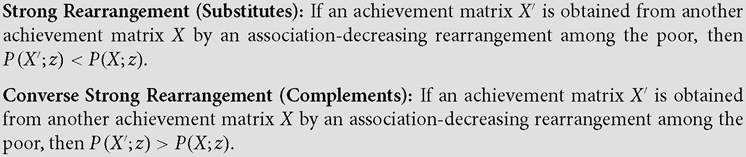
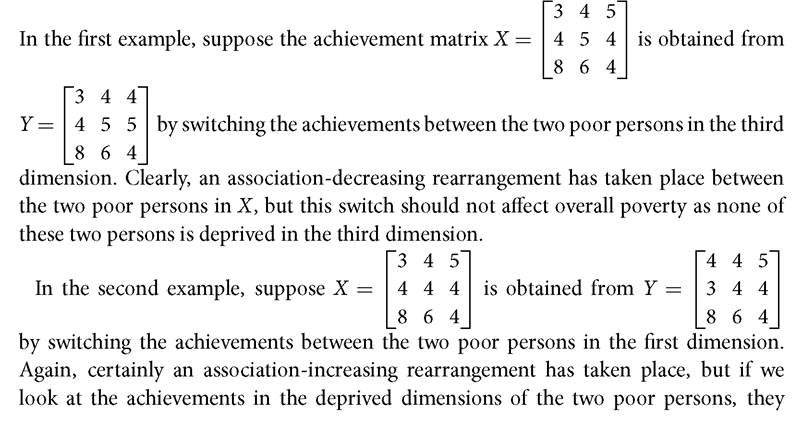
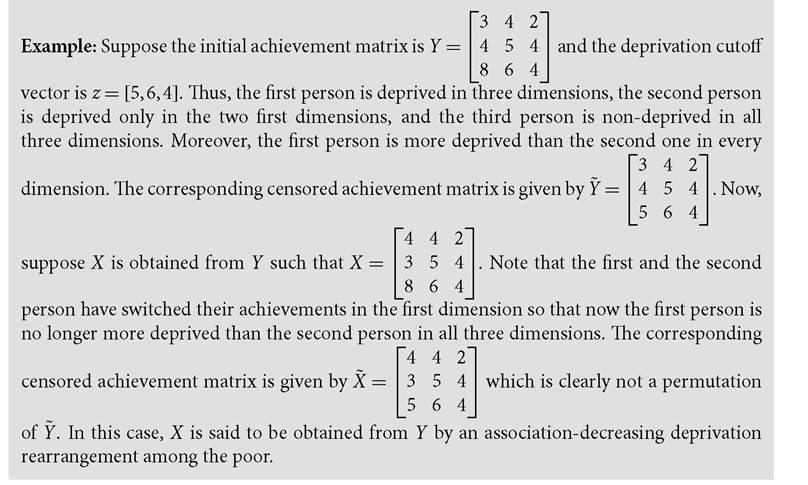
A consensus may emerge around some properties, thus they may be considered as axioms, while others may remain optional. In what follows, we use the words ‘principles' and ‘properties' interchangeably.The set of properties for multidimensional measurement has been built upon its unidimensional counterpart. However, as noted by Alkire and Foster (2011a), there is one vitally important difference: in the multidimensional context, the identification step is no longer elementary and properties must be viewed as restrictions on the overall poverty methodology M = (ρ,P), that is, as joint restrictions on the identification and the aggregation method. For simplicity, in what follows, we state the properties in terms of the poverty index P(X; z), which entails two assumptions. First, that any multidimensional poverty index is associated with an identification function. Second, that the identification function relies on a functional form of the type ρ (xi.;z).[64]
We classify the properties into four categories.[65] The first set of properties requires that a poverty measure should not change under certain transformations of the achievement matrix. We refer to these as invariance properties, which are symmetry, replication invariance, scale invariance and two alternative focus properties, poverty focus and deprivation focus. The second set requires poverty to either increase or decrease with certain changes in the achievement matrix. We refer to these as dominance properties, which are monotonicity, transfer, rearrangement, and dimensional transfer properties. The third set of principles relates overall poverty to either groups of people or groups of dimensions and thus is called subgroup properties. Other properties that guarantee that the measure behaves within certain usual, convenient parameters, we refer to as technical properties. Each of the four following sections provides a formal outline and intuitive interpretations of each set of properties.
1.4.1 invarianceproperties
The first invariance principle is symmetry. Symmetry requires that each person in a society is treated anonymously so that only deprivations matter and not the identity of the person who is deprived. Hence this property is also often referred to as anonymity. As long as the deprivation profile of the entire society remains unchanged, swapping achievement vectors across people should not change overall poverty.[66] This type of rearrangement can be obtained by pre-multiplying the achievement matrix by a permutation matrix of appropriate order.
Symmetry: If an achievement matrix X' is obtained from achievement matrix X as X' = ΠX, where ∏ is a permutation matrix of appropriate order, then P (X'; z) = P(X; z).

and the permutation
Example: Suppose the initial achievement matrix is X =

that the first and the second person (rows) in matrix X have swapped their positions. However, as long as the deprivation cutoffs remain unchanged, there is no reason for the level of poverty to be different for these two societies. Hence, P (X';z) = P(X;z).
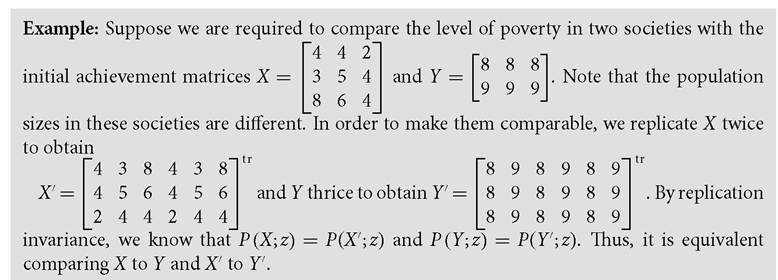
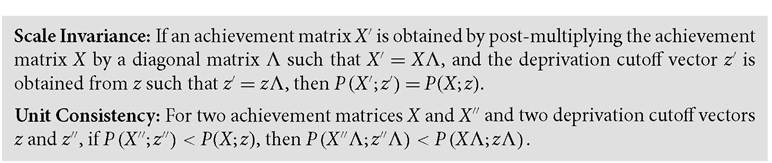
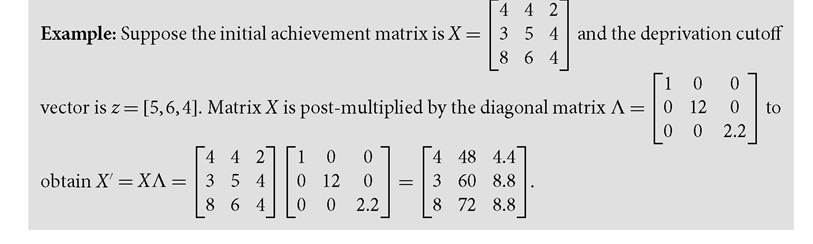
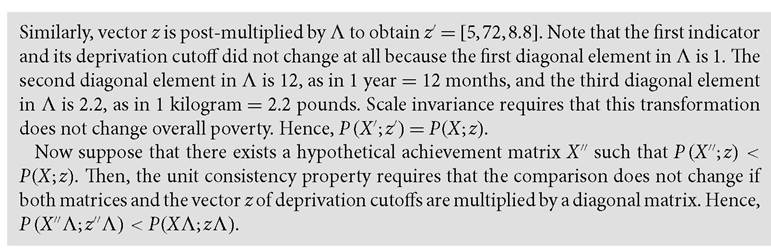
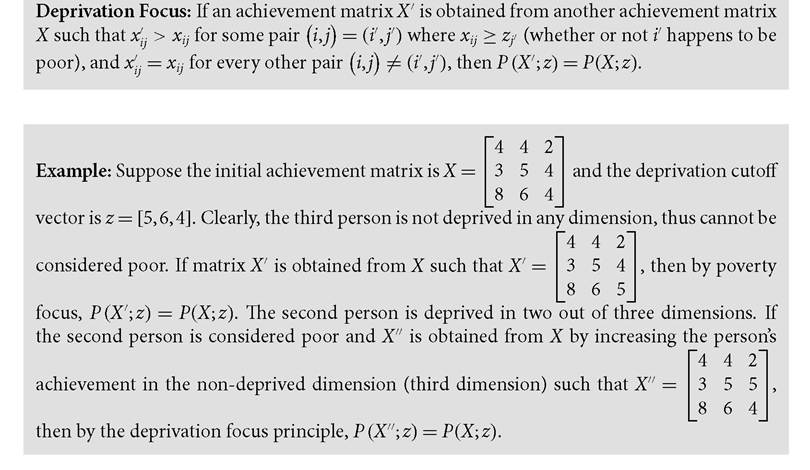
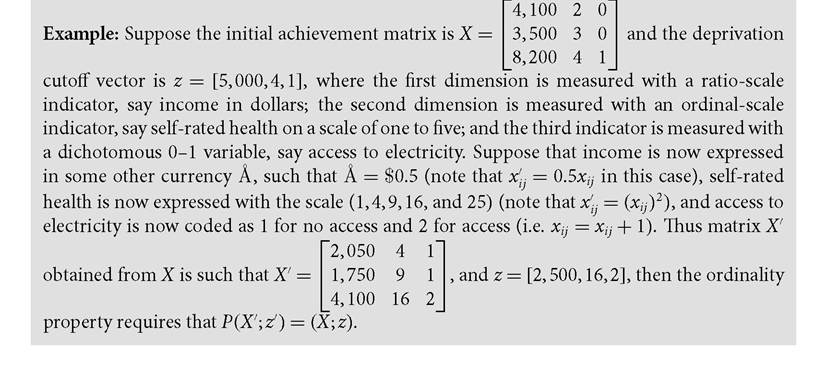
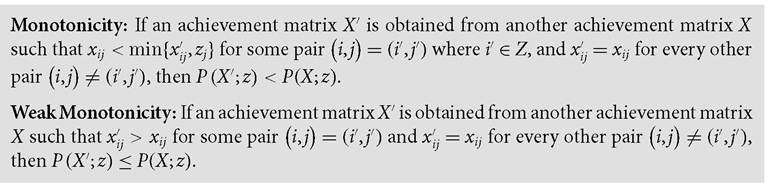
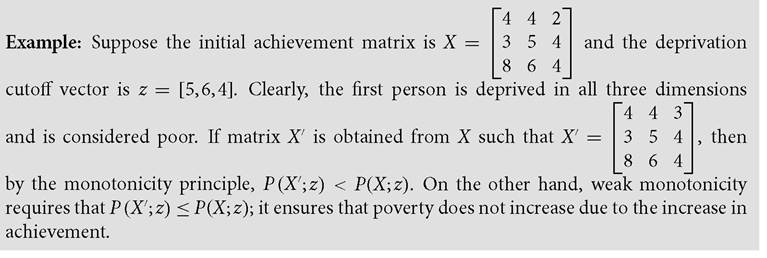
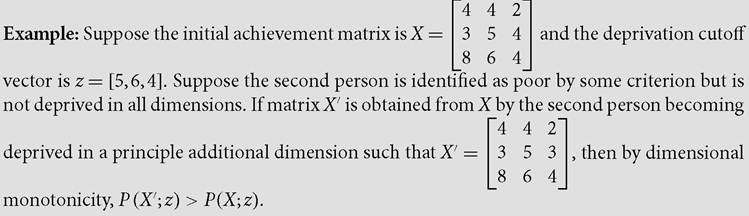
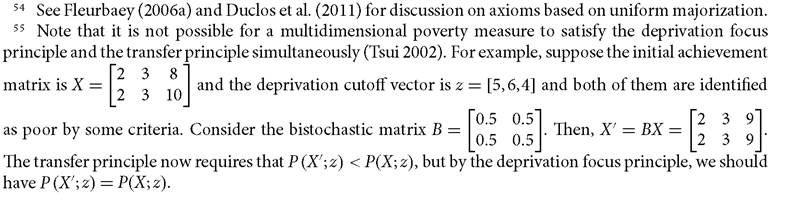
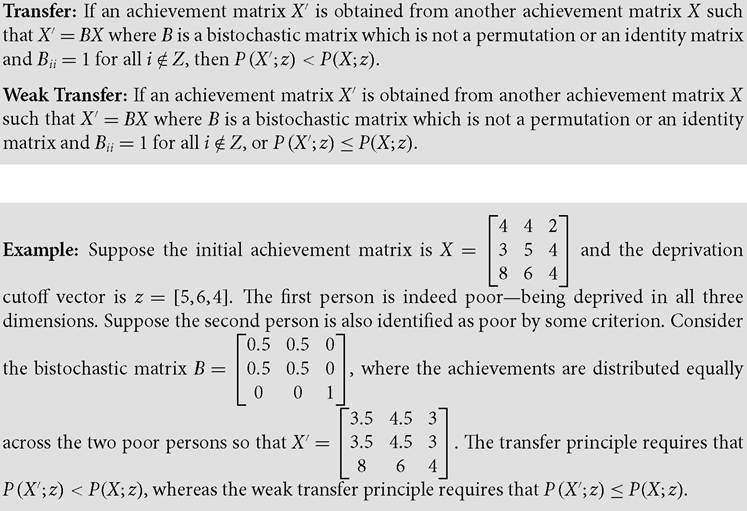
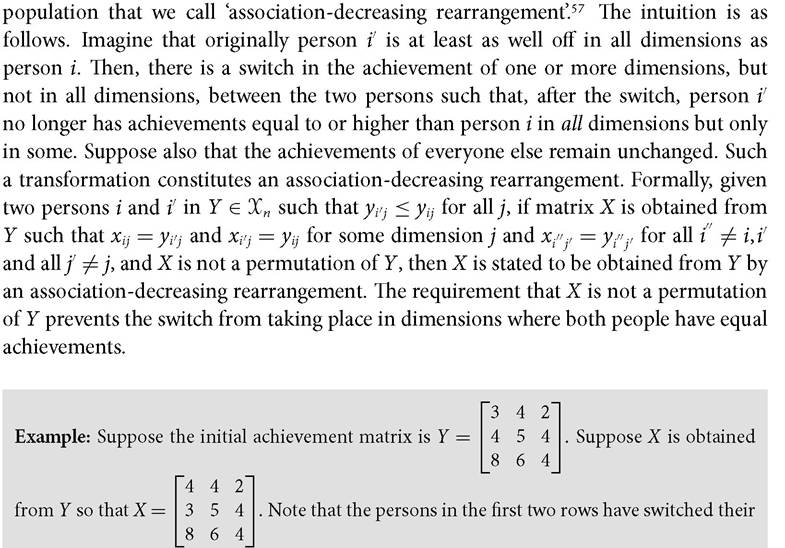
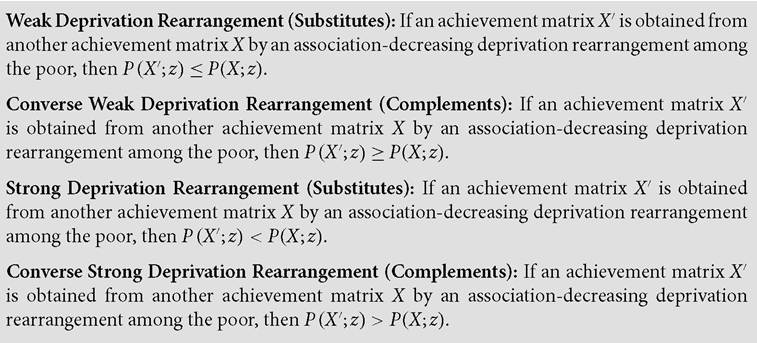
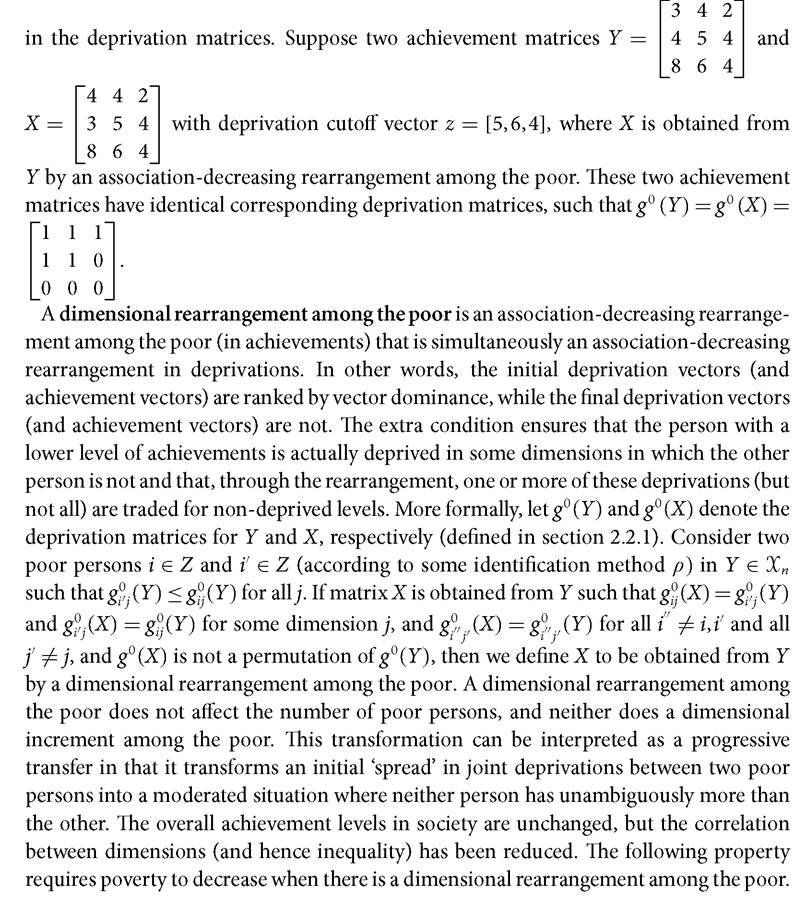
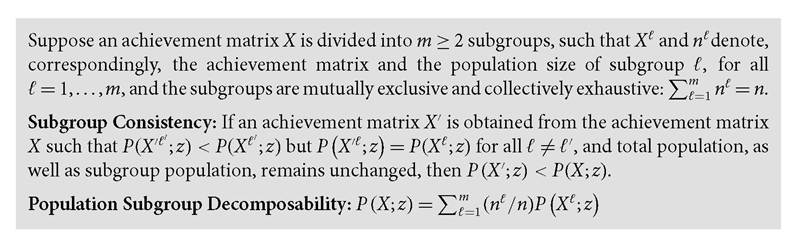
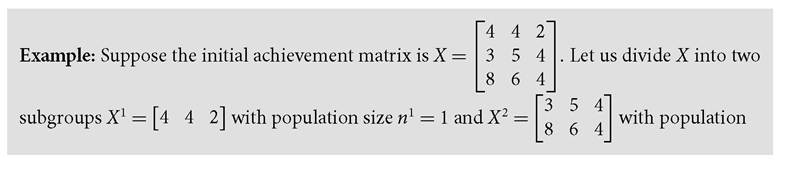
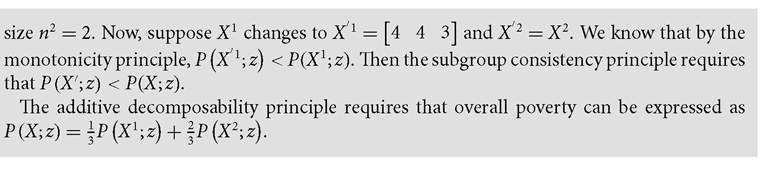
The second invariance principle, replication invariance, requires that if the population of a society is replicated or cloned with the same achievement vectors a finite number of times, then poverty should not change.[67] In other words, the replication invariance property requires the level of poverty in a society to be standardized by its population size so that societies with different population sizes are comparable to each other, as are societies whose populations change over time. Thus, this property is also known as the principle of population.[68] [69] Replication Invariance: If an achievement matrix X' is obtained from another achievement matrix X by replicating X a finite number of times, then P (X'; z) = P(X; z). The third invariance principle, scale invariance,48 requires that the evaluation of poverty should not be affected by merely changing the scale of the indicators. For example, if the duration of completed schooling is an indicator, then deprivation in education, thus overall poverty, should be the same regardless of whether duration is measured in years or in months, provided the deprivation cutoff is correspondingly adjusted. The scale of any indicator in an achievement matrix can be altered by post-multiplying the achievement matrix by a diagonal matrix Λ of appropriate order (d, the number of dimensions). If a diagonal element is equal to one, then the scale of the respective indicator does not change. The diagonal elements of Λ need not be the same because different indicators may have different scales and units of measurement. A weaker version of the scale invariance principle, referred to as ‘unit consistency', has been proposed by Zheng (2007) in the context of unidimensional poverty measurement and extended to the multidimensional context by Chakravarty and DAmbrosio (2013). This principle requires that poverty comparisons, but not necessarily poverty values, should not change if the scales of the dimensions are altered.[70] The scale invariance property implies the unit consistency property, but the converse does not hold. [1] Most ofthe studies, such as Chakravarty, Mukherjee, and Ranade (1998), Bourguignon and Chakravarty (2003), and Deutsch and Silber (2005), have used the term ‘scale invariance', whereas Tsui (2002) uses the term ‘ratio-scale invariance'. The fourth invariance principle is focus. However, in the multidimensional framework, the terms ‘deprived' and ‘poor' are not synonymous. Someone can be poor yet not deprived in every single indicator. The poverty focus principle does not cover the situation where a poor person's achievement increases in a dimension in which that person is not deprived. If poverty were to change in this case, the non-deprived attainments would compensate deprived attainments, creating a form of substitutability across dimensions. Practically, this could encourage a policymaker who is enthusiastically interested in reducing the poverty figures to assist the poor in their non-deprived dimensions, instead of addressing the dimensions in which they are deprived. Thus, a second focus principle might be relevant. The deprivation focus principle requires that overall poverty not change if there is an increase in achievement in a non-deprived dimension, regardless of whether it belongs to a poor or a non-poor person. This property prevents poverty from falling when a poor person's achievements increase in non-deprived dimensions. Note that focus properties motivate the construction of a censored achievement matrix X, as described in section 2.2.1.[71] The focus principle is one example in which it can be verified that the properties of multidimensional poverty measures are, as stated at the beginning of this section, joint restrictions on the identification and the aggregation methods. The last invariance property ‘ordinality’ relates to the type of scale of the particular indicator used for measuring each dimension. As we explained in section 2.3, the scale of an indicator affects the type of operations and statistics that can be meaningfully applied, in the sense that statements remain unchanged when all scales in the statement are transformed by admissible transformations. Building on this notion of meaningfulness, ordinality requires the poverty estimate not to change under admissible transformations of the scales of the indicators that compose the poverty measure.[72] More formally, we say that (X'; z') is obtained from (X; z) as an equivalent representation if there exist appropriate admissible transformations fj: R+→ R+ for j = 1,..., d such that x,ij = fj(xij) and zj = fj(zj) for all i = 1,..., n. In other words, an equivalent representation can comprise a set of admissible transformations, each of which is appropriate for each scale type, and which assigns a different set of numbers to the same underlying basic data. For example, an equivalent representation can include monotonic increasing transformations for ordinal variables, linear transformations for interval-scale variables, and proportional changes for ratio-scale variables. We now state the ordinality axiom as follows: 2.5.2 DOMINANCE PROPERTIES This section covers six principles, each of which has a stronger version and a weaker version. The stronger version requires that a poverty measure strictly moves in a particular direction, given certain transformations in the achievements of the poor. The weaker version does not require a poverty measure to move in a particular direction but ensures that the poverty measure does not move in the opposite (wrong) direction under certain transformations of the achievements.[73] The first dominance principle, monotonicity, requires that if the achievement of a poor person in a deprived dimension increases while other achievements remain unchanged, then overall poverty should decrease. Normatively, this principle considers that improvements in deprived achievements of the poor are good and should be reflected by producing a reduction in poverty. Its weaker version, referred to as weak monotonicity, ensures that poverty should not increase if there is an increase in any person's achievement in the society.53 The monotonicity and weak monotonicity principles are natural extensions of the analogous concepts in the unidimensional poverty analysis. However, the next principle in this category, referred to as dimensional monotonicity, is specific to the multidimensional context. This principle was introduced by Alkire and Foster (2011a). Dimensional monotonicity requires that if a poor person who is not deprived in all dimensions, becomes deprived in an additional dimension then poverty should increase. This principle ensures that we are not only concerned with the number of poor in a society but also with the extent to which the poor are deprived in multiple dimensions—what we call the intensity of their deprivation. A measure that satisfies monotonicity also satisfies dimensional monotonicity. 53 Alkire and Foster (2011a) distinguished the monotonicity principle from the weak monotonicity principle. Others, including Chakravarty, Mukherjee, and Ranade (1998), Tsui (2002), Bourguignon and Chakravarty (2003), and Deutsch and Silber (2005) imply weak monotonicity by their monotonicity principle. Bossert, Chakravarty, and DAmbrosio (2013) did not introduce a weak monotonicity principle. The third principle in the category of dominance principles, transfer, is concerned with inequality among the poor. This property has been borrowed from the multidimensional inequality measurement literature and governs how a poverty measure should behave when the distribution of achievements among the poor becomes more or less equal while their average achievements remain the same. There are different ways of reducing inequality within a multidimensional distribution (see Marshall and Olkin 1979). We follow the approach known as uniform majorization introduced by Kolm 1977). A uniform majorization among the poor is a transformation in which the achievements among the poor are averaged across them or, equivalently, the original bundles of achievements of poor individuals are replaced by a convex combination of them. It is worth noting that the ‘averaging' occurs within dimensions, across people.54 Mathematically, this transformation is obtained by pre-multiplying the achievement matrix by a bistochastic matrix. The transfer principle requires that if an achievement matrix is obtained from another achievement matrix by reducing inequality among the poor, while the average achievement among the poor remains the same, then poverty decreases.55 The weak transfer principle ensures that poverty does not increase when achievements among the poor become more equal. 60 MULTIDIMENSIONAL POVERTY MEASUREMENT AND ANALYSIS The transfer principle in the multidimensional context is similar to its unidimensional counterpart, which is also concerned with the spread of the distribution. There is a second form of inequality among the poor that is only relevant in the multidimensional context and depends on how dimensional achievements are associated across the population. This second form of inequality corresponds to the joint distribution of achievements and was introduced by Atkinson and Bourguignon (1982): ‘in the study of multiple deprivation, investigators have been concerned with the ways in which different forms of deprivation (...) tend to be associated...' (p. 183). Authors working on this issue have used both the term ‘correlation' and the term ‘association'. Correlation refers to the degree of linear association between two variables, whereas association is a broader term that includes linear association and also encompasses other forms of association such as quadratic or simply rank association.56 Given a monotonic transformation of a variable, it is possible that while some form of association, such as rank association, remains invariant, the degree of correlation changes. Thus, here we prefer to use the broader concept of association to define the related properties. The principles that require a measure to be sensitive to the association between dimensions refer to a specific type of rearrangement of the achievements across the 56 Rank association refers to the degree of agreement between two rankings. In the context of the properties discussed here, perfect rank association would occur if person i', having higher achievement than person i achievements in the first dimension so that the person in the first row no longer has a lower achievement than the next person in all three dimensions. Thus, X is obtained from Y by an association-decreasing rearrangement. In fact, note that the achievement vectors of the first and the second person are comparable by vector dominance in Y (each element in one vector is equal to or greater than the same element in the other vector) but not in X. Hence, the overall association between dimensions in X is lower. To be relevant to the analysis of poverty, there is one further qualification: the transformation must take place among two poor persons. Thus, in the example above, both the first and the second person must have been identified as poor in order for this transformation to affect the poverty measure. For example, if the deprivation cutoff vector z = [5,6,4], then initially in Y the first person is deprived in three dimensions, the second person is deprived only in the first two dimensions, and the third person is non-deprived in all three dimensions. Suppose that the identification function identifies the first two persons as poor. When X is obtained from Y, the first and the second person have switched their achievements in the first dimension so that now the first person is no longer more deprived than the second person in all three dimensions. Thus, in this case, X is said to be obtained from Y by an association-decreasing rearrangement among the poor.[74] [75] Should poverty increase or decrease due to an association-decreasing rearrangement among the poor? One possible intuitive view is that poverty should go down or at least not increase because the association-decreasing rearrangement seems to reduce inequality among the poor. In the numerical example above, the first person was originally more deprived in all dimensions than the second person, and after the rearrangement, she is less deprived in one dimension. This was the argument provided by Tsui (2002). However, in line with Atkinson and Bourguignon (1982), Bourguignon and Chakravarty (2003) argued that the change in overall poverty should be contingent on the relation between dimensions, namely, whether they are substitutes or complements. When dimensions are thought to be substitutes for one another, poverty should not increase under the association-decreasing rearrangement. The intuition is that if dimensions are substitutes, an association-decreasing rearrangement helps both people compensate for their meagre achievements in some dimensions with higher achievements in other, a capacity that was limited for one of them before the rearrangement. When indicators are thought to be complements, poverty should not decrease under the described transfer. The intuition is that the association-decreasing rearrangement has reduced the ability of one of the persons to combine achievements and reach a certain level of well-being.59 Based on the arguments above, the following properties can be defined. As with the case of monotonicity and transfer, we may define a strong and a weak version of each of the properties. rearrangement-increasing transfer’ by Tsui (2002), ‘correlation increasing switch’ by Bourguignon and Chakravarty (2003), and ‘correlation increasing arrangement’ by Deutsch and Silber (2008). In multidimensional welfare analysis, an analogous concept has been called ‘association increasing transfer’ (Seth 2013), and in multidimensional inequality analysis it has been called ‘correlation increasing transfer’ by Tsui (1999) and ‘unfair rearrangement principle’ by Decancq and Lugo (2012). 59 In the multidimensional measurement literature the substitutability and complementarity relationship between indicators is defined in terms of the second cross-partial derivative of the poverty measure with respect to any two dimensions being positive or negative. This obviously requires the dimensions to be cardinal and the poverty measure to be twice differentiable. Practically, given two dimensions j and j', substitutability implies that poverty decreases less with an increase in achievement in dimension j for people with higher achievements in dimension j' (Bourguignon and Chakravarty 2003: 35). Conversely, complementarity implies that poverty decreases more with an increase in achievement in dimension j for people with higher achievements in dimension j'. If the dimensions are independent, the second cross-partial derivative is zero and poverty should not change under the described transformation. This corresponds to the Auspitz-Lieben-Edgeworth-Pareto (ALEP) definition and differs from Hick’s definition, traditionally used in demand theory (which relates to the properties of the indifference contours) (Atkinson 2003: 55). See Kannai (1980) for critiques of the ALEP definition. For a critique of Bourguignon and Charkavartys (2003) association axiom, see Decancq (2012). The weak versions of these properties have been previously defined; the strict versions have not.60 Note that the properties above are applicable when the identification function uses the deprived as well as the non-deprived dimensions to identify poor people. In other words, a poor person's identification status is allowed to change even when their achievements in non-deprived dimensions change while their achievements in the deprived dimensions remain unchanged. The rearrangement set of properties could be made more precise when the identification of the poor respects the deprivation-focus property as well as the poverty-focus property. Identification that respects deprivation focus occurs when identification is solely based on dimensions in which poor persons are deprived, not on dimensions in which poor persons are not deprived. For example, these properties cannot distinguish situations when a poverty measure satisfying the deprivation-focus property should be strictly or weakly sensitive to the joint distribution of achievements among the poor. Let us consider the following two examples where the deprivation cutoff vector is z = [5,6,4]. 6° For various weak versions of the sensitivity to rearrangement properties in poverty measurement literature, see Tsui (2002), Chakravarty (2009) (which contains a modified version of the properties in Bourguignon and Chakravarty (2003)), and Alkire and Foster (2011a). For different statements of the stronger versions of the property in the measurement of welfare and inequality, see Tsui (1995), Gajdos and Weymark (2005), Decancq and Lugo (2012), and Seth (2013). appear to be permutations of each other and thus overall poverty should not change. In order to make the transformations relevant in this situation, we need to ensure that the association-decreasing rearrangements occur only among the deprived dimensions of the poor. Thus, there is a need to define a new set of properties that is compatible with the deprivation-focus property, which can be done by defining the properties in terms of the censored achievement matrices. In this book, we define an additional set of new rearrangement properties by defining a transformation called association-decreasing deprivation rearrangement among the poor. Let Y and X denote the censored achievement matrices for Y and X, respectively (defined in section 2.2.5). Consider two poor persons i and i' in Y ∈ Xn such thatyi∣j < yij for all j. If matrix X is obtained from Y such that xij = yi∣j and xi∣j = yij for some dimension j, and xiHj, = yiHj, for all ι = i, i' and all j = j, and X is not a permutation of Y, then X is stated to be obtained from Y by an association-decreasing deprivation rearrangement among the poor. The requirement of X not being a permutation of Y has two analogous implications as in case of the association-decreasing rearrangement. It prevents the two cases presented in the previous paragraph. Thus, it does not consider the cases where the switch of achievements between the two (poor) persons takes place in their non-deprived dimensions instead of the deprived dimension. Also, it prevents the censored deprivation vectors from being permutations of each other due to an association-decreasing rearrangement. The following example illustrates the transformation. We define the following four additional properties using the same concept of substitutability and complementarity between dimensions discussed previously, but require the association-decreasing rearrangement to take place between the deprived dimensions of the poor. Note that, due to the transformation, the set of poor remains unchanged. How are deprivation rearrangement properties related to or different from the rearrangement properties? First, if a poverty measure satisfies the (converse) weak deprivation rearrangement property, then the poverty measure will satisfy the (converse) weak rearrangement property, and the converse is true as well. Also, a poverty measure that satisfies the (converse) strong deprivation rearrangement property automatically satisfies the (converse) strong rearrangement property. But a poverty measure that satisfies the (converse) strong rearrangement property does not necessarily satisfy the (converse) strong deprivation rearrangement property. Therefore, the main difference between these two set of properties lies in their strong versions. Although the rearrangement properties show technically how the change in poverty is related to association between dimensions, further research is required to understand the practicalities of rearrangement properties. Importantly, note that these properties require a uniform assumption across dimensions: either they are all substitutes or they are all complements, which may be highly constraining. On the empirical side, there does not seem to be a standard procedure for determining the extent of substitutability and complementarity across dimensions of poverty. Moreover, it is not entirely clear that any interrelationships across variables must be incorporated into the overarching methodology for evaluating multidimensional poverty. Instead, the interconnections might plausibly be the subject of separate empirical investigations that supplement, but do not constitute, the underlying poverty measure. A related property, which is consistent with the ordinality property discussed in section 2.5.1, is dimensional transfer. The association-decreasing rearrangement, as well as the association-decreasing deprivation rearrangement among poor people, requires the achievements of poor people to be rearranged. However, some rearrangements, even when achievement matrices are not permutations of each other, may not alter the deprivation status of the poor, and thus the corresponding deprivation matrices may either be identical or a permutation of each other. Therefore, the rearrangement properties discussed above are not useful forjudging whether an ordinal poverty measure (as we discuss in section 3.6.1) is strictly or weakly sensitive to data transformations when deprivations are transferred between poor persons. Let us show with an example how an association-decreasing rearrangement among the poor may cause no change Dimensional rearrangement among the poor, as defined above, covers only switches of achievements and deprivations in deprived dimensions among people who are and remain poor, and excludes permutations of corresponding deprivation matrices. Dimensional Transfer: If an achievement matrix X' is obtained from another achievement matrix X by a dimensional rearrangement among the poor, then P (X';z) < P(X;z).61 2.5.3 SUBGROUP PROPERTIES The next set of principles is concerned with the link between overall poverty and poverty in different subgroups of the population, and the link between overall poverty and dimensional deprivations. The first principle—subgroup consistency—ensures that the change in overall poverty is consistent with the change in subgroup poverty.62 For example, suppose the entire society is divided into two population subgroups: Group 1 and Group 2. Povertyin Group 1 remains unchanged while poverty in Group 2 decreases. One would expect overall poverty to decrease. If overall poverty did not reflect subgroup poverty, there would be an inconsistency, which would be conceptually and politically problematic. As a result, national poverty estimates would not reflect regional successes in poverty reduction. A related principle with a stronger requirement is population subgroup decomposability. This principle requires overall poverty to be equal to a weighted sum of subgroups' poverty, noted as P(Xt; z) in section 2.2.2, where the weight attached to each subgroup's poverty is the population share of that subgroup. 61 For a different statement of the strong dimensional transfer property using an association-increasing rearrangement, see Seth and Alkire (2014a,b). 62 The concept of subgroup consistency in poverty measurement has been motivated by Foster and Shorrocks (1991). The population subgroup decomposability property has been one of the most attractive properties for policy analysis as it can be particularly useful for targeting and monitoring progress in different subgroups. It is worth noting that a poverty measure that satisfies population subgroup decomposability necessarily satisfies subgroup consistency. However, the converse is not true, which means subgroup consistency does not necessarily imply population subgroup decomposability. The other form of decomposition that is of tremendous relevance in the policy analysis of multidimensional poverty refers to the possibility of breaking down poverty by deprivations across dimensions among the poor. This property, called dimensional breakdown, requires overall poverty to be equal to a weighted sum of the dimensional deprivations after identification Pj (x.j;z) introduced in section 2.2.2. It creates a consistency between the post-identification dimensional deprivations and overall poverty. In the particular case in which a counting approach using a union criterion is followed for identification, then Pj∙(x.j∙;z) = Pj(xj;Zj), provided the base population nj = n for all j. In other words, the dimensional deprivation of any dimension j after identification coincides with the dimensional deprivation level before identification. In this special case, the property of dimensional breakdown coincides with the property of ‘factor decomposability' introduced by Chakravarty, Mukherjee, and Ranade (1998) and referred to by Bossert, Chakravarty, and D'Ambrosio (2013) as ‘additive decomposability in attributes'. In other cases, dimensional breakdown is done after the identification of the poor and shows only the deprivations faced by the poor. Given that the dimensional breakdown property requires additivity in the deprivations, it is not consistent with the properties of association sensitivity in their strict form—that is, with requiring decreasing or increasing poverty under an association-decreasing rearrangement.[76] 2.5.4 technicalproperties Finally, we introduce certain technical principles, which ensure that the poverty measure is meaningful. These principles are non-triviality, normalization, and continuity. The non-triviality principle requires that a poverty measure takes at least two different values. This property may appear to be trivial by its name, but it is important: unless a measure takes two different values, it is not possible to distinguish a society with poverty from a society with no poverty. Note that when a measure satisfies the strong version of at least one of the dominance principles, this property is automatically satisfied (by definition, poverty will take at least two different values). However, when a measure only satisfies the weak version of all dominance principles, this property becomes necessary. The normalization principle requires that the values of a poverty measure lie within the 0-1 range. It takes a minimum value of 0 when there is no poverty in a society, and it takes a maximum value of 1 when poverty is at its maximum. The continuity property prevents a poverty measure from changing abruptly, given marginal changes in achievements. Non-triviality: A poverty measure should take at least two distinct values. Normalization: A poverty measure should take a minimum value of 0 and a maximum value of 1. Continuity: A poverty measure should be continuous over the achievements. It is worth noting that not all properties defined above are applicable across all scales of measurement, just as not all mathematical operations are admissible for all scales of measurement. Thus, some of these properties may need to be adapted according to the requirements of different scales. The next chapter outlines various poverty measurement methodologies based on the framework introduced in this chapter and discusses which scales of measurement they use and which properties they satisfy.