THE ROLE OF POLICY
The role ofpolicy is considered in many of the chapters, but this is the explicit focus of the final part of the Handbook.
5.1 Policy Objectives
Here, we should begin by observing that the past 15 years has seen a major change in the extent to which there has been official adoption of distributional objectives.
This development is the culmination of a series of shifts in attitudes toward policy, notably with regard to the abolition ofpoverty. In Chapter 22, Martin Ravallion traces, with a broad geographical and historical sweep, the evolution of thinking on poverty and antipoverty policy.The most evident manifestation of this change has been the adoption at a world level of the Millennium Development Goals (MDGs). The goals were ratified by world leaders in 2000 at the U.N. Millennium Assembly, and the first on the list was the halving between 1990 and 2015 of the proportion of people whose income was less than $1 a day (later $1.25 a day). At a national level, countries have adopted their own goals, such as the national social target for poverty reduction in Ireland aiming to reduce consistent poverty. In the United Kingdom, the Child Poverty Act 2010 requires the government to produce a poverty strategy every 3 years setting out actions to end child poverty. At a regional level, the European Union adopted in 2010, as part of the Europe 2020 program, the objective of reducing by 20 million the number of people in or at risk ofpoverty and social exclusion. These have been translated to varying degrees into national targets (Social Protection Committee, 2014).
It is not clear whether the same kind of change is occurring in the field of inequality reducing policies. Due to the rise in inequality, and possibly to the recent crisis, it is certainly the case that the public spotlight is focused on inequality and some announcements have been made by politicians that important measures would be taken to fight inequality.
Yet, few explicit targets have been set and no ambitious measure has been taken or is being seriously considered in advanced countries that would make a major dent in the existing income inequality.5.2 Impact of Policy to Date
What grounds are there then for optimism if one is concerned with present levels of economic inequality? Can we point to past experience where inequality has been reduced? The first obvious, but important, point is that inequality is not increasing everywhere. Globally, the recent past has been more encouraging, as is well summarized in Chapter 9 by Alvaredo and Gasparini:
The available evidence suggests that on average the levels of national income inequality in the developing world increased in the 1980s and 1990s, and declined in the 2000s. There was a remarkable fall in income poverty since the early 1980s, driven by the exceptional performance of China over the whole period, and the generalized improvement in living standards in all the regions of the developing world in the 2000s.
They caution that the decline in the 2000s was not universal: in 15% the fall was less than
2.5 percentage points, and in 20% of cases the Gini coefficient increased. The latter included two populous countries: China and Indonesia. The decline was most evident in Latin America, where they say
This remarkable decline appears to be driven by a large set of factors, including the improved macroeconomic conditions that fostered employment, the petering out of the unequalizing effects of the reforms in the 1990s, the expansion ofcoverage in basic education, stronger labour institutions, the recovery of some countries from severe unequalizing crises and a more progressive allocation of government spending, in particular monetary transfers.
In other words, policy was relevant in influencing both market incomes and redistribution. In the case of Brazil, they conclude that the two major determinants were the decline in wage inequality, due to the expansion of the supply of educated workers and to the substantial increase in the minimum wage, and the expansion of cash transfers, notably the Bolsa Familia.
Despite this noticeable progress, however, it remains the case that Brazil, like most other countries in Latin America, is extremely unequal by world standards—with the exception of several countries in sub-Saharan Africa. The drop in inequality observed during the 2000s compensated for the increase that took place during the 1980s and part of the 1990s. Overthe very long run, progress remains limited. Moreover, it must be kept in mind that top income earners are undersampled in the developing countries’ household surveys so that it is not impossible that reported inequality figures miss the same increase at the top of the distribution as has been observed in many developed countries.[10]Although lower than in Latin America, inequality is sizable in many emerging Asian countries and it is increasing. In discussing how far the policies pursued in several Latin American countries could be applied in an Asian context, Kanbur notes in Chapter 20 that
the additional expenditure on conditional cash transfers requires revenues, and the progressivity of the tax system is another major determinant of how globalization related increases in inequality can be mitigated. But progressivity is also important in addressing the rise in very high incomes the world over, especially in Asia. Asian tax systems do not generally score highly on progressivity. In fact, it is argued that raising progressivity of taxation would have a bigger impact on inequality than elsewhere in the world.
What about the richer countries? In terms of reducing the inequality of market incomes, the standard policy response is educational expansion, as would be indicated by the supply and demand explanation for rising wage dispersion (as discussed in Section 4). The review of cross-country time series evidence by Forster and Toth in Chapter 19 concludes that most evidence points to an equalizing impact of educational expansion:
none of the studies covering the set of OECD/EU countries suggest a dis-equalising role of the growth in average educational attainment over the past three decades, but to the contrary, in their majority rather an equalising one.
Human capital can be seen as a complement to technology. Increases in human capital and in the supply of skills are necessary to decrease and eventually reverse the pressure to higher inequality that stems from technological change.The impact of labor market policy is reviewed in Chapter 18 by Salverda and Checchi who conclude that their empirical results
are consistent with the main findings in the literature.... They confirm that the presence and stringency of a minimum wage reduces earnings inequality, also setting an (implicit) control on the distribution of working hours, which seems to be the main channel of inequality reduction of the bargaining activity of unions. Less common in the literature is the finding of a negative impact of both active and passive labour market policies.
The reason that the overall distributive effect of labor market regulations and institutions can be insignificant, as found by Forster and TtSth in their cross-country analysis, is that the employment and wage dispersion effects can operate in opposite directions.
When it comes to redistributive tax and transfer policy, Forster and Toth conclude in Chapter 19 that:
• Policies are inequality reducing, but the effects vary across countries;
• Transfers are typically more effective than taxation;
• There has been a reduction in the redistributive effectiveness since the 1990s;
• Behavioral responses may offset but do not in general outweigh the first-round effects. The last ofthese conclusions is particularly important. For understandable reasons, much of the analysis of public policy by economists in recent decades has focused on negative behavioral responses. Understandable, since the toolkit of economists is designed to illuminate these responses and the second-round effects are often missed in the public debate. At the same time, the analysis seems often to lose sight ofthe purpose for which transfers are paid. As put by Ive Marx, Brian Nolan and Javier Olivera in Chapter 23, “no advanced economy achieved a low level of inequality and/or relative income poverty with a low level of social spending, regardless of how well that country performed on other dimensions that matter for poverty, notably employment.” The GINI project concluded that
The best performers among the rich countries in terms of employment and economic and social cohesion have one thing in common: a large welfare state that invests in people, stimulating them and supporting them to be active and adequately protecting them when everything else fails.
This continues to offer the best prospect for rich countries pursuing growth with equity.Salverda et al. (2014, p. 349).
But it is also clear, as these authors bring out, that it is not only the aggregate but also the design of spending that matters. It is for this reason that the construction of policy reforms has to be based on analysis of the contribution that they can make to distributive and efficiency objectives, and to this end an important development has been that of microsimulation modeling, as surveyed in Chapter 24 by Francesco Figari, Alari Paulus and Holly Sutherland. These models build on the improvements in data availability described in Section 1—their construction requires access to microdata. They also require in-depth knowledge of the institutional details of public policy and how it operates in reality. As is discussed in Chapter 24, there is a considerable challenge in modeling noncompliance and—the less commonly discussed—other side of the coin, which is the non-take-up of benefits to which people are entitled. In melding microdata and institutional detail, the microsimulation models provide an important bridge between the theoretical analysis of policy design and the implementation of policy in the form of legislation and administration.
5.3 Prospects for Future Policy
Given their high level of inequality and the limited development of redistribution in many developing countries, the scope for progress in redistributive policies and in preredistribution opportunity equalizing policies is considerable. This is especially true in middle income or emerging countries where state capacity is sufficient to manage effective redistribution instruments.
What should make things easier for emerging countries’ governments wishing to strengthen their redistribution system is, on the one hand, that they can learn from the experience of developed countries and, on the other hand, that modern technology permits better monitoring and control of individual incomes.
Beyond some level of income, it is difficult today to function without a bank account and a credit/debit card, so that individual transactions are recorded. Approaching 50% of all households in Latin America hold a bank account and this proportion is rising so that the tax authority’s capacity of auditing taxpayers suspected of underreporting their income is necessarily increasing. Yet, the income tax is severely underdeveloped in most emerging countries, where it represents most often less than 2% of GDP. Brazil is an exception but with an income tax amounting to 6% of GDP, it is still lower than the 9% average rate observed in OECD countries. Modern technology also makes easier the transfer of income to people at the bottom of the distribution. Smart payment cards in particular assist in avoiding suspicious leakages. There is therefore scope for extending redistribution and making use of policies in the field of education, social protection, minimum pensions, or minimum wage that are currently seldom used or at a very low scale despite their huge equalizing potential in most countries. As a result, the extent of redistribution in emerging countries, evaluated with the same microsimulation tools as described in Chapter 24, appears much smaller than in developed countries. For instance, the fall in the Gini coefficient when moving from market income—including replacement income like public or private pensions—to disposable income averages 3 percentage points in Latin American countries where such simulation has been performed (Lustig, 2014), whereas it oscillates around 10 percentage points for rich countries (Immervoll et al., 2009).Of course, having the capacity to redistribute will lead to a substantial redistribution only if there is the political willingness to do so, or if the political system permits a majority to impose some redistribution, as could be expected in a democracy. In the empirical work undertaken in Chapter 21, Acemoglu et al. find that a transition to democracy indeed tends to raise the average tax rate in a country. Yet, no significant effect is found on income inequality as such. This may suggest that the political system is more complex than the mere distinction between democracies and nondemocracies would imply; or, as the authors note, may reflect the poorer quality of the income inequality data, an aspect we discussed in Section 3.
In contrast, OECD countries may be closer to their frontier in terms of the trade-off between less inequality and a higher degree of aggregate economic efficiency. The distance depends however on the institutional features of taxes and transfers—aspects to which economists have devoted too little attention (Atkinson, 1999)—and there may be scope for new and innovative ideas, as discussed in the final part of this section. The frontier itself may have been affected itself by the globalization process, its requirement for more competitiveness and, through factor mobility, its weakening of redistributive instruments like the progressivity ofincome taxation, including capital or capital income. At the same time, the same forces of globalization may have increased the need for social protection, just as they did in the early days of the welfare state toward the end of the nineteenth century. Today, as then, the extent to which redistribution takes place depends on the political context. It may also be the case that the perception of inequality in the society today may not coincide with the evolution of inequality as measured by statisticians and economists. In the United States, for instance, the feeling that income mobility matters more than income inequality and the (unfounded) belief that income mobility is and remains high in comparison with other countries may make the public opinion insensitive to the mounting objective income and wealth inequality. Clearly, this cannot continue forever. At some stage, beliefs will change and it is not unlikely that this process is under way—as McCall (2013) seems to detect in the changing discourse on inequality in the U.S. media.
5.4 Thinking Outside the Box
At the beginning of this Introduction, we evoked the increasing attention being paid by policymakers to rising income inequality. To date, the response in terms of policy proposals has been along conventional lines, notably investment in education and reform of redistribution. In our view, these are important, but if progress is to be made, then we
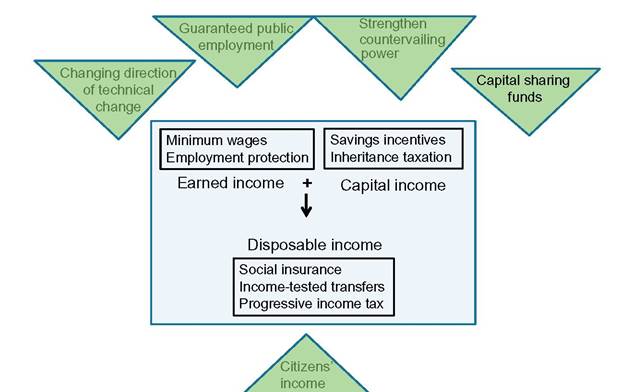
Figure 5 Thinking outside the box.
need to think outside of the box. We must consider ideas that—while far from new—are not on the current policy agenda.
The standard labor market policies—shown inside the box in Figure 5—clearly have a major role to play, and there have been moves to strengthen minimum wages, in order to reduce wage dispersion. As we have noted, however, central is the conjunction of wages and employment, and the latter has proved a hard nut to crack. In our view, one of the crucial elements is the direction of technical progress. Rather than concentrating on factor-augmentation, as in much of the literature, our discussion in Section 4.3 suggests that we should instead focus on the interaction between labor and capital, and specifically the supplantation of labor by capital. Given that much of the innovation is funded directly by public bodies, or subsidized through tax or other concessions, it would be possible to influence this trade-off.This is the first of the “out of the box” alternatives shown in Figure 5. The second concerns public employment. The fact that the present-day market economy does not deliver full employment suggests that we should learn from policy responses in other cases of market failure, notably in financial markets. Here, the government has intervened as a lender of last resort, and the obvious parallel is that the government should act as the employer of last resort. The state should guarantee to everyone seeking it employment at the minimum wage. Such a proposal may seem to some readers outlandish and infeasible on fiscal grounds, but to others it may appear no more outlandish or fiscally irresponsible than the policy that financial institutions are too big to fail. After all, such policies have already been pursued. It is an initiative of this type which was taken by the Indian government when it launched the Mahatma Gandhi National Rural Employment Guarantee Act in 2005. Public employment has formed part of active labor market programs in a number of countries. In the United States, it was authorized under the Humphrey-Hawkins Full Employment and Balanced Growth Act of 1978, which allowed the Federal Government to create a “reservoir of public employment,” where these jobs were required to be in the lower ranges of skill and pay to minimize competition with the private sector.
The third proposal refers back to the discussion of bargaining power in Section 4.4. To the extent that rising inequality is the outcome of a shift in the balance of market power favoring profits and capital, its impact may be offset by strengthening the countervailing powers. This may take the form of a stronger role for the social partners, or it may involve more determined action to protect consumers against monopolistic pricing. Again such actions may be rejected as too radical, but again they are not so far removed from current policy. In the case of the European Union, both the promotion of competition and the encouragement of the social partners are already accepted objectives.
The fourth proposal draws attention to an aspect that has been missing from the policy arena—the capital market—but which has received increasing attention following the debate surrounding Piketty (2014). For macroeconomic reasons outlined in Section 4.6, and given the return of inherited capital in a number of richer countries, capital income is potentially of increasing significance, as it was in the past. The particular proposal is indeed far from new. It goes back at least to the eighteenth century English- man/Frenchman/American Thomas Paine, who in 1797 in his Agrarian Justice proposed:[11]
To create a national fund, out of which there shall be paid to every person, when arrived at the age of twenty-one years, the sum of fifteen pounds sterling, as a compensation in part, for the loss of his or her natural inheritance, by the introduction of the system of landed property.
The proposal of Paine for a capital element payable on reaching the age of majority has its modern counterpart in various schemes for asset-based egalitarianism (as proposed, for example, by Ackerman and Alstott, 1999). The creation of a sovereign wealth fund, as already well established in a number of countries, would offer the possibility of a minimum inheritance for all.
The fifth proposal—which also has shades of Paine—is for a citizen’s income, or the payment of a guaranteed minimum income to all individuals. Such an income is sometimes described as “unconditional”; however, conditions are naturally attached. As described in Figure 5, a condition would be that of citizenship. An alternative, advocated in Atkinson (1995,1996) is that of a participation income, paid not on the basis of citizenship but of participation in the society in question, through employment, past employment (on retirement), caring for dependants, being available for work when unemployed, in approved education or training, and with appropriate provisions for those who are sick, injured, or disabled. The participation income would represent a radical departure from the targeted income-tested transfers that have been the preoccupation of policymakers in recent decades. It would be individual-based, rather than involving a family means-test. It would recognize the fluidity of the employment relationship in the twenty-first century labor market.
No doubt there will be many objections to these final policy proposals, but we hope that the chapters contained in volume II of the Handbook will stimulate new ideas in this important field.
ACKNOWLEDGMENTS
In writing this Introduction, we have drawn heavily on the Handbook chapters. This will be evident from the frequency of cross-references, although we have tried to stop short of the point at which such references become tedious to the reader. We are most grateful to Rolf Aaberge, Facundo Alvaredo, Andrew Berg, Andrea Brandolini, Daniele Checchi, Pierre-Andre Chiappori, Andrew Clark, Koen Decancq, Jean-Yves Duclos, Francesco Figari, Michael Forster, Marc Fleurbaey, StephenJenkins, Salvatore Morelli, Dominique Meurs, Brian Nolan, Jonathan Ostry, Alari Paulus, Sophie Ponthieux, Thomas Piketty, Victor Rios-Rull, Wiemer Salverda, Tim Smeeding, Frederick Solt, Holly Sutherland, Istvan Toth, Alain Trannoy, and Daniel Waldenstrom for their very helpful comments on the draft of the Introduction, but none of them should be held responsible in any way for its contents. We thank Maarit Kivilo for her help with the bibliography. Atkinson’s research for the Introduction was carried out as part of the EMoD program supported by INET at the Oxford Martin School.
REFERENCES
Acemoglu, D., 2002. Directed technical change. Rev. Econ. Stud. 69 (4), 781-809.
Acemoglu, D., Robinson, J.A., 2014. The Rise and Fall of General Laws of Capitalism. working paper, Cambridge, MA. http://economics.mit.edu/files/9834.
Ackerman, B., Alstott, A., 1999. The Stakeholder Society. Yale University Press, New Haven.
Alkire, S., Foster, J., 2010. Designing the Inequality-Adjusted Human Development Index (HDI): OPHI Working Paper 37. University of Oxford.
Alkire, S., Foster, J., 2011. Counting and multidimensional poverty measurement. J. Public Econ. 95 (7-8), 476-487.
Allison, R.A., Foster, J., 2004. Measuring health inequality using qualitative data. J. Health Econ. 23 (3), 505-524.
Alvaredo, F., Londofio Velez, J., 2013. High Incomes and Personal Taxation in a Developing Economy: Colombia 1993-2010: Center for Equity, Working Paper No. 12. Tulane University.
Anand, P., Santos, C., Smith, R., 2007. The Measurement of Capabilities: Discussion Paper 67. The Open University.
Atkinson, A.B., 1970. On the measurement of inequality. J. Econ. Theory 2, 244-263.
Atkinson, A.B., 1995. Beveridge, the national minimum and its future in a European context. In: Atkinson, A.B. (Ed.), Incomes and the Welfare State. Cambridge University Press, Cambridge, pp. 290-304.
Atkinson, A.B., 1996. The case for a participation income. Polit. Q. 67 (1), 67-70.
Atkinson, A.B., 1999. The Economic Consequences of Rolling Back the Welfare State. MIT Press, Cambridge, MA.
Atkinson, A.B., 2008. The Changing Distribution of Earnings in OECD Countries. Oxford University Press, Oxford.
Atkinson, A.B., Bourguignon, F., 1982. The comparison of multi-dimensioned distributions of economic status. Rev. Econ. Stud. 49 (2), 183-201.
Atkinson, A.B., Bourguignon, F., 2000. Income distribution and economics. In: Atkinson, A.B., Bourguignon, F. (Eds.), Handbook of Income Distribution, vol. 1. Elsevier, Amsterdam.
Atkinson, A.B., Brandolini, A., 2001. Promise and pitfalls in the use of “secondary” data-sets: income inequality in OECD countries as a case study. J. Econ. Lit. 34 (3), 771-799.
Atkinson, A.B., Harrison, AJ., 1978. Distribution of Personal Wealth in Britain. Cambridge University Press, Cambridge.
Atkinson, A.B., Marlier, E., 2010. Indicators of poverty and social exclusion in a global context. J. Policy Anal. Manage. 29 (2), 285-304.
Atkinson, A.B., Morelli, S., 2014. Chartbook of Economic Inequality: Economic Inequality Over the Long Run. INET Oxford. http://www.chartbookofeconomicinequality.com/.
Atkinson, A.B., Casarico, A., Voitchovsky, S., forthcoming. Top incomes and the glass ceiling. Working Paper, INET Oxford.
Becchetti, L., Massari, R., Naticchioni, P., 2011. The Drivers of Happiness Inequality: Suggestions for Promoting Social Cohesion: Working Papers 2011-06. Universita' di Cassino.
Benhabib, J., Bisin, A., Zhu, S., 2011. The distribution of wealth and fiscal policy in economies with finitely lived agents. Econometrica 79 (1), 123-157.
Bertola, G., Foellmi, R., Zweimuller, J., 2006. Income Distribution in Macroeconomic Models. Princeton University Press, Princeton.
Bourguignon, F., 2014. Appraising income inequality databases in Latin America. mimeo, J. Econ. Inequal. (forthcoming).
Bourguignon, F., 2013. La mondialisation de l'inegalite. Le Seuil, Paris (Expanded English version, The Globalization of Inequality, forthcoming, Princeton University Press).
Brunori, P., Ferreira, F., Peragine, V., 2013. Inequality of Opportunity, Income Inequality and Economic Mobility: Some International Comparisons: IZA Discussion Paper 7155. Institute for the Study of Labor (IZA).
Budd, E.C., 1970. Postwar changes in the size distribution of income in the US. Am. Econ. Rev. Pap. Proc. 60, 247-260.
Canada, Statistics, 2013. High-Income Trends Among Canadian Taxfilers, 1982 to 2010, Release January 28, 2013.
Clark, A., Fleche, S., Senik, C., 2012. The Great Happiness Moderation: IZA Discussion Paper 6761. Institute for the Study of Labor (IZA).
Cornia, G.A. (Ed.), 2014. Falling Inequality in Latin America: Policy Changes and Lessons. Oxford University Press, Oxford.
Cornia, A., Rosignoli, S., Tiberti, L., 2008. Globalization and Health Impact Pathways and Recent Evidence: Research Paper No. 2008/74. UNU-WIDER, Helsinki.
Dalton, H., 1920. The measurement of the inequality of incomes. Econ. J. 30 (119), 348-461.
Decancq, K., Fleurbaey, M., Maniquet, F., 2014. Multidimensional Poverty Measurement with Individual Preferences: Princeton University William S. Dietrich II Economic Theory Center Research Paper 058. Princeton University.
Deininger, K., Squire, L., 1996. A new data set measuring income inequality. World Bank Econ. Rev. 10 (3), 565-591.
Drandakis, E., Phelps, E.S., 1965. A model of induced invention, growth and distribution. Econ. J. 76 (304), 823-840.
Duclos, J.-Y., Echevin, D., 2011. Health and income: a robust comparison of Canada and the US. J. Health Econ. 30, 293-302.
Duclos, J.-Y., Sahn, D.E., Younger, S.D., 2011. Partial multidimensional inequality orderings. J. Public Econ. 98, 225-238.
Dutta, I., Foster, J., 2013. Inequality of happiness in the US: 1972-2010. Rev. Income Wealth 59 (3), 393-415.
Ferreira, F., Lustig, N. (Eds.), 2015. International databases on inequality. Special issue of the J. Econ. Inequal., forthcoming.
Fisher, G., 1986. Estimates ofthe Poverty Population Underthe Current Official Definition forYears Before 1959. Office of the Assistant Secretary for Planning and Evaluation, U.S. Department of Health and Human Services (Mimeograph).
Fleurbaey, M., Blanchet, D., 2013. Beyond GDP: MeasuringWelfare and Assessing Sustainability. Oxford University Press, Oxford.
Foster, J., Lopez-Calva, L., Szekely, M., 2005. Measuring the distribution of human development: methodology and an application to Mexico. J. Hum. Dev. 6 (1), 5—29.
Hicks, J.R., 1932. The Theory of Wages. Macmillan, London.
Immervoll, H., Levy, H., Nogueira, J.R., O’Donoghue, D., Bezera de Siqueira, R., 2009. The impact of Brazil’s tax and benefit system on inequality and poverty. In: Klasen, S., Nowak-Lehmann, F. (Eds.), Poverty, Inequality and Policy in Latin America. In: CES-Ifo Seminar Series, The MIT Press, Cambridge, MA, pp. 271-302.
Jenkins, S., 2014. World Income Inequality Database: an assessment, mimeo. Final version forthcoming in J. Econ. Inequal.
Kalecki, M., 1971. Selected Essays on the Dynamics of the Capitalist Economy 1933-1970. Cambridge University Press, Cambridge.
Karoly, L., 1992. The Trend in Inequality Among Families, Individuals, and Workers in the United States: A Twenty-Five-Year Perspective. Rand, Santa Monica.
Kennedy, C., 1964. Induced bias in innovation and the theory of distribution. Econ. J. 74 (295), 541-547. Kolm, S.-Ch, 1966. The optimal production ofjustice. In: Guitton, H., Margolis, J. (Eds.), Public Economics. Proceedings of an IEA conference held in Biarritz, published (1969). Macmillan, London, pp. 145-200.
Kolm, S.-Ch., 1971. Justice et equite. Cepremap, Paris (English translation, Justice and Equity, MIT Press, 1988).
Kolm, S.-Ch., 1977. Multi-dimensional Egalitarianism. Q. J. Econ. 91 (1), 1-13.
Kopczuk, W., Saez, E., 2004. Top wealth shares in the US, 1916-2000: evidence from the Estate Tax returns. Natl. TaxJ. 57, 445-487 (longer version in NBER Working Paper 10399).
Korinek, A., Mistiaen, J., Ravallion, M., 2006. Survey nonresponse and the distribution ofincome. J. Econ. Inequal. 4 (1), 33-55.
Krusell, P., Ohanian, L., Rios-Rull, V., Violante, G., 2000. Capital skill complementarity and inequality: a macroeconomic analysis. Econometrica 68 (5), 1029-1053.
Kuznets, S., 1955. Economic growth and income inequality. Am. Econ. Rev. 45 (1), 1-28.
Lemieux, T., 2008. The changing nature of wage inequality. J. Popul. Econ. 21 (1), 21-48.
Lustig, N., 2014. Taxes, Transfers, Inequality and the Poor in the Developing World, Presentation at the USAID, Washington, DC, May 15, 2014.
Maasoumi, E., 1986. The measurement and decomposition of multi-dimensional inequality. Econometrica 54 (4), 991-997.
McCall, L., 2013. The Undeserving Rich: American Beliefs About Inequality, Opportunity, and Redistribution. Cambridge University Press, Cambridge.
Meade, J.E., 1964. Efficiency, Equality and the Ownership of Property. Allen and Unwin, London.
Milanovic, B., 2013. All the Ginis You Ever Wanted. World Bank website, http://econ.worldbank.org/ WBSITE/EXTERNAL/EXTDEC/EXTRESEARCH/0,contentMDK:22301380—pagePK: 64214825—piPK:64214943—theSitePK:469382,00.html.
Moretti, E., 2013. Real wage inequality. Am. Econ. J. Appl. Econ. 5, 65-103.
Nolan, B., Salverda, W., Checchi, D., Marx, I., McKnight, A., Toth, I., van de Werfhorst, H. (Eds.), 2014. Changing Inequalities and Societal Impacts in Rich Countries. Oxford University Press, Oxford.
OECD, 2014. All on Board: Making Inclusive Growth Happen. OECD, Paris.
Ostry, J., Berg, A., Tsangarides, C.G., 2014. Redistribution, Inequality, and Growth: IMF Discussion Note, SDN 14/02. International Monetary Fund, Washington, D.C.
Ovaska, T., Takashima, R., 2010. Does a rising tide lift all the boats? Explaining the national inequality of happiness. J. Econ. Issues 44 (1), 205-224.
Paine, T., 1797. AgrarianJustice, Printedby W. Adlard, Paris. Reprinted and soldbyJ. Adlard andJ. Parsons, London.
Pigou, A.C., 1920. The Economics of Welfare. Macmillan and Co., London.
Piketty, T., 2001. Les hauts revenus en France. Grasset, Paris.
Piketty, T., 2014. Capital in the 21st Century. Harvard University Press, Cambridge, MA.
Piketty, T., Saez, E., 2003. Income inequality in the United States, 1913—1998. Q. J. Econ. 118, 1—39.
Ravallion, M., 2014. The Luxembourg Income Study. J. Econ. Inequal. (forthcoming).
Roemer, J., 1998. The Equality of Opportunities. Harvard University Press, Cambridge.
Salverda, W., Nolan, B., Checchi, D., Marx, I., McKnight, A., Toth, I., van de Werfhorst, H. (Eds.), 2014. Changing Inequalities in Rich Countries. Oxford University Press, Oxford.
Samuelson, P.A., 1965. A theory of induced innovations along Kennedy-Weizsacker lines. Rev. Econ. Stat. 47 (4), 444-464.
Sato, R., 1963. Fiscal policy in a neo-classical growth model: an analysis ofthe time required for equilibrating adjustment. Rev. Econ. Stud. 30 (1), 16-23.
Sato, K., 1966. On the adjustment time in neo-classical models. Rev. Econ. Stud. 33 (3), 263-268.
Schwabish, J.A., 2014. An economist’s guide to visualizing data. J. Econ. Perspect. 28 (1), 209-234.
Sen, A., 1973. On Economic Inequality. Clarendon Press, Oxford (Expanded edition with a substantial annexe by James Foster and Amartya Sen, Oxford University Press, 1997).
Sen, A., 1976. Real national income. Rev. Econ. Stud. 43 (1), 19-39.
Sen, A., 1980. Equality of what? In: McMurrin, S. (Ed.), Tanner Lectures on Human Values, vol. 1. Cambridge University Press, Cambridge, pp. 195-220.
Sen, A., Stiglitz, J., Fitoussi, J.-P., 2010. Mismeasuring Our Lives: Why GDP Doesn’t Add Up. The New Press, New York.
SocialProtection Committee, 2014. SocialEurope—ManyWays, One Objective. Publications Office ofthe European Union, Luxembourg.
Solt, F., 2009. Standardizing the World Income Inequality Database. Soc. Sci. Q. 90 (2), 231-242.
Stevenson, B., Wolfers, J., 2008. Happiness inequality in the US. J. Leg. Stud. 37, 33-79.
Stiglitz, J.E., 1969. Distribution of income and wealth among individuals. Econometrica 37 (3), 382-397.
Stiglitz, J., 2012. The Price of Inequality. W. W. Norton & Company, New York.
Summers, L., 2013. Economic possibilities for our children, pp. 1-13, The 2013 Martin Feldstein Lecture. NBER Reporter, No. 4.
Tinbergen, J., 1975. Income Distribution: Analysis and Policies. North-Holland, Amsterdam.
United Nations Economic Commission for Europe, 2011. Canberra Group Handbook on Household Income Statistics, 2nd edition. United Nations, New York and Geneva.
Veenhoven, R., 2005. Return of inequality in modern society? Test by dispersion of life-satisfaction across time and nations. J. Happiness Stud. 6, 457-487.
ACKNOWLEDGMENTS
First, we would like to thank Ken Arrow and Mike Intriligator for having persuaded us back in 2010 that the time was ripe for a new volume. How prescient their advice was!
In the course of preparing the new Handbook volume, we have incurred many debts. Without the—more than 50—authors, there would be no Handbook, and we would like to thank them sincerely for the cooperative spirit in which they have produced such excellent chapters. We much appreciate the way in which they responded to several rounds of comments from the editors and (usually) met deadlines. Part of preparation took the form of an Author’s conference, entitled “Recent Advances in the Economics of Income Distribution” that was held on April 4—7, 2013 at the Paris School of Economics. We are most grateful for the support that was provided to this conference by the Agence National de la Recherche (Projet INDURA INEG 2011), Cornell University, the UK Economic and Social Research Council and DFID (Grant ES/1033114/1), Ouvrir la science economique (Opening Economics), and the Paris School of Economics.
Throughout all this, a key organizing role has been played by Veronique Guillotin of the Paris School of Economics, and we thank her most warmly.
Tony Atkinson Francois Bourguignon
lxv