THEORETICAL CONSIDERATIONS
In this section, we illustrate some of the linkages between democracy and inequality that have been proposed in the literature. We begin with the seminal Meltzer and Richard (1981) model, but then alter the set of instruments available to the government to show how the logic of the standard model can be altered and even reversed.
We will discuss the impact of democracy, modeled as a broader franchise, relative to a nondemocratic regime modeled as a narrower franchise or controlled by a small group. This broadening of access to political power is what our primary cross-country empirical measures of democracy attempt to capture, and is arguably the most important feature of a democratic regime.21.2.1 The Redistributive and Equalizing Effects of Democracy
We start with the standard “equalizing effect” of democracy, first emphasized formally in Meltzer and Richard’s (1981) seminal study (see also Acemoglu and Robinson, 2006). Democratization, by extending political power to poorer segments of society, will increase the tendency for pro-poor policy naturally associated with redistribution, and thus reduce inequality.
Suppose that society consists of agents distinguished only with respect to their endowment of income, denoted by yi for agent i, with the distribution of income in the society denoted by the function F(y) and its mean by y. The only policy instrument is a linear tax τ imposed on all agents, with the proceeds distributed lump-sum again to all agents. We normalize total population to 1 without loss of any generality.
The government budget constraint, which determines this lump-sum transfer T, takes the form
T ≤ τy - C(τ)y, (21.1)
where the second term captures the distortionary costs of taxation. C(τ) is assumed to be differentiable, convex and nondecreasing, with C0 (0) = 0.
Each agent’s post-tax income and utility is given by
У =(1 - τ)yi + τy ~ C(τ)y. (21.2)
This expression immediately makes it clear that preferences over policy—represented by the linear tax rate τ—satisfy both single crossing and single-peakedness (e.g., Austen- Smith and Banks, 1999). Hence the median voter theorem, and its variants for more limited franchises (see e.g., Acemoglu et al., 2012) hold.[371]
Suppose, to start with, that there is a limited franchise such that all agents with income above yq, the qt percentile of the income distribution, are enfranchised and the rest are disenfranchised. Consider a “democratization,” which takes the form of yq decreasing, say to some γq < yq, so that more people are allowed to vote. Let the equilibrium tax rate under these two different political institutions be denoted by τq and τq', and the resulting post-tax income distribution by Fq and Fq. Then from the observation that the median of the distribution truncated at γq0 is always less than the median for the one truncated above yq > yq, the following result is immediate:
Proposition 1
Redistributive Effects of Democracy
Suppose that Startingfrom only those above yq being enfranchised, there is a further democratization so that now those above yq < yq are enfranchised. This democratization leads to higher taxes (τq ≥ τq), higher redistribution, and a more equal distribution of post-tax income in the sense that Fq0 is more concentrated around its mean than Fq.
A few comments about this proposition are useful. First, this result is just a restatement of Meltzer and Richard’s (1981) main result. Second, the first part of the conclusion is stated as τq > τq, since if both yq and yq∣ are above the mean, with standard arguments, τq = τq = 0.
Third, the second part of the conclusion does not state that Fq is a mean-preserving spread of, or is second-order stochastically dominated by Fq, because higher taxes may reduce mean post-tax income due to their distortionary costs of taxation. Instead, the statement is that Fq is more concentrated around its mean than Fq, which implies the following: if we shift Fq so that it has the same mean as Fq, then it second-order stochastically dominates Fq (and thus automatically implies that standard deviation and other measures of inequality are lower under Fq than under Fq).Finally, the result in the proposition should be carefully distinguished from another often-stated (but not unambiguous) result, which concerns the impact of inequality on redistribution. Persson and Tabellini (1994) and Alesina and Rodrik (1994), among others, show that, under some additional assumptions, greater inequality leads to more redistribution in the median voter setup (which in these papers is also embedded in a growth model). This result, however, is generally not true.[372] It applies under additional assumptions on the distribution of income, such as a log normal distribution, or when the gap between mean and median is used as a measure of inequality (which is rather nonstandard). In contrast, the result emphasized here is unambiguously true.
This result of Meltzer and Richard (1981) is the basis for the hypothesis that democracy should increase taxation and income redistribution and reduce inequality. In the model, the only way that redistribution can take place is via a lump-sum transfer. This is obviously restrictive. For example, it could be that individuals prefer the state to provide public goods (Lizzeri and Persico, 2004) or public education. Nevertheless, the result generalizes, under suitable assumptions, to the cases in which the redistribution takes place through public goods or education.
We next discuss another possible impact of democracy and why its influence on redistribution and inequality may be more complex than this result may suggest.
21.2.2 Democracy and the Structural Transformation
The logic of Proposition 1 applies when the main political conflict involves the tax rate but not other policy instruments. One of the most important alternatives, emphasized by Moore (1966) and by Acemoglu and Robinson (2006) in the economics literature, is the combination of policies used to create abundant (and cheap) labor for the rural sector (see also Llavador and Oxoby, 2005). Many nondemocratic agrarian societies use explicit and implicit limits on migration out of the rural sector, together with labor repression, to keep wages low and redistribute income from the population to the politically powerful landed elites. Even industrial sectors in nineteenth century England used the Master and Servant law to prosecute workers and repress trade unions, and it was only repealed following an expansion of the franchise to workers and decriminalization of workers’ organizations (Naidu and Yuchtman, 2013). For example, in rural Africa, land is often controlled by traditional rulers and chiefs and not held as private property. People moving away from particular chieftaincies lose rights over land, which inhibits migration. In Sierra Leone, forced labor controlled by chiefs was common in rural areas prior to the civil war in 1991 (e.g., Acemoglu et al., 2014). We may expect that these policies will be relaxed or lifted when political power shifts either to industrialists, who would benefit from migration out of the rural sector into the industrial one, or to poorer segments of society who are bearing the brunt of lower wages (see Acemoglu, 2006, for a political economy analysis of wage repression and the impact of democracy on it).
To model these issues in the simplest possible way, suppose that there is a single policy instrument denoted by η 2 R+ capturing the extent of barriers against mobility out of the rural sector. Suppose now that yi denotes the land endowment of agent i, so that postpolicy income (and utility) of an agent is given by

where ω(η) can be interpreted as the impact of this policy on wage income (thus it applies agents with no land endowment) and naturally we assume that ω(η) is decreasing.
On the other hand, υ(η) is the impact of its policy on land rents, and is thus increasing. This formulation can also be easily extended to include industrialists who may also be opposed to high values of η, which would reduce the supply of labor to their sector.Inspection ofEquation (21.3) immediately reveals that preferences over η satisfy single crossing, and thus the median voter theorem again applies. This leads to the following result:
Proposition 2
Democracy and Structural Transformation
Consider the model outlined in this subsection. Suppose that Startingfrom only those above yq being

This proposition highlights that the same reasoning that leads to the redistributive and equalizing effects of democracy also weighs in favor of lifting barriers that are against the interest of the middle class and the poor. An important implication of this might be a push toward the structural transformation out of agriculture and into industry and cities that might have been partly arrested artificially by the political process before democratization. An illustrative example of this is the impact of the 1832 Reform Act in Britain, which enfranchised urban manufacturing elites in the newly industrializing cities such as Birmingham and Manchester. This led directly to the
abolition of the Corn Laws in 1846 which was a huge distortionary subsidy to landowners (Schonhardt-Bailey, 2006).
It is also straightforward to apply this reasoning to other policies related to redistribution and structural transformation, such as investment in mass schooling, which we may also expect to be boosted by democratization.
21.2.3 OtherConsiderations
Obviously, the simple model presented in the previous two subsections leaves out many mechanisms which might influence the extent of redistribution in a democracy and other forces that can shape the political equilibrium (Putterman, 1996, provides an overview of many ideas).[373]
Several papers have investigated how social mobility influences the demand for redistribution even in a democracy (Alesina and La Ferrara, 2005; Benabou and Ok, 2001; Carter and Morrow, 2012; Wright, 1996).
When rates of social mobility are high and tax policy is sticky, people who are poor today may not support high rates of taxation and redistribution because they worry that it will negatively impact them should they become rich in the future. Relatedly, Piketty (1995) suggests that different beliefs about distortionary taxation can be self-fulfilling and lead to multiple equilibria, some with low inequality and a lot of redistribution, and others with high inequality and little redistribution (see also Alesina and Angeletos, 2005; Benabou, 2001,2008; Benabou and Tirole, 2006). Thus, a democratic society could result in an equilibrium with little redistribution.Alternatively, it could be that social cleavages or identities may be such as to reduce the likelihood that a coalition favoring redistribution would form (De la O and Rodden, 2008; Frank, 2005; Lee, 2003; Roemer, 1998; Roemer et al., 2007; Shayo, 2009). For example, in Roemer’s model there is a right-wing political party that does not like taxation and redistribution and a left-wing political party that does. People are ideologically predisposed toward one of the parties, but they also care about religion, as do the parties. If the right-wing party is Catholic, a poor Catholic may vote for it even if it does not offer the tax policy that the voter wishes. Another reason that the above model may fail to characterize the political equilibrium accurately is because ethnic heterogeneity limits the demand for redistribution (Alesina and Glaeser, 2004; Alesina et al., 1999). Daalgard et al. (2005) argue that institutions, particularly ones that influence the efficiency of the state, will influence the demand for redistribution. Finally, recent work has tied the amount of social capital to the extent of redistribution such as in Scandinavia (Algan et al., 2013).
Another idea, due to Moene and Wallerstein (2001), is that most redistribution under democracy does not take the form of transfers from rich to poor but of social insurance. Moene and Wallerstein develop a model to show that the comparative statics of this with respect to inequality may be very different from the Meltzer-Richard model.
In the rest of this section, we will instead focus on what we view as the first-order mechanisms via which democracy may fail to increase redistribution or reduce inequality.
21.2.4 Why Inequality May Not Decline: Captured Democracy and Constraints on Redistribution
In contrast to Propositions 1 and 2, greater democratization may not always reduce inequality. In this and the next two subsections, we discuss several mechanisms for this.
The first possible reason is that even though democracy reallocates de jure power to poorer agents, richer segments of society can take other actions to offset this by increasing their de facto power. This possibility, first raised in Acemoglu and Robinson (2008), can be captured in the following simple way here. Suppose that the distribution of income has mass at two points, the rich elite, who are initially enfranchised, and the rest of the citizens, who make up the majority of the population and are initially disenfranchised. Suppose, in addition, that the rich elite can undertake costly investments to increase their de facto power (meaning the power they control outside those that are strictly institutionally sanctioned, such as their influence on parties’ platforms via lobbying or repression through control of local law enforcement or nonstate armed actors; see Acemoglu and Robinson, 2006, 2008; Acemoglu et al., 2013b,c). If they do so, they will “capture the political system,” for example, control the political agenda of all parties or change political ideology via the media. Suppose also that this type of capture is costly, with cost denoted by Γ > 0. Then clearly, when there is a limited franchise, the elite will not need to incur the cost for doing so. Once there is enfranchisement, if this cost is not too large, they will find it beneficial to incur this cost, and may then succeed in setting the tax rate at their bliss point, rather than putting up with the higher redistribution that the majority of citizens would impose.
This reasoning immediately implies the following result:
Proposition 3
Captured Democracy
Suppose that the elite can control the political system after democratization at cost Γ > 0. Then if Γ is less than some Γ, they will prefer to do so, and democratization will lead to no change in taxes and the distribution of income.
This proposition, in a simple way, captures the main idea of Acemoglu and Robinson (2008), even though the specific mechanism for capture is somewhat different. In Acemoglu and Robinson, each elite agent individually contributes to their collective de facto power, which needs to be greater in democracy to exceed the increased de jure power of poor citizens. Under some conditions, the main result of Acemoglu and Robinson (2008) is that the probability of the elite controlling political power is invariant to democratization—or more generally may not increase as much as it may have been expected to do owing to the direct effect of the change in de jure power.
A related channel to Proposition 3 is that democracy may be highly dysfunctional, or effectively captured, because its institutional architecture is often chosen by previous restricted franchises or dictatorships. Acemoglu et al. (2011) develop a model where the elite can take control of democracy by forming a coalition in favor of the continuation of patronage, keeping the state weak.
Other mechanisms include de jure constitutional provisions that restrict the scope for redistribution (e.g., a cap on τ) after democratization. For instance, Siavelis (2000) and Londregan (2000) argue that the constitution imposed by the Pinochet government in Chile prior to the transition to democracy was a way to constrain future redistribution. Another is the threat of a future coup preventing democracy from pursuing high redistribution. Ellman and Wantchekon (2000) discuss how fear of a military coup induced voters to support the right-wing ARENA party, taking redistribution off the political agenda, and also suggest that similar forces operated in electing Charles Taylor in Liberia in 1997 (see also Acemoglu and Robinson, 2001). An alternative mechanism is the threat of capital flight increasing the cost of redistribution (in the reduced-form model here, this would mean an increase in C(τ)).[374] Moses (1994) argues that this was the case for Sweden in 1992, as well as Campello (2011) and Weyland (2004), among others, who suggest that capital flight restrained redistribution in new Latin American democracies (see also Acemoglu and Robinson, 2006). Mohamed and Finnoff (2003) similarly argue that capital flight constrained redistribution in post-apartheid South Africa (see also Alesina and Tabellini, 1989; Bardhan et al., 2006). All of these constraints would reduce the potential impact of democracy on inequality.
An implication of Proposition 3 and our discussion is that democracy may change neither fiscal policy nor the distribution of income. Nevertheless, it is also useful to note that a variant of this model can lead to an increase in taxes without a major impact on inequality. Suppose, for example, that the elite can use their de facto power to redirect spending toward themselves (e.g., toward some public goods that mostly benefit the elite such as investments in elite universities rather than in primary or secondary education), but have a more limited ability to control taxes. In that case, a variant of Proposition 3 would apply whereby democracy might be associated with an increase in taxation, but may not have a major impact on inequality. Moreover, in the Acemoglu et al. model mentioned above, democracy may increase taxes in order to use them as payments to state employees, but still not increase redistribution or reduce inequality.
Another variant of this result where elites can block democratization ex-ante, rather than capturing democracies ex-post, shows how selection bias can affect the correlation between democracy and the extent of redistribution observed. If elites can block democratizations that would be highly redistributive, then the only democratizations that are observed would be those that are not particularly redistributive, and we would see no correlation between democracies and increased taxation or redistribution.
A number of studies present empirical evidence consistent with these mechanisms. Larcinese (2011), for example, shows that the democratization of Italy in 1912, though it had a large positive effect on the number of people who voted, had little impact on which parties were represented in the legislature, something he interprets as consistent with the democracy being captured by old elites. Berlinski and Dewan (2011) similarly show that the British Second Reform Act of 1868, though it greatly expanded voting rights, did not have a significant immediate impact on representation.
Anderson et al. (2011) show that in Maharashtra in Western India, areas where the traditional Maratha landlords are powerful as measured by their landholdings, have democratic equilibria that are far more pro-landlord and anti-poor because the Maratha elites control voting behavior via their clientelistic ties to workers. See also Baland and Robinson (2008, 2012) on Chile; McMillan and Zoido (2004) on Peru; Pettersson- Lidbom and Tyrefors (2011) on Sweden; and Albertus and Menaldo (2014) for a cross-country empirical study of how the strength of elites at the time of democratization influences how redistributive democracy is.
There is also qualitative historical evidence on the redistributive constraints faced by democracies. Writers since James Madison have argued that the U.S. constitution is an effective bulwark against redistribution (Beard, 1913; Holton, 2008; McGuire, 2003). Others have noted that the constitution was a large obstacle to slave emancipation (Einhorn, 2006; Waldstreicher, 2009), and Dasgupta (2013) argues that the Indian constitution has been a key component in elites maintaining control of land reform projects.
21.2.5 Why Inequality May Not Decline: Inequality-Increasing Market Opportunities
Our second mechanism for an ambiguous effect of democracy on inequality is inspired by the experiences of South Africa and Eastern Europe. In South Africa, the end of apartheid in 1994 has been associated with an increase in inequality. This is partly because the black majority now takes part in economic activities from which it was previously excluded, and earnings are more dispersed in these activities than the low-skill, manual occupations to which they were previously confined. Likewise in Eastern Europe after 1989, the collapse of communism created new opportunities for people who were previously trapped in sectors of the economy where they could not use their skills and talents optimally (Atkinson and Micklewright, 1992; Flemming and Micklewright, 2000).
To incorporate this possibility, let us return to the model of structural transformation presented above. Suppose that yi denotes the “skill” endowment of agent i, and is strictly positive for all agents. Now η 2 {0,1} denotes a policy instrument preventing people from moving into some potentially high-productivity activity, with η = 1 representing such prevention and η = 0 as its cessation. Post-policy income of agent i is

where υ(η) denotes the return to agents above the percentile of the distribution
(e.g., the landowners) from preventing the rest of the population’s entrance into the high-productivity activities (e.g., banning black workers in South Africa from skilled occupations). The indicator function I(yi∙ > yq) makes sure that this term only applies to agents above the qt percentile. In view of this, it is natural to assume that υ(η = 1) > υ(η = 0)+1 so that the very rich benefit from this policy. In addition, if η = 1, then the remaining workers just receive a baseline wage w0 > 0. In contrast, if η = 0, they are able to take part in economic activities, and in this case, some of them, depending on their type, will be more successful than others.
The median voter theorem still applies in this formulation, and following democratization extending the franchise sufficiently, the political process will lead to a switch to η = 0. However, this formulation also makes it clear that the increased market opportunities for agents below the qth percentile will create inequality among them. This effect can easily dominate the reduction in inequality resulting from the fact that the very rich no longer benefit from restricting access for the rest of the population. We summarize this result in the next proposition:
Proposition 4
Implications of Inequality-Inducing Market Opportunities
In the model described in this subsection, suppose there is an increase in democracy. If a sufficient number of voters are enfranchised, this will lead to a switch from η = 1 to η = 0, but the implications for inequality are ambiguous.
21.2.6 Why Inequality May Not Decline: The Middle Class Bias
The third possible reason for a limited impact of democracy on inequality is that, with additional tax instruments, greater democratization may empower the middle class (loosely and broadly defined), which can then use its greater power to redistribute to itself.Suppose society now consists of three groups: the rich elite with income yr, the middle class with income ym < yr, and the poor with income yp < ym. Let the proportions of these three groups be, respectively, δr, δm, and δp. Consider an extension of the baseline model where there are two types of transfers: the lump-sum transfer, T, as before, and a transfer specifically benefiting the middle class, denoted by Tm. The government budget constraint is then

Now suppose that starting with the rich elite in power there is a democratization, which makes the median voter an agent from the middle class. This will be the case if there is a limited franchise extension only to the middle class and δr < δm (the middle classes are more populous than the rich), or there is a transition to full democracy but the middle class contains the median voter (i.e., δr + δp < δm). Clearly, when only the elite are empowered there will be zero taxation (because, given the available fiscal instruments, the elite cannot redistribute to itself). With the middle class in power, there will be positive taxation and redistribution to the middle class using the instrument Tm. The resulting income distribution may be more or less equal (it will be more equal if the middle class is much poorer than the rich, and less equal if the middle classes are much richer than the poor).
In this case, the impact of democracy on inequality is generally ambiguous and depends on the specific measure ofinequality under consideration, the cost of taxation and the predemocracy distribution of income. It can be shown that, focusing on the Gini coefficient, when the poor are numerous and not too poor relative to the rich, that is, when

inequality increases under democracy.9 Intuitively, in this case, taxes hurt the poor who also do not benefit from the transfers. When the poor are more numerous and richer, they bear more of the burden of taxation, and this can increase inequality.
Furthermore, whether democratization increases or reduces inequality depends on the shares of income accruing to the rich and the poor before democracy. When either 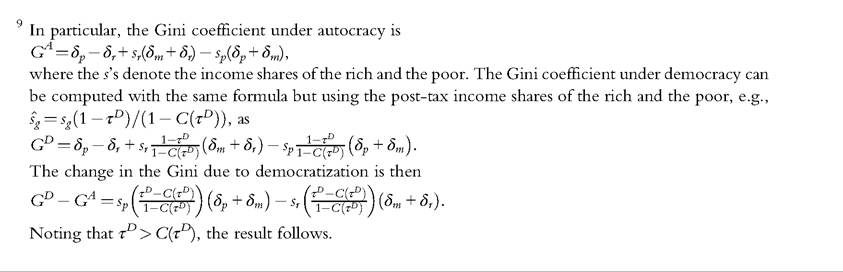
Equation (21.5) holds or when C is sufficiently convex that the tax choice of the middle class is not very elastic, an increase in the share of income of the rich or a decrease in the share ofincome of the poor makes it more likely that democracy will reduce inequality.10 These results are summarized in the next proposition.
Proposition 5
Modified Director’s Law
In the model described in this subsection, suppose there is limited enfranchisement to the middle class and δr < δm, or there is a transition to full democracy and δr + δp < δm. Then there will be an increase in taxes but the effect on inequality—measured by the Gini coefficient—is ambiguous. IfEquation (21.5) holds, democracy increases the Gini coefficient. Moreover, if either Equation (21.5) does not hold or C is sufficiently convex, then a larger share of income of the rich (which always increases taxes) makes it more likely that inequality will decline under democracy. IfeitherEquation (21.5) holds or C is sufficiently convex, then a larger share of income of the poor (which also always increases taxes) makes it more likely that inequality will increase under democracy.
We refer to this result as the “Modified Director’s law” since it relates to an idea attributed to Aaron Director by Stigler (1970) that redistribution in democracy involves taking from the poor and the rich to the benefit of the middle class (one can derive a similar result in a model of probabilistic voting when the middle class has a larger density for the distribution of its valence term, Persson and Tabellini, 2000, section 7.4).
This result is also related to what Aidt et al. (2009) call the “retrenchment effect” of democratization. They show that local franchise expansion in nineteenth-century Britain to the middle class often reduced expenditure on public good provision since the middle class bore the brunt of property taxes which financed local public good provision. In their model, an expansion of voting rights, by reducing public good provision and taxes on the 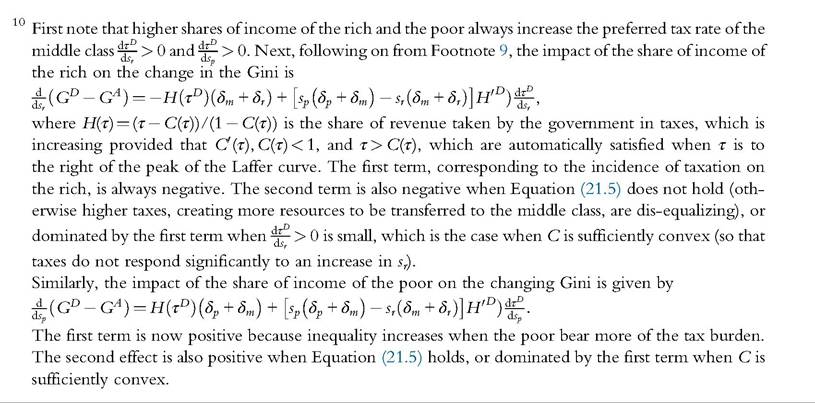
middle class, can thus increase inequality. Relatedly, Fernandez and Rogerson (1995) show how an equilibrium like this could arise in a political economy model of taxation and educational subsidies.
An important contrast between this result and Proposition 3 is on taxes. In Proposition 3, democracy neither increases taxes nor reduces inequality (but note the contrast with extended versions of the captured democracy mechanism). Here democracy increases taxes, but because the additional revenue is used for the middle class, it may not reduce inequality.[375]
21.2.6 Discussion and Interpretation
The theoretical ideas presented so far suggest that in the most basic framework, we expect democracy to increase redistribution and reduce inequality. We may also expect a boost to structural transformation from democratization. However, several factors militate against this tendency. The elite—the richer segments of society—who stand to lose from increased redistribution can attempt to increase their de facto power to compensate for their reduced de jure power under democracy. As we have seen, this can limit redistribution and/or the potential reduction in inequality. Alternatively, consistent with Director’s law, democracy may indeed increase taxes but use the resulting revenues for redistribution to the middle class, thus not necessarily reducing inequality. Finally, democracy may also be associated with the opening up of new economic opportunities to a large segment of society, which can be an additional source of inequality.
After reviewing the existing empirical literature, we will investigate the impact of democracy on redistribution and inequality. We will, in particular, study whether the effect of democracy on redistribution and inequality is heterogeneous and whether it depends on the economic and political forces we have highlighted in this section. In line with the theoretical mechanisms here, we expect the captured democracy effect to be stronger if the elite have more to lose from democracy, for example, if they are more vested in land or other assets that will lose value when wages increase and nondemocratic policies useful for these assets are lifted. Additionally, we expect the position of the middle class in the distribution of income to shape the type and extent of redistribution observed in democracy. Finally, we also expect the inequality-inducing market opportunity effect to be stronger when frontier technologies and global economic activities are more human or physical capital-biased and when society is more urbanized and presents greater opportunities for entrepreneurship and capitalist development. These are some of the ideas we will investigate in greater detail in the empirical analysis.
21.3.