WEALTH DYNAMICS AND ANTIPOVERTY POLICIES
A longstanding explanation heard for poverty is that it stems from the “bad behaviors” of poor people—high fertility, laziness, or bad spending choices, such as excessive consumption of alcohol.[399] It is not that they are in any way constrained to be poor, but that they (implicitly or explicitly) chose to be poor.
By this view, the role for antipoverty policy is to ensure behavioral change. We will hear more of these arguments later in this chapter. However, it will be useful to sketch here an alternative model whereby poverty emerges from the wealth dynamics implied by the external constraints facing poor people.By “wealth” I shall mean both human capital—the accumulated stock of past educational and health inputs, including past nutritional intakes—as well as nonhuman capital, such as industrial or financial capital.[400] To simplify the analysis, however, wealth is treated as a single composite asset. Initial wealth, wt at date t, is distributed across individuals, some of whom have zero wealth, but may still earn some labor income, consumed fully on their survival needs in each period. A fixed share of current wealth is used for current consumption. Each person has a production function yielding output h(k) from a capital stock k. There is a threshold capital stock needed to produce any output, i.e., h(k) = 0 for all k ≤ kmln(>0). Once the threshold is reached, output emerges in the next period, though diminishing returns start to set in immediately; in other words, the function h(k) is strictly positive, strictly increasing and strictly concave for all k > kmin. Those for whom the threshold has not been reached (w < kmin) have no demand for capital as it will not yield any output.
There is more than one interpretation of the threshold. Dasgupta (1993) provides a persuasive argument for its existence based on the biological fact of a positive basal metabolic rate, given that maintaining the human body at rest requires a (substantial) minimum food energy intake, without which no physical work can be done.
(Maintenance requirements are 60-75% of food energy intake.) Physiology entails that the set of feasible production activities for an individual is inherently nonconvex. Threshold effects can also reflect nonconvexities in production possibilities associated with minimum schooling needs, the nature of the production technology or from the existence of a lumpy “threshold good” in consumption.[401] In a more elaborate version of this model, one would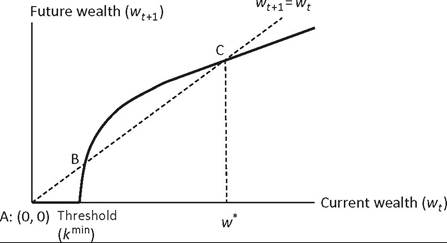
Figure 22.1 Wealth dynamics with a poverty trap.
also want to allow for interaction effects among different dimensions of wealth, such as when poor nutritional status impedes children’s learning.
There is another constraint on production possibilities stemming from credit market failures. Because lenders are imperfectly informed about borrowers, a borrowing constraint is imposed, whereby a person can only borrow up to λ times her wealth. Let k* denote the individual’s desired capital stock. Those with wealth sufficient to produce but less than k*∕(λ + 1) have a desire to invest but are constrained in that, after investing all they can, they still find that the marginal product of capital exceeds the interest rate, given the borrowing constraint. Finally, someone who starts her productive life with sufficient wealth (greater than k*∕(λ +1)) is able to invest her unconstrained optimal amount, equating the (declining) marginal product of her capital with the prevailing interest rate r (the price of capital), which is taken to be fixed (h0(k*) = r).[402]
The recursion diagram (the mapping from current wealth to future wealth) then takes the form depicted in Figure 22.1. Future wealth is zero at low levels of current wealth (wt < kmin). For levels of initial wealth in the interval [kmin, k*∕(λ + 1)], future wealth is a strictly concave function of current wealth.
At higher wealth (wt > k*∕(λ + 1)), the function becomes linear.There are potentially three steady-state equilibria (with constant wealth over time) for each individual. Two of these, namely, points A and C in Figure 22.1, are stable while the middle one, at point B, is unstable in that shocks will move those at B toward A or C.[403] In the long run, after repeated small shocks, the economy will settle in a state that can be thought of as having two main classes of people. One class has little or no wealth, given that its members are caught in a wealth poverty trap, at point A. There can be many reasons in practice why people are so trapped, including lack of any marketable skills, social exclusion, geographic isolation, debilitating disease, or environmental degradation. The second class comprises people who have settled at point C, at their respective steady-state levels of wealth (w*). There can still be inequality within each class. There can be inequality of labor earnings among the poorer class, and there can be wealth inequality among the “point C folk,” given different steady-state levels of wealth. There can be poverty even if nobody is caught in a poverty trap. The “poor” can be identified as two groups of people, namely, those at point A and the poor among those at point C, that is, those for whom their steady-state level of wealth turns out to be very low, even though they are not caught in a poverty trap.
Although the wealth poverty trap at point A is economically stable for each individual, social and political stability is another matter. The latter types of instability can arise in many ways, defying simple generalizations about its economic causes. However, it is plausible that a large mass of people at point A can threaten social stability, especially if their labor earnings and (hence) consumptions are very low, either in steady state or as a result of some severe shock, and in the latter case the threat to stability may well be even greater.[404]
Motivated by this stylized representation of wealth dynamics, we can think of two broad types of antipoverty policies.
There can be policies that provide short-term palliatives, possibly to maintain social stability by assuring that current incomes do not fall below some crucial level, even though poor people remain poor, either because they are caught in a wealth poverty trap or they have a low steady-state level of wealth. These are purely protection policies. And there are promotion policies that allow poor people to attain the higher level of wealth needed to escape poverty. For those caught in a poverty trap, this will require a sufficiently large wealth gain to put them on a path to eventually reaching their own (higher and stable) steady-state level of wealth. For those not caught in a trap, but still poor, promotion will require some combination of higher wealth and higher returns to their wealth—an upward shift in the recursion diagram in Figure 22.1.The rest ofthis chapter will study the origins and nature ofboth types ofpolicies. Itwillbe argued that, although the idea of some public responsibility for protecting poor people from negative shocks is an old one, the idea of such a role for promotion by relieving the constraints facing poor people (either caught in poverty trap or with low returns to their wealth) is remarkably new. The latter idea came with a significant evolution in thinking about the causes ofpoverty. The longstanding view that the “moral weaknesses” ofpoor people caused their poverty implied little scope for public action to promote people from poverty, and rebuffed any calls for taxing the rich to finance such action. It was ultimately up to poor people to escape poverty by changing their behaviors. Public responsibility was largely confined to limited, and highly targeted, protection to address extreme transient poverty and some efforts at aiding the “moral reform” of poor people. Although one still hears casual claims blamingpoor people for their poverty today, across the globe, from the mid-nineteenth century, though not carrying much policy weight until well into the twentieth century, deeper causal understandings of poverty emerged in popular and scholarly writings. These pointed to a new promotional role for public action in fighting persistent poverty.[405] Poverty was seen to reflect in no small measure public failures, including uncorrected market failures.
10
22.3.