Although the temple of Divus Vespasian and Divus Titus housed cult images and served as the site of recurring cult ritual in favor of Divus Vespasian and Divus Titus, for many modern viewers the Arch of Titus with its haunting relief of the deified emperor ascending to the celestial heavens on the back of an eagle has become a more potent symbol of Flavian imperial deification.
Yet the temple at the northwest corner of the Roman Forum on the steep ascent up the Clivus Capitolinus to the sacred Capitolium, and flanked by the Porticus Deorum Consentium and the temple of Concordia, remained a center of cult veneration for at least two and half centuries after its dedication.1 Three in situ Corinthian columns of white Italian marble supporting a section of the original architrave give a tantalizing glimpse of the original grandeur of the temple as restored by Septimius Severus and Caracalla in the early third century (fig.
1). Analysis of the architectural ornament in the architrave, however, which includes features characteristic of Flavian architecture, such as the small circular elements between the dentils called spectacles and attributed to the architect Rabirius, affirms that the architectural sculpture was a product of the Flavian era.[247] [248] [249]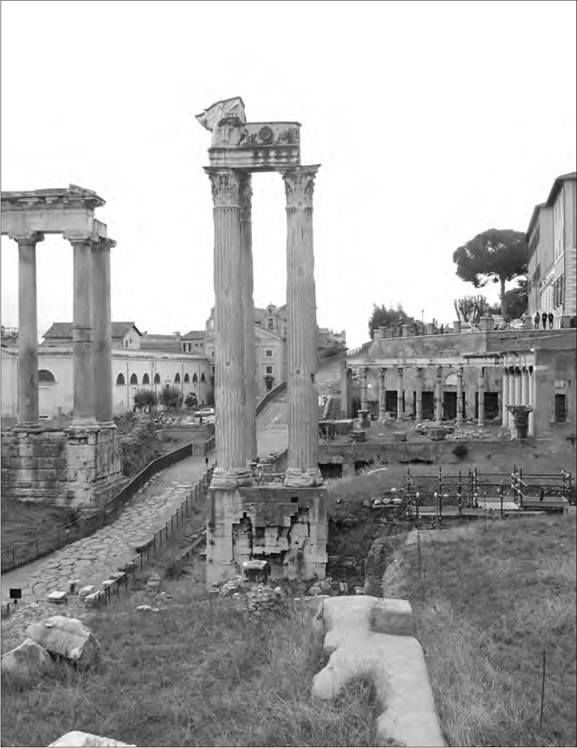
Figure 1. Remains of temple of Divus Vespasian and Divus Titus on the northeast edge of the Roman Forum with the facade of the temple of Saturn to the southwest, and the remains of the Porticus Deorum Consentium slightly further up the Clivus Capitolinus; photo by author.
The temple's exterior entablature is noteworthy for its deeply carved, complex, decorative quality. Most striking is the meticulously detailed frieze
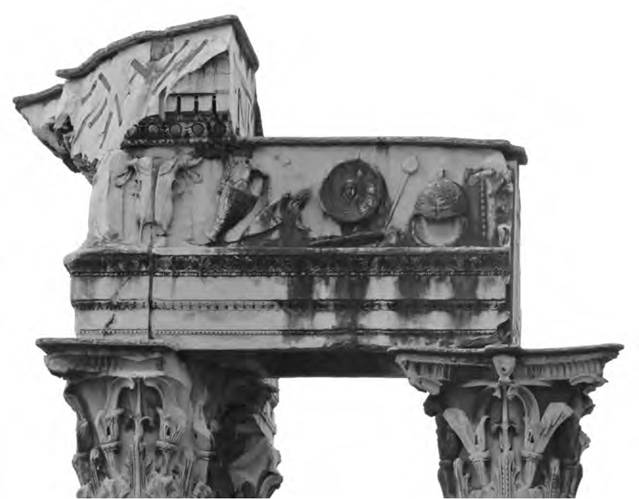
Figure 2. In situ section of the frieze of the temple of Divus Vespasian and Divus Titus; photo by author.
extending the length of each lateral side of the temple. Each section of the frieze, confined to the width of one block of the architrave, was articulated by bucrania festooned in a decorative fillet known as an infula.
Based on the in situ section in the Roman Forum and the surviving reconstructed section of the frieze now in the Tabularium, there are at least two possible sequences, if not more, of the same seven objects between the bucrania (De Angeli 1992, 94-107; in situ section, fig. 2; Tabularium section, fig. 3). On the in situ section the sequence of objects is, moving from left to right after the first bucranium: an urceus, a sacred vessel in the shape of a jug; a culter, the knife used to slit the victim's throat and slaughter the animal; an aspergillum for sprinkling liquids; along the ground line a securis, the small hatchet used to strike the death blow; above the securis a patera for libations; a malleus, a long and straight mallet with a circular head for stunning the animal in anticipation of the sacrifice; a galerus apicatus, the pointed leather cap of a flamen surmounted by an apex; and a concluding bucranium? Exploring the frieze in terms of its visual rhetorical strategies reveals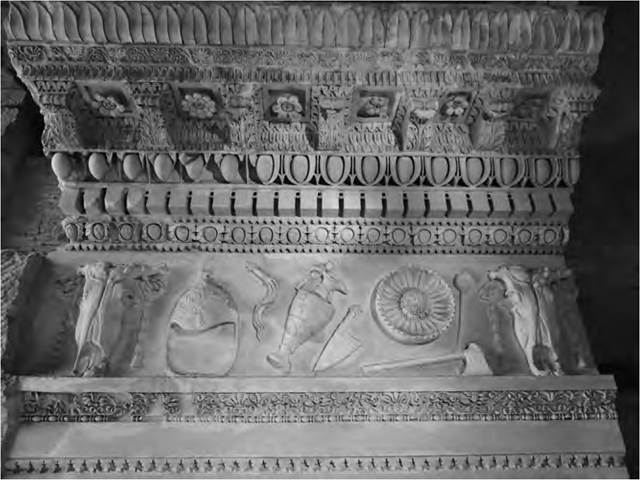
Figure 3. Section of the frieze in the Tabularium; photo by author.
a more sophisticated approach on the part of the Roman patrons and viewers to so-called generic religious ornament than has previously been acknowledged. I argue that the frieze underscores the religious nature of the temple dedicated to the eternal gods of the Roman state pantheon and suppresses Flavian dynastic connotations. In addition, in a deft appeal to the senatorial elite and the people of Rome, the frieze and temple inscription together highlighted the elevated status of state priesthoods and the communal religious authority of the Senate, and involved all Romans in the deification and posthumous veneration of Rome's rulers.
Existing interpretations of the instrumenta sacra depicted in the frieze, such as that by Stefano De Angeli, find the earliest precedents in republican and early imperial relief and coin representations of the simpulum, lituus, tripod, and patera. De Angeli argues that the instrumenta sacra are symbols of the four major priestly colleges: the pontifical college of which the flamines of Jupiter, Mars, Quirinus, and in the Imperial period, the deified emperors, were a part; the augural college responsible for reading the signs of the gods; the quindecemviri sacris faciundis that oversaw the Sibylline Books; and the septemviri epulonum
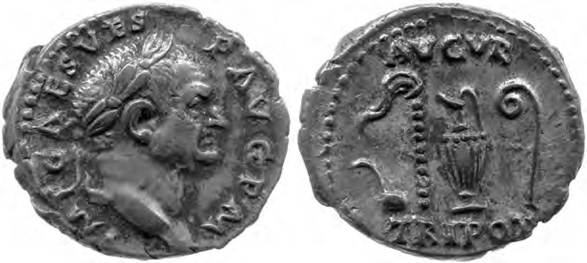
Figure 4.
Denarius of Vespasian, 71 CE, obverse showing the laureate head of Vespasian and reverse with simpulum, aspergillum, jug, and lituus; British Museum, London, inv. no. 1841,0726.1095; © The Trustees of the British Museum.in charge of public feasts (De Angeli 1992, 140-41).[250] On coins of Augustus the motif of these four instruments commemorates membership by the emperor in the four priestly colleges and indicates the emperor's profound religiosity and pietas to the state gods.[251] These motifs reappear on coins of Nero minted while he was Caesar under Claudius, and representations of clusters of sacred implements indicating membership in the four priestly colleges continue under the Flavian emperors (fig. 4).[252] Anne Siebert highlights assemblages of ritual implements as a particularly Roman device and emphasizes their role in the development of a repertoire of imperial self-representation (1999, 147-201). While Siebert recognizes groupings of ritual instruments as more than symbolic decoration, along the same lines as De Angeli, she too concludes that their primary function was to assert the social status of the priesthood while conveying the message of piety on the part of some individual or group toward the gods, the res publica, or family (1999, 157-75).
De Angeli suggests that in addition to promoting the priestly role and pietas of the living emperor, the frieze on the temple of Divus Vespasian and Divus Titus may allude to sacrificial acts and to the high religious dignity of the four priestly colleges (1992, 142). With the telltale lituus, tripod, and simpulum conspicuously absent from the ensemble adorning the temple, however, the frieze excludes any overt references to the augurs, the quindecemviri sacris faciundis, and the septemviri epulonum. Most recently, Laetitia La Follette advances our understanding of sculpted sacred assemblages by comparing them to the painted still lifes from Campania and exploring the animated qualities of the sculptural reliefs.
For La Follette context is paramount. She persuasively concludes that the reliefs of sacred implements in the Imperial period, such as that on the temple of Divus Vespasian and Divus Titus, did not follow a generic program but were tailored to their context through the inclusion of implements used in the cult in question (La Follette 2011-2012, 15-29). Rather than conveying messages about priestly status, La Follette focuses on cult ritual to argue that visual images including groupings of sacred implements functioned to re-present or reenact cultic actions.[253]Building on La Follette’s conclusions about the temple of Divus Vespasian and Divus Titus, which foreground her analysis of the lituus on private grave monuments, I further explore the implications of this approach in a public setting: a Roman state temple dedicated to the deified emperors.[254] Moreover, by exploring the visual rhetorical strategies employed in the frieze and their potential effect on viewers, I highlight the significance of individual experience for generating meaning in visual culture. In addition, in line with recent trends, I contribute to a richer and more dynamic understanding of so-called symbolic ornament by acknowledging the cultic and monumental specificity of these complex images.