ANCESTORS AND SACRIFICES
Farming and animal husbandry were introduced to northern Europe (i.e. the Netherlands, northern Germany, Denmark and southern parts of Sweden) around 4000 BCE. At first, hunting and fishing still made significant contributions to the diet, but over the course of the Neolithic, agriculture and animal husbandry became increasingly important.
The size of the settlements and the length of occupation at each location vary. In many cases, however, the burial sites appear to have constituted focal points with clusters of graves (Madsen 1982; Andersen 1997: 90-91; Andersson 2004). There is, of course, a great deal of chronological and geographical variation within the Neolithic period in northern Europe. The practices discussed below appear to have been of long-term importance over wider areas.The Neolithic of northern Europe is particularly well known for its burial practices. Not only were many of the graves themselves monumental, but they were associated with rather complex practices and structures. The very earliest Neolithic graves were simple earth graves, continuing the tradition from the Mesolithic (A. Fischer 2002). After a few hundred years, monumental earthen long barrows were constructed in different parts of northern Europe. The graves in these barrows were initially often simple earthen graves or diverse wooden constructions (Madsen 1979), although burials involving stone and eventually smaller megalithic tombs also emerged (see also Woll 2003). Most burials were inhu-mation graves, although some cremations (in the form of burning of wooden chambers) also took place. These Early Neolithic graves usually included some grave goods, such as pottery, axes or amber beads. The next phase, at the transition to the Middle Neolithic A (ca. 3400 BCE), saw the construction of collective megalithic tombs in various sizes and shapes. While the first burials in these stone chambers appear to have been ordinary inhumations, this was followed by a phase where the dead were completely excarnated before being placed in the tombs (where the bones were often sorted).
The large megalithic tombs (passage graves) were re-used for many centuries, some even as late as the Bronze Age. During the later phases, bodies were again interred intact. Some new (stone and wooden) collective tombs were also built in the later phases (Middle Neolithic B and Late Neolithic), but less monumental graves also appeared. Many of these were, however, situated close together, either in rows (stone-packing graves from late Middle Neolithic A and Swedish Boat Axe Culture in Middle Neolithic B), clusters or above each other in low mounds (Jutish Single Grave Culture and Late Neolithic graves).Rituals of different kinds were conducted both during the construction phases and at the completed monuments. In addition, rebuilding of the monuments was a common phenomenon. In one well-documented case, a long barrow goes through at least five stages involving palisades, wooden mortuary houses, earthen graves and the construction of the mound, later rebuilt as a megalithic mound with a stone chamber (Tilley 1996: 76-7). Offerings of pots were usually made at the wooden facades at the eastern end of the mound, and this wooden structure was then burnt down. Later, several sequential depositions of pots (possibly made specifically for that purpose, as they differ from ordinary settlement pottery) were performed at the entrance to each megalithic tomb, as were depositions of axes and other flint artifacts. The pots were deliberately smashed and the flint artifacts further destroyed by fire.
In the mid-fourth millennium BCE, extensive rituals were also carried out in cult houses and at large enclosed sites termed causewayed enclosures (Andersen 1997, 2000). Apparently the dead were buried or deposited temporarily at the enclosed sites and, after excarnation, transferred to megalithic tombs. The rituals arranged in intricate patterns. Pottery was prominent in wetland offerings in the Early Neolithic, but then appears to have been transferred to rituals at burials. Amber beads were usually found inside pots (Jensen 2001: 416-18).
Amber beads were also more commonly found in burials after the Early Neolithic, and by then an increasing number of the beads were formed as axes. While initially partly deposited in pots, copper (in the form of jewellery, axes and daggers) was hardly found at all during the Middle Neolithic, but reappeared in wetland deposits and burials in the Late Neolithic (Vandkilde 1996).Depositions in water or wetlands were prominent, but not exclusive, in the Neolithic and continued throughout prehistory in northern Europe. This practice differed markedly from the rituals related to burials and ancestors. In contrast to the artifacts involved in burial rituals in the Early and Middle Neolithic, the deposited artifacts were not destroyed. They were in many cases particularly well-executed pieces (e.g. exceptionally long flint axes). There are also several known cases of Neolithic human sacrifices from wetland areas (E. Koch 1998: 155-7). Some of the dead appear to have been strangled. These offerings must be linked to beliefs in powers that could be reached at particular locations, powers of a different kind than the ancestor community. It is tempting to see these as gift s associated with requests (or at least expectations) of some kind.
Depositions also took place at the settlements (inside the houses and within the settlement area more generally), demonstrating that there was no definitive spatial separation between religious and domestic activities. In addition there were most likely numerous more private and personal religious practices that we are not able to detect in the archaeological data. Many of these may well have taken place at the settlement.
The rituals at the burial monuments and the depositions away from the settlement had distinctly different themes: one was associated with fire, the other often with water; one had destroyed or fragmentary objects, the other complete ones; one was definitely a collective undertaking, the other may have been performed by a more limited group.
One artifact, the axe, whether made of flint, greenstone or copper, or copied in amber, was an important ritual artifact during the entire period.
As has been noted (Kristiansen 1984b), this was an artifact with a conspicuous role in many contexts, transcending any defined contexts, and suggesting that there were no exclusive religious spheres in Neolithic societies. It demonstrates flexibility, with different qualities of axes employed in different situations (see also Holten 2009: 168).No kind of figurative motifs seem to have played a prominent role in these societies; at least they have left few traces behind. A few pots are ornamented with pairs of eyes (Jensen 2001: 312), otherwise the designs were exclusively geometric. No figurines - zoomorphic or anthropomorphic - are known. Combined with the destruction of bodies and artifacts, this may suggest that many of the powers were not believed to be embodied in any specific being, but were perhaps more ephemeral and of a fluid character. This could suggest a very different understanding of personhood in these societies (Fowler 2004).
anthropomorphic figurines in clay and bone, with examples of human-seal hybridity (Carpelan 1975; Wyszomirska 1984; Sognnes 1996). In historic times, the northern Fennoscandian landscape of the Sami had numerous sacred features, such as sacred lakes, island and mountains, as well as powerful rocks. The location of the rock art in specific topographical settings suggests that landscape features would also have been important in the Neolithic (Gjerde 2009)
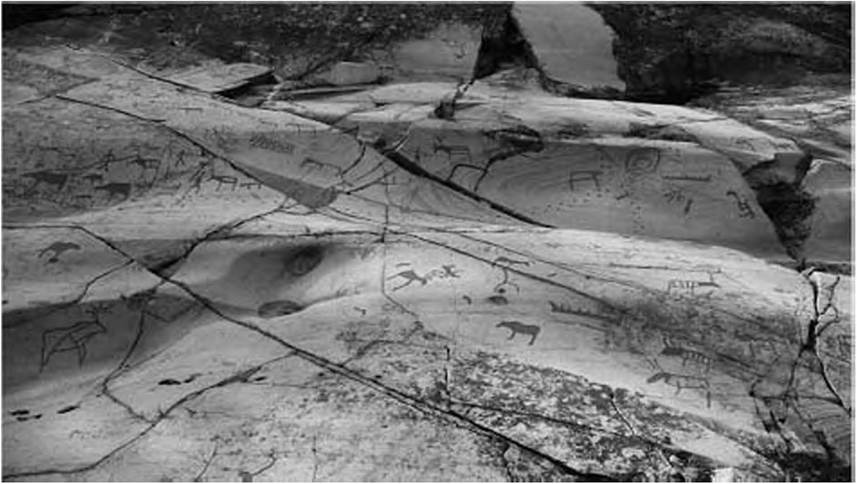
Figure 8.1 Section of the rock art panel at Bergbukten, Hjemmeluft in Alta, Norway. In the top right hand corner one sees a bear’s lair with tracks leading in different directions. At the end of the tracks to the left the bears are being hunted. Notice how the motifs relate to the microtopography of the rock surface. Photo: Jan Magne Gjerde, reproduced with permission.
Depositions of artifacts, similar to those performed in southern Scandinavia and in the later Sami religion, are not known from this period.
Graves are known from across northern Fennoscandia and the Baltic (Wyszomirska 1984; Miettinen 1990; Rimantiene 1992; Liedgren 1994; Halinen 1999), but apart from a few notable larger cemeteries such as Zvejnieki in Latvia (Zagorskis 2004; Larsson & Zagorska 2006), not in any great numbers. They are generally single inhumation graves in fairly shallow depressions. In many cases the dead were placed in a supine position, but the crouching position was also used. They were sometimes covered by small cairns, but were frequently without any preserved markings. In many cases, there was a generous amount of red ochre in and over the burials. This was also practised in Mesolithic graves in the same areas, as well as in Mesolithic graves in other parts of Europe (O’Shea & Zvelebil 1984; Nilsson Stutz 2003). Red ochre was not used exclusively in graves. Red ochre has been found in a number of houses in both Norway and Sweden. It was used on the surface of Comb Ware, and for rock paintings. It may well have
been used also to decorate clothes or as body paint. Ochre is often interpreted as metaphor for blood and consequently linked to both life and death. The varied use of ochre in rituals in northern Fennoscandia suggests that it encompassed a multiplicity of meanings for different occasions.
The graves contained a limited number of grave goods, such as stone or bone arrow-heads, stone artifacts or amber beads. These should most likely be viewed as personal equipment or possibly gifts to the deceased. Pottery is very rarely found in the graves. Often, several graves were found together, close to or even at the settlement site. At the Norwegian coastal sites, the graves are located behind the semi-subterranean houses. There are often hearths in the immediate vicinity of the graves.
The limited number of graves discovered suggests that other forms of burial were practised too. Human skeletal remains have been found in the so-called middens in front of houses, and burials have been found in the floors of houses.
While the middens certainly contain abundant osteological material, numerous exceptional artifacts have also been found in them: figurines, complete slate artifacts, and even a copper dagger. This suggests that the middens were also associated with ritual and symbolic activities (K. Schanche 1989). Since ordinary burials were rare, it has been suggested that many of the dead were placed in the house or in the immediate vicinity of the house, and the settlement vacated for some time (the latter practice is found in many hunter-gatherer societies [Knutsson 1995]). When the relatives returned to the site, the remaining bones were deposited in the midden. The formal variation in the burials may suggest that this aspect was of little relevance. Similarly, the body appears to have been of little significance as such, but proximity to the group and relatives is a repeated practice, which may indicate belief in rebirth within the group. As discussed above, there are indications of shamanistic belief in northern Fennoscandia. This may have meant a belief in several different souls, one tied to the body and its bones and another that was more spiritual and able to travel. In several northern societies certain parts of a dead animal are kept and handled in prescribed ways in order to ensure its continued existence (Jordan 2003). This may well have been applicable to humans too. After a certain period the body perishes, but the free soul has transferred and lives on.