ARCHAEOLOGY AND THE STUDY OF RELIGION: A HISTORICAL OUTLINE
Why is it that in archaeology religious interpretations are the focus of research in some periods, while neglected in others? To answer that question, let me begin by presenting a long-forgotten scholar.
In 1963 Ake Ohlmarks presented a popular synthesis on rock art and religion during the Bronze Age. Originally a specialist of comparative religion, he drew on a corpus of religious knowledge that was beyond that possessed by contemporary archaeologists who did not wish to acquire it in any case. He continued a research tradition founded by Oscar Almgren with his 1927 book Hallristningar och kultbruk (“Rock Carvings and Cult Practices”). In this book, an archaeologist drew on European folk-lore and comparative religion to gain a better understanding of Bronze Age religion, as manifested in rock art. This path-breaking book was part of a revival of cultural- historical studies, initiated by Gustav Kossina in the decades around 1900. The original spirit was now expanded to encompass archaeological interpretation throughout Europe, although with other interpretative perspectives, such as the study of religion.The cultural-historical revival was a widespread phenomenon in the humanities and social sciences during this period, represented in anthropology by the works of Franz Boas and James Frazer in the USA and England, most notably in the twelve volumes of The Golden Bough (1993) by James Frazer that appeared between 1890 and 1915, later summarized in a single volume in 1922 which is still in print. In Vienna, the Kulturkreislehre represented a related trend in anthropology, contemporary with the rise of phenomenology and of the comparative study of Indo-European mythology in France and Germany, along with Heidegger’s search for an irrational Being in philosophy. Much of this was revived during the post-modern period in the humanities and social sciences, and within comparative religion, most notably in the works of scholars such as Mircea Eliade and Georges Dumezil, who had their academic roots in the pre-war European paradigm, as critically discussed by Bruce Lincoln (1999: chs 3 and 7).
In archaeology, a related trend is represented in the later works of Marija Gimbutas, where she contrasts an “Old European” Neolithic religion of the mother goddess with the later Copper Age “Indo European” religion of war gods and male domination (Gimbutas 1974; 1991). In his critique, Lincoln concludes in a rather defeatist manner that it is not possible to study Indo-European mythology without being ideological, and therefore he now refrains from investigating that mythology and concentrates on studying the ideological use of myth in the present (Lincoln 1999: epilogue). However, his ideological critique can be applied to most of the humanities. The implication is therefore that we should not stop researching the past, but rather pursue such research with a critical consciousness about the interaction between past and present.Whereas Oscar Almgren’s book justly earned him fame, this was not the case for Ake Ohlmarks’s. This book (like other works of his)1 was largely ignored and forgotten by the archaeological establishment, who had come to favour a more objective study of rock art. This research trend culminated in Goran Burenhult and Mats Maimer’s typological and quantitative exercises from 1980 and 1981 respectively, Bertil Almgren’s formalistic curvature analysis (typology in disguise; only published in 1987, nearly two decades after it was written), and Jarl Nordbladh’s structuralist interpretations from the late 1970s and early 1980s (Nordbladh 1978a; see Nordbladh, this volume, Ch. 3).
Why this dramatic change? Here we need to situate rock art research in the wider historical cycles of archaeological interpretation and theorizing. The ideological climate had changed after World War II; archaeology and the humanities followed suit. Pre-war historical interpretations were now considered ideologically tainted and methodologically flawed, and they were universally rejected, in Sweden in the work of Mats Maimer (Maimer 1963). Instead, a new concern for objective science prevailed, much in the tradition of the latter half of the nineteenth century, a trend which was to last well into the late twentieth century.
In this, although forming a specialized niche, rock art research and the study of prehistoric religion followed the general global trends, as I have summarized in a diagram of cyclical change during the last 200 years (Kristiansen 1998: fig. 14). In Figure 10.1 the cycle is redrawn, with new names added, to illustrate the point that rock art research and interest in religion corresponds to a historical barometer determined by the global cycle of Rationality versus Romanticism in the ideological climate (also recently supported by Flemming Kaul 2004a: ch. 1).In periods of rational, positivistic thinking, religion is considered an irrational epiphenomenon, which functions as an ideological mirror of society. It can therefore be studied in order to understand social organization, that is, through analyses of grave goods. A classic example from the previous rationalistic cycle is Lewis Binford’s 1971 article on mortuary analysis, which gave rise to a whole research tradition. However, in more romantic periods of cultural historical thinking, religion is considered to be an independent organizing power, with a cosmology pervading all aspects of society. Therefore an understanding of the inherent nature of religion becomes a central objective. In the Scandinavian context where my own work has been carried out, Lotte Hedeager’s book Skygger af en anden virkelighed (“Shadows of Another Reality”) published in 1997 may serve as a classic example in the present Romantic cycle. In Figure 10.1, I trace these changes back in time.
The Romanticism of the early nineteenth century was a great period of cultural-historical revival, with the translation of sagas: in Denmark, N. F. S. Grundtvig, a Danish polymath poet and priest, translated the Icelandic sagas and used them in his poetry and history writing; in Germany, the Grimm brothers documented and studied folklore. In the same way, historians such as Finn Magnussen in Denmark combined the study of Norse mythology and archaeology.
Here archaeology merely served to illustrate the historical sources. His work was critically scrutinized by Danish archaeologist Jens Jacob Asmussen Worsaae, a critique which paved the way for presenting archaeology as an independent discipline with its own methodology derived from the natural sciences (Kristiansen 2002). This led to a Rationalistic period of positivistic research led by such figures as Oscar Montelius, Hans Hildebrandt and Sophus Müller from 1860 onwards. By the early twentieth century, a new cultural- historical revival reintroduced the use of Norse mythology in archaeological interpretation in the works of Bernhard Sahlin, Oscar Almgren, Just Bing and - late in the period - Ake Ohlmarks. However, after 1950, the positivistic, rationalistic wave again swept through archaeology and the humanities, and empirical studies of classification took over in the works of Bertil Almgren and Mats Maimer, which owed much methodological inspiration to Montelius. It was later followed by structuralist analyses of rock art by Jarl Nordbladh, which paved the way for a reintroduction of religious interpretations by the 1990s.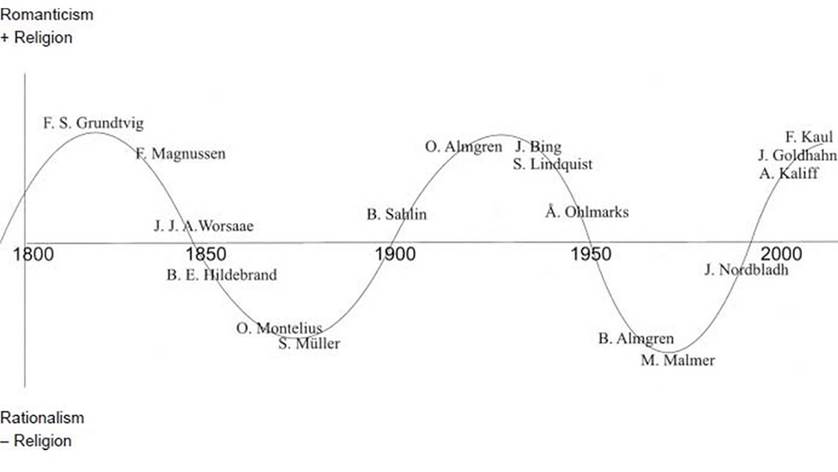
Figure 10.1 Cyclical changes between Rationalism and Romanticism in archaeological/cultural-historical interpretation, and the corresponding value (+ and -) attached to religion. © Kristian Kristiansen.
So the answer to why Ake Ohlmarks was ignored and forgotten is, at least in part, that he was out of touch with the trends. His book came at the wrong time, prehistoric religion; exemplifying this trend are some recent books (e.g. Insoll 2004) and the Journal of Prehistoric Religion, published since 1987 and mainly focusing on the Mediterranean. However, there is very little discussion of theoretical frameworks, and very little advice about methodology, with the possible exception of Colin Renfrew’s work (Renfrew 1994). He presented a classification of indicators of ritual, but it remained at a basic descriptive level.
For Bronze Age religion I would suggest a division between an earthly sphere and a divine sphere, each with a number of basic domains that materialize in texts, iconography or ritual sites and objects (Fig. 10.2). Mediators between the two spheres are priest gods and priest goddesses, who organize the rituals, and preserve and reproduce the oral tradition of hymns and texts. The Bronze Age is thus characterized by the emergence of an institution of religious specialists, which I term ritual chiefs, or priest gods/goddesses. Bronze Age societies were theocratic, as chiefs and kings were empowered by the gods and were in command of a large corpus of religious texts, preserved as oral tradition, to be written down often much later.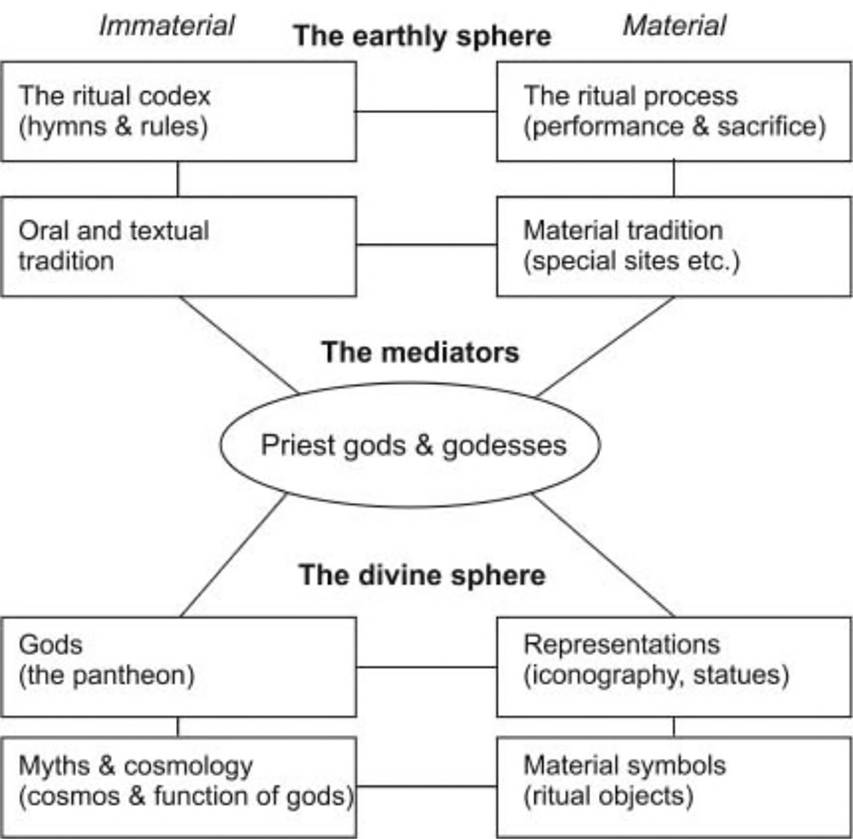
Figure 10.2 Theoretical model of the place of Bronze Age religion in society, embedded in both material and immaterial practices. © Kristian Kristiansen.
In the following I shall argue that written sources and archaeological sources are complementary from the Bronze Age onwards. Written sources can be used to formulate hypotheses that can be tested in the archaeological record according to normal scientific practice. This is due to the fact that from the Bronze Age onwards a new historical situation emerged, as societies became interlinked owing to the distribution of metal, the consequences of which will be demonstrated below (Kristiansen & Larsson 2005). This relationship between material culture and text in the study of prehistoric religion is exemplified in Figure 10.3. It suggests that archaeology can provide a complementary and independent method to determine the chronological and spatial structure of the formation of the various elements preserved in oral tradition and mostly written down much later. When used with due respect to source criticism and sound methodology, archaeology has the potential to revitalize and sometimes even reorganize textual evidence from comparative mythology on prehistoric cosmology and religion.
The prescribed method consists of identifying religious institutions/gods and their diagnostic features in the texts, which can then be identified in the archaeological record.Institutions can sometimes be demonstrated in material culture through a combination of symbolic traits that relates to ritual performance and to divine features. In the following I shall use the textual evidence of the so-called Divine Twins to define their diagnostic features, their dominant rituals and the myths in which they participate. I shall then link textual evidence, first, to the newly discovered Nebra find in central Germany (dating to the seventeenth century BCE), and subsequently to the application of the institution of the Divine Twins in Scandinavia from the sixteenth century onwards. My method is grounded in a traditional archaeological hypothesis testing through correspondence between a hypothesis with a set of diagnostic traits, in this case derived from texts, and a set of material correlates. The degree of correspondence between the diagnostic features of the hypothesis and the archaeological features defines the degree of verification. A full correspondence, as in the case of the Divine Twins, implies that the archaeological record is able to identify and define the distribution of these gods in time and space. It lends support to the archaeological verification based on a complex set of four correspond-ences that are not random, and which suppose a full knowledge of the functions of the Divine Twins and the corresponding myths. It should also be stated that while twins are a common phenomenon in many religions, the particular historical functions of the Divine Twins set them apart from this general phenomenon. Before proceeding I shall give a brief overview of Bronze Age religion in general as known through textual and archaeological evidence, stretching from India to Scandinavia. This geographical space was historically connected during the Bronze Age (Kristiansen & Larsson 2005).
Material culture
Oral / written culture
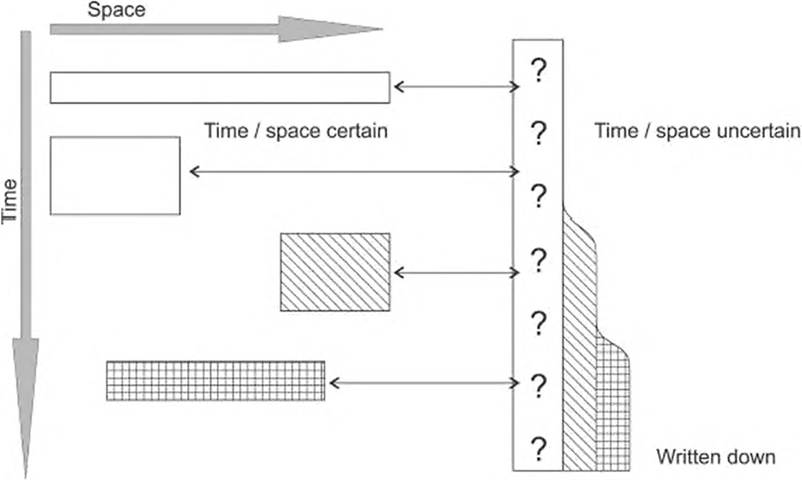
Figure 10.3 Relationship between material culture and oral/written culture. © Kristian Kristiansen.