Buddhism, Gender, and Inclusion
Early Buddhist texts express both positive and negative views of women. Some say the Buddha’s doctrine of no-self leaves no room for meaningful distinctions between genders, that women can attain enlightenment just as readily as men, and that it was in a past life as a woman that the Buddha first resolved to attain enlightenment.
Others say that women should aspire to rebirth as men, that no woman could ever become a buddha, and that even if a woman were to attain enlightenment she would not be qualified for leadership in a Buddhist community.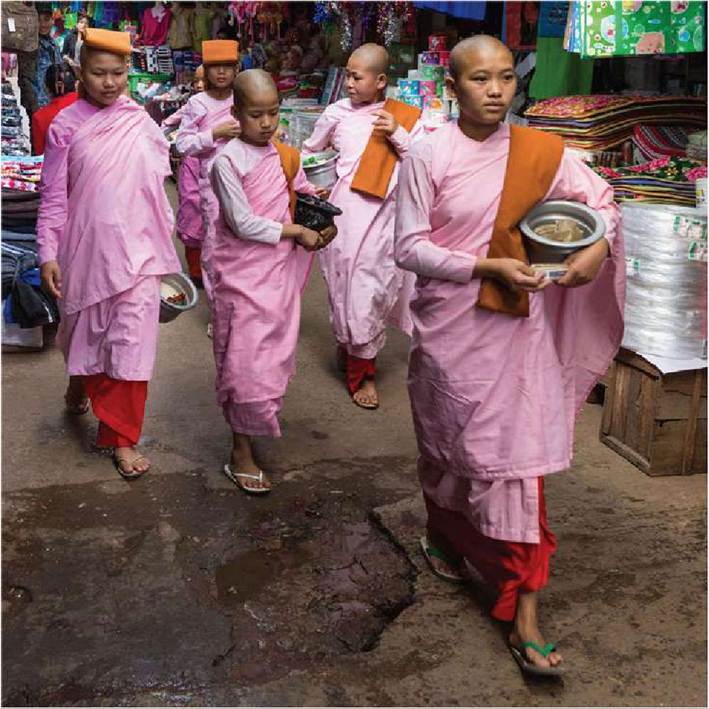
Buddhist nuns with their begging bowls.
To provide women with the opportunity to attain enlightenment, the Buddha established the order of nuns. Like monks, nuns live in monastic communities and in accordance with the rules for monastic life found in the Vinaya. Most of their time is devoted to study, meditation, and service. Nuns pass through two levels of training before they are fully ordained. Because fully ordained nuns are required to place themselves under the authority of senior monks, monks are ultimately in control of the order of nuns. Seeking greater freedom, some religious women in Asia live as if they were nuns but choose not to take vows. Living outside of the traditional order of nuns, they determine what their spiritual practice will be. But there is a price to be paid for their independence. Because of their unofficial status, they do not have the community support enjoyed by traditional nuns and often fall into poverty and homelessness.
Traditionally, women have had roles secondary to those of men in Buddhist institutions. This situation is beginning to change, especially in the West where liberal values are shaping the development of new and inclusive Buddhist institutions.
For example, laywomen are on a par with men in teaching and governance at Western meditation centers. And many prominent Buddhist writers and retreat leaders are women.The issue of inclusion is also of concern to those who identify as LGBTQ. Although one can find evidence of resistance and hostility toward those who identify as such in Buddhist history and literature, these attitudes have been informed more by cultural traditions than Buddhist teaching. For the most part, Buddhists have refrained from making sexuality and sexual identity moral issues. What does matter is how one behaves sexually. For monks and nuns, who are celibate, all forms of sexual activity are prohibited. For laypeople, the general rule is that any kind of sexual behavior that harms others is immoral. Early Buddhist literature generally speaks about queer individuals without judgment. Recording examples of what some today might call gender fluidity, some texts even describe people who experienced changes in gender in a single lifetime due to karmic influences. Today, and especially in the West, Buddhist communities are increasingly welcoming to people who identify as LGBTQ, many of whom are assuming positions of leadership.