Chronology and history
But first a word on the temporal context. Crete was first reached by humans moving from the Near East, Anatolia and Cyprus around 6000 BCE. However it is only millennia later, with the Early Bronze Age (Early Minoan, Early Helladic, ca.
3100-2000 BCE) of Greece, that we have substantial evidence of the beginnings of urban civilization. It is to the third millennium that the celebrated Cycladic figurines belong (see Figs 12.1a and 12.1b). These enigmatic figurines from the Cyclades group of islands in the Aegean are probably the oldest category of Bronze Age European plastic art. Associated with grave offerings, they have also been linked to shrines, but it is impossible to draw any conclusions about the meaning of the figurines or even what role they played.Thus the cultures we associate with Crete and Greece did not really begin until after the end of the Early Bronze Age. The origins of what later became the dominant Minoan culture begin to appear around 2000 BCE (Middle Minoan IA), a century before the first palaces. Yet what is typical of the Bronze Age Aegean culture is that dominated by the Minoan palaces which are scattered around Crete (ca. 1900-1500 BCE) and the Mycenaean citadels of Greece (ca. 1600-1050 BCE). Around 1900 BCE, the first palaces (Fig. 12.2) were erected on Crete (Protopalatial phase). Around 1700 BCE, after a destruction, the Minoans rebuilt their cultural heritage (the Neopalatial phase), and reached the highpoint of their civilization. Then, from the end of the seventeenth century onwards, a series of events (including the eruption of the volcano at Santorini/Thera, the subsequent destruction of settlements on Crete, the Mycenaean conquest of Crete) followed one another swiftly (in archaeological terms), leading to the decline and collapse of Minoan political power. Thus some time after 1500 BCE the Mycenaeans took over Crete after having dominated the mainland for some time.
The surviving artwork implies that Minoan traditions survived in parallel with the Mycenaean Greeks for some time after the conquest.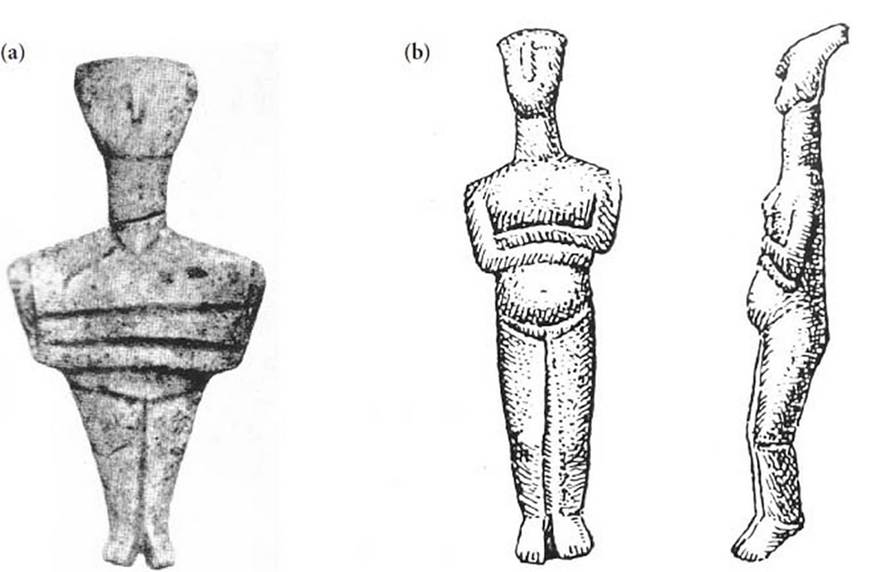
Figure 12.1 (a) Photo of a Cycladic figurine found on Crete (ca. 20 cm tall) (Evans 1921-35:1. 115). (b) Evans’s sketch of a “typical” figurine from the Cyclades (figures are usually less than half a metre in height) (Evans 1921-35: IV. 428).
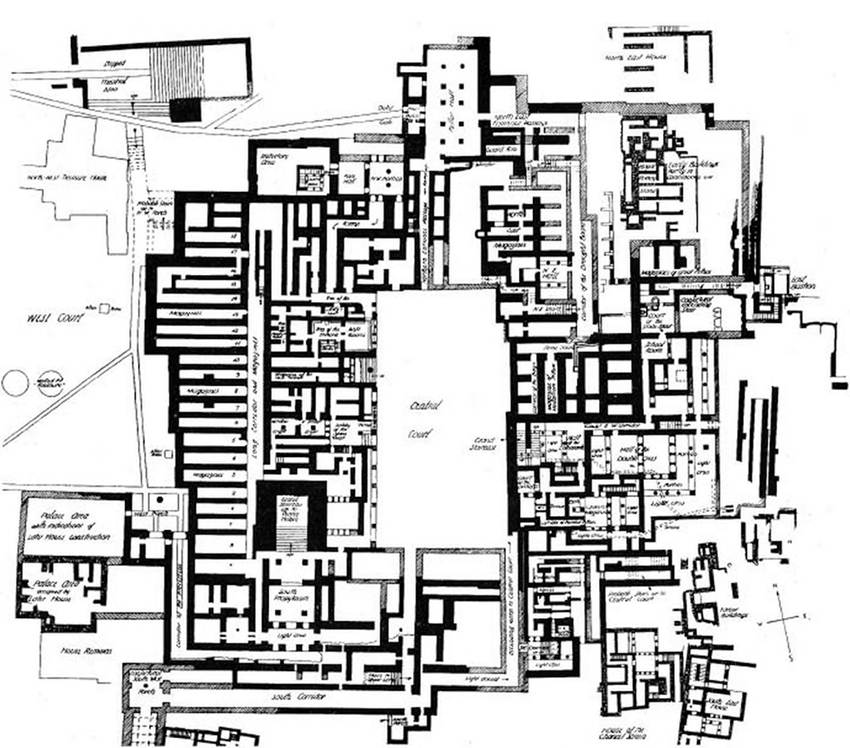
Figure 12.2 One of Evans’s last reconstructions of the ground plan of the Minoan/Mycenaean palace at Knossos (ca. 125 x 125 m) (Evans 1921-35: IV, following xxv).
The origins of the Mycenaean culture on the mainland are unclear, but tombs preceded the emergence of the citadels (Fig. 12.3) which dominated the Mycenaean world in the second half of the second millennium BCE. The Mycenaean culture is quite different from what was present in third millennium mainland Greece, and thus represents a new phenomenon which expanded throughout the Greek world, taking hold along the Anatolian coasts of the Aegean as well as the island of Crete.
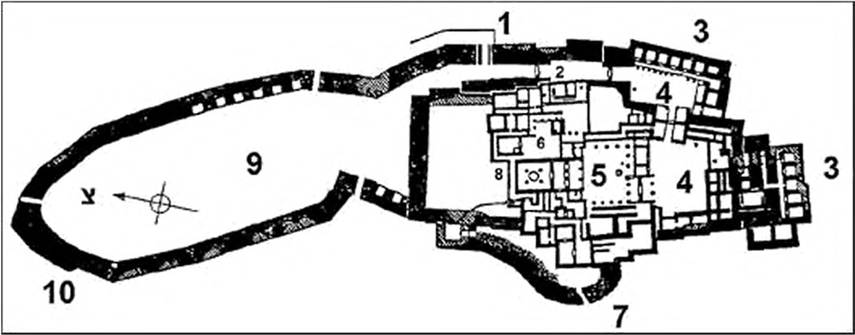
Figure 12.3 A plan of the citadel at Tiryns (ca. 300 x 100 m) (Wikimedia Commons, Tiryns, Napoleon Vier).
By around 1050 BCE, the Mycenaean culture, based on the political power of the citadels of the mainland and the palace at Knossos, had itself succumbed to the migrations in Europe and the Mediterranean at the end of the Bronze Age. This collapse led the way into the “Sub-Mycenaean” period which opens the Dark Ages, out of which archaic Greece (beginning sometime in the eighth century BCE) gradually emerges several centuries later. The cultural blossoming of Greece took place in the classical era (479-323 BCE), which was followed by the Hellenistic and Roman periods taking Greece into the Christian fold under halfOriental, half-Roman Byzantium. The Mycenaean culture was decisive for the long-term development of the Greeks, and their understanding of their own origins. But by that time, the Bronze Age Aegean civilization had completely disappeared and there remained nothing but ruins and dim memories.