CONCLUSION
Undoubtedly, Babylonian and Assyrian scholars regarded their writing system, first and foremost, as a tool that provided them with the opportunity to accurately reproduce language.
But this was not the only function cuneiform writing fulfilled for them. Drawing on the polysemy and polyphony inherent in the repertoire of cuneiform signs, and inspired by the belief that the many alternative readings of each of these signs conveyed to them a secret message on how things were actually connected, they found ways to imbue the texts they wrote, by using particular characters, with additional layers of meaning,116 * and to discover such layers, through the application of creative hermeneutics, in the foundational texts they read and commented on.117 Cryptographic writing was employed to make certain texts inaccessible to everybody except a small group of initiates.118 And finally, as demonstrated in our preceding overview of omens dealing with graphemes, there were also traditions that applied completely alien “codes” to cuneiform writing. In the case presented here, scholars employeda code in which, as far as we can determine, the shape of the signs was the primary factor that determined their meaning.119 This peculiar “grammar” of the visual appearances of cuneiform signs was part of the much larger system of analogies governing the Mesopotamian omen corpus.120 Another code unrelated to the established conventions of cuneiform writing seems to be used in a few cuneiform syllabaries from the first millennium B.C. that associate individual graphemes with numbers. The principles behind the equations presented in these texts are still obscure to us.121
Given the ever increasing complexity of Mesopotamian “grammatology,” it is not surprising that the etiological tale the Enmerkar epic gave with regard to the cuneiform writing system — that it was invented to ease long-distance communication — was eventually replaced by another story.
The most prominent version of it can be found in Berossos’s famous “Babyloniaka,” written at the beginning of the Seleucid era and in Greek language, but in the spirit of Babylonian scholarship. Berossos reports that in the early days of mankind, the semi-divine sage Oannes-Adapa, emerging from the sea, had taught the people how to found cities, establish temples, introduce laws, and measure land, had inaugurated sciences and crafts of all kinds — and had given men the knowledge of letters.122 For Berossos, and many other Babylonian and Assyrian scholars, the cuneiform writing system was not a human creation, compromised by all the imperfections of mortal striving, but a gift of the gods, originating in a period that preceded historical times, and capable of conveying, on various levels, completely incontestable eternal truths.ABBREVIATIONS
| AHw BM CAD | W. von Soden, Akkadisches Handworterbuch Tablets in the collections of the British Museum A. Leo Oppenheim et al., editors, The Assyrian Dictionary of the Oriental Institute of the University of Chicago |
| CT K. KAR MSL | Cuneiform Texts from Babylonian Tablets in the British Museum Tablets in the Kouyunjik collection of the British Museum Keilschrifttexte aus Assur religiosen Inhalts Materials for the Sumerian Lexicon |
ECKART FRAHM
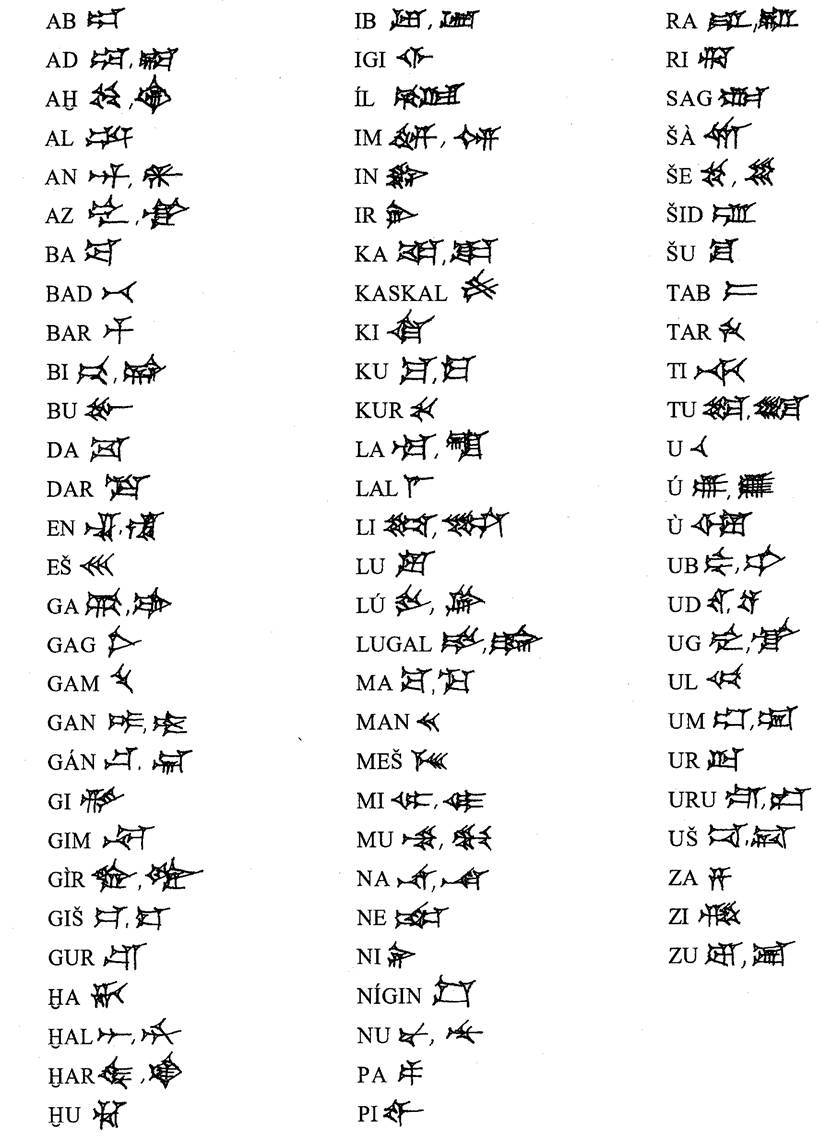
Figure 7.1. Cuneiform graphemes mentioned in the extispicy texts, Alamdimmu III, and KAR 395, in alphabetical order. The sign forms, for the most part taken from Goetze 1947, pls. 127-32, are those of the Old Babylonian younger cursive and the so-called “archaic cursive.”
ECKART FRAHM
BIBLIOGRAPHY
Assmann, Jan
2003 “Etymographie: Zeichen im Jenseits der Sprache.” In Hieroglyphen: Stationen einer
anderen abendländischen Grammatologie, edited by A.
Assmann and J. Assmann, pp. 37-63. Munich: Fink.Biggs, Robert D.
1968 “An Esoteric Babylonian Commentary,” Revue d’Assyriologie 62: 51-58.
Bilbija, Jovan
2008 “Interpreting the Interpretation: Protasis-Apodosis-Strings in the Physiognomic Omen
Series summa alamdimmü 3.76-132.” In Studies in Ancient Near Eastern World View and Society Presented to Marten Stol on the Occasion of his 65th Birthday, edited by E. J. van der Spek, pp. 19-27. Bethesda: CDL Press.
Bock, Barbara
2000a Die babylonisch-assyrische Morphoskopie. Archiv für Orientforschung, Beiheft 27. Vienna: Institut für Orientalistik der Universität Wien.
2000b “‘An Esoteric Babylonian Commentary' Revisited.” Journal of the American Oriental Society 120: 615-20.
Bodi, Daniel
1991 The Book of Ezekiel and the Poem of Erra. Orbis Biblicus et Orientalis 104. Freiburg:
Universitätsverlag; Gottingen: Vandenhoeck & Ruprecht.
Borger, Rykle
1996 Beiträge zum Inschriftenwerk Assurbanipals. Wiesbaden: Harrassowitz.
2003 Mesopotamisches Zeichenlexikon. Alter Orient und Altes Testament 305. Münster:
Ugarit-Verlag.
Bottero, Jean
1974 “Symptomes, signes, ecritures en Mesopotamie ancienne.” In Divination et rationa
lite, edited by J. P. Vernant, pp. 70-197. Sources orientales 2. Paris: Seuil.
Burstein, Stanley M.
1978 The Babyloniaka of Berossus. Sources from the Ancient Near East 1/5. Malibu:
Undena.
Cavigneaux, Antoine
1987 “Aux sources du Midrash: L'hermeneutique babylonienne.” Aula Orientalis 5:
243-55.
1996 Review of Uruk: Spätbabylonische Texte aus dem Planquadrat U 18, Teil IV, by
E. von Weiher. Zeitschrift für Assyriologie 86: 148-50.
Charpin, Dominique
2008 Lire et ecrire ä Babylone. Paris: Presses Universitaires de France.
Civil, Miguel
1973 “The Sumerian Writing System: Some Problems.” Orientalia 42: 21-34.
1974“Medical Commentaries from Nippur.” Journal of Near Eastern Studies 33: 329-38.
Clay, Albert T.
1923 Epics, Hymns, Omens and Other Texts. Babylonian Records in the Library of
J. Pierpont Morgan 4. New Haven: Yale University Press
Dornseiff, Franz
1925 Das Alphabet in Mystik und Magie. Leipzig and Berlin: Teubner.
Edzard, Dietz Otto
1980 “Keilschrift.” Reallexikon der Assyriologie 5: 544-68.
Finkel, Irving L.
1988“Adad-apla-iddina, Esagil-kin-apli, and the Series SA.GIG.” In A Scientific Humanist: Studies in Memory of Abraham Sachs, edited by E. Leichty, Μ. de Jong Ellis, and P. Gerardi, pp. 143-59. Philadelphia: The University Museum.
1997 “Practical Political Paleography.” Nouvelles Assyriologiques Breves et Utilitaires
1997: no. 1.
Foster, Benjamin R.
2005 Before the Muses: An Anthology of Akkadian Literature. 3rd edition. Bethesda: CDL
Press.
George, Andrew R.
1991“Babylonian Texts from the Folios of Sidney Smith, Part Two: Prognostic and Diagnostic Omens, Tablet I.” Revue d’Assyriologie 85: 137-63.
1992Babylonian Topographical Texts. Orientalia Lovanensia Analecta 40. Leuven: Peeters.
2009 Babylonian Literary Texts in the Schpyen Collection, Cornell University Studies in
Assyriology and Sumerology 10. Bethesda: CDL Press.
Glassner, Jean-Jacques
1984 “Pour un lexique des termes et figures analogiques en usage dans la divination me-
sopotamienne.” Journal asiatique 272: 15-46.
2000 Ecrire a Sumer: L’invention du cuneiforme. Paris: Seuil.
2004 Mesopotamian Chronicles, edited by B. R. Foster. Writings from the Ancient World
19. Atlanta: Society of Biblical Literature.
Goetze, Albrecht
1947 Old Babylonian Omen Texts. Yale Oriental Series 10. New Haven: Yale University
Press.
Gong, Yushu
1993 Studien zur Bildung und Entwicklung der Keilschriftzeichen. Hamburg: Kova.
2000 Die Namen der Keilschriftzeichen. Alter Orient und Altes Testament 268. Münster:
Ugarit-Verlag.
Green, Margaret W., and Hans J. Nissen
1987 Zeichenliste der archaischen Texte aus Uruk.
Ausgrabungen der DeutschenForschungsgemeinschaft in Uruk-Warka 11. Berlin: Mann.
Heeßel, Nils P.
2007 Divinatorische Texte I: Terrestrische, teratologische, physiognomische und onei-
romantische Omina. Keilschrifttexte aus Assur literarischen Inhalts 1. Wiesbaden: Harrassowitz.
Hunger, Hermann
1976 Spätbabylonische Texte aus Uruk, Part 1. Ausgrabungen der Deutschen
Forschungsgemeinschaft in Uruk-Warka 9. Berlin: Gebruder Mann.
Jeyes, Ulla
1989Old Babylonian Extispicy: Omen Texts in the British Museum. Istanbul: Nederlands Historisch-Archaeologisch Instituut te Istanbul.
Jones, Christopher P.
1987 “Stigma: Tattooing and Branding in Graeco-Roman Antiquity.” Journal of Roman
Studies 77: 139-55.
Jursa, Michael
2000 “Der ‘Zahn’ des Schreibers: Ein aramäischer Buchstabenname in akkadischer
Transkription.” Zeitschrift für Assyriologie 90: 78-84.
2002“Weitere aramäische Buchstabennamen in akkadischer Überlieferung.” Nouvelles Assyriologiques Breves et Utilitaires 2002: no. 13.
Kammerzell, Frank
1998 “The Sounds of a Dead Language: Reconstructing Egyptian Phonology.” Gottinger
Beiträge zur Sprachwissenschaft 1: 21-41.
Koch-Westenholz, Ulla
2000 Babylonian Liver Omens: The Chapters Manzäzu, Padänu and Pan täkalti of the
Babylonian Extispicy Series Mainly from Assurbanipal’s Library. Copenhagen: Museum Tusculanum Press.
Koch, Ulla
2005 Secrets of Extispicy: The Chapter Multäbiltu of the Babylonian Extispicy Series and
Nisirti bäruti Texts Mainly from Assurbanipal’s Library. Alter Orient und Altes Testament 326. Münster: Ugarit-Verlag.
Kraus, Fritz R.
1935 Die physiognomischen Omina der Babylonier. Mitteilungen der Vorderasiatisch
Ägyptischen Gesellschaft 40/2. Leipzig: C. Schulze.
1939 Texte zur babylonischen Physiognomatik. Archiv für Orientforschung, Beiheft 3.
Berlin.
Labat, Rene
1974 Textes litteraires de Suse.
Memoires de la Delegation en Perse 57. Paris: Geuthner.Lambert, Wilfred G.
1962 “A Catalogue of Texts and Authors.” Journal of Cuneiform Studies 16: 59-77.
Lieberman, Stephen J.
1977 “The Names of the Cuneiform Graphemes in Old Babylonian Akkadian.” In Essays
on the Ancient Near East in Memory of Jacob Joel Finkelstein, edited by M. de Jong Ellis, pp. 147-54. Memoirs of the Connecticut Academy of Arts and Sciences 19. Hamden: Archon Books.
1987 “A Mesopotamian Background for the So-Called Aggadic ‘Measures’ of Biblical
Hermeneutics?” Hebrew Union College Annual 58: 157-225.
Lipinski, Edward
1998“Gyges et Lygdamis d’apres les sources neo-assyriennes et hebraiques.” In 34eme Rencontre Assyriologique Internationale - 34. Uluslararasi Assiriyoloji Kongresi - Türk Tarih Kurumu Yayinlari 26, edited by H. Erkanal, V. Donbaz, and A. Uguroglu, pp. 159-65. Ankara: Türk Tarih Kurumu Basimevi.
Maul, Stefan M.
1999“Das Wort im Worte: Orthographie und Etymologie als hermeneutische Verfahren babylonischer Gelehrter.” In Commentaries — Kommentare, edited by G. W. Most. Aporemata 4: 1-18. Gottingen: Vandenhoeck & Ruprecht.
2003 “Omina und Orakel.” Reallexikon der Assyriologie 10: 45-88.
Meyer, Jan-Waalke
1987 Untersuchungen zu den Tonlebermodellen aus dem Alten Orient. Alter Orient und
Altes Testament 39. Kevelaer: Butzon & Bercker; Neukirchen-Vluyn: Neukirchener Verlag.
Noegel, Scott B.
2007 Nocturnal Ciphers: The Allusive Language of Dreams in the Ancient Near East.
American Oriental Series 89. New Haven: American Oriental Society.
Nougayrol, Jean
1945-46 “Textes hepatoscopiques d'epoque ancienne conserves au musee du Louvre II.” Revue d’Assyriologie 40: 55-97.
1974 “Deux figures oubliees (K 2092).” Revue d’Assyriologie 68: 61-68.
Oelsner, Joachim
1995“‘Number Syllabaries': Das Keilschrift-Syllabar A mit Zahlwerten.” In Meilenstein: Festgabe für Herbert Donner zum 16. Februar 1995, edited by Μ. Weippert and S. Timm, pp. 154-63. Ägypten und Altes Testament 30. Wiesbaden: Harrassowitz.
Parpola, Simo
1983 Letters from Assyrian Scholars to the Kings Esarhaddon and Assurbanipal, Part
2: Commentary and Appendices. Alter Orient und Altes Testament 5/2. Kevelaer: Butzon & Bercker; Neukirchen-Vluyn: Neukirchener Verlag.
1993 Letters from Assyrian and Babylonian Scholars. State Archives of Assyria 10.
Helsinki: Helsinki University Press.
Pearce, Laurie E.
1996“The Number Syllabary Texts.” Journal of the American Oriental Society 116: 453-73.
Reiner, Erica
2004 “Runaway — Seize Him.” In Assyria and Beyond: Studies Presented to Mogens
Trolle Larsen, edited by J. G. Dercksen, 475-82. Leiden: Nederlands Instituut voor het Nabije Oosten.
Rochberg, Francesca
2004 The Heavenly Writing: Divination, Horoscopy, and Astronomy in Mesopotamian
Culture, Cambridge/New York: Cambridge University Press.
Romer, Willem H. Ph.
2007 Review of Ur Excavation Texts VI/3, by A. Shaffer. Bibliotheca Orientalis 64:
180-82.
Schildkrout, Enid
2004 “Inscribing the Body.” Annual Review of Anthropology 33: 319-44.
Scholem, Gershom
1969 “Ein Fragment zur Physiognomatik und Chiromantik aus der Tradition der spätantiken
jüdischen Esoterik.” In Liber Amicorum: Studies in Honour of Professor Dr. C. J. Bleeker, pp. 175-93. Studies in the History of Religions 17. Leiden: Brill.
Scurlock, JoAnn, and Farouk N. H. Al-Rawi
2006 “A Weakness for Hellenism.” In If a Man Builds a Joyful House: Assyriological
Studies in Honor of Erle Verdun Leichty, edited by A. K. Guinan et al., pp. 357-81. Cuneiform Monographs 31. Leiden: Brill.
Starr, Ivan
1977 “Notes on Some Published and Unpublished Historical Omens.” Journal of Cuneiform
Studies 29: 157-66.
1983 The Rituals of the Diviner. Bibliotheca Mesopotamica 12. Malibu: Undena.
1990 Queries to the Sungod: Divination and Politics in Sargonid Assyria. State Archives
of Assyria 4. Helsinki: Helsinki University Press.
Stol, Martin
1993 Epilepsy in Babylonia. Cuneiform Monographs 2. Groningen: Styx.
Stolper, Matthew W.
1998 “Inscribed in Egyptian.” In Studies in Persian History: Essays in Memory of David M.
Lewis, edited by Μ. Brosius and A. Kuhrt, pp. 133-43. Achaemenid History 11. Leiden: Nederlands Instituut voor het Nabije Oosten.
Taylor, Insup, and Μ. Martin Taylor
1995Writing and Literacy in Chinese, Korean and Japanese. Studies in Written Language and Literacy 3. Philadephia: John Benjamins.
van Dijk, Johannes J. A.
1962 “Die Inschriftenfunde.” In 18. vorläufiger Bericht über die Ausgrabungen in Uruk-
Warka, edited by H. Lenzen, pp. 39-62. Berlin.
Vanstiphout, Herman L. J.
2004 Epics of Sumerian Kings: The Matter of Aratta. Edited by J. S. Cooper. Writings from
the Ancient World 20. Atlanta: Society of Biblical Literature.
Virolleaud, Charles
1907-09 L’astrologie chaldeenne, le livre intitule “enuma (Anu) iluBel”: Adad. Paris: Geuthner.
von Weiher, Egbert
1993 Uruk: Spätbabylonische Texte aus dem Planquadrat U18, Teil IV. Ausgrabungen in
Uruk-Warka, Endberichte 12. Mainz: Philipp von Zabern.
Weidner, Ernst F.
1964 “Geheimschrift.” Reallexikon der Assyriologie 3: 185-88.
Westenholz, Joan Goodnick
1997Legends of the Kings of Akkade. Mesopotamian Civilizations 7. Winona Lake: Eisenbrauns.
1998“Thoughts on Esoteric Knowledge and Secret Lore.” In Intellectual Life of the Ancient Near East: Papers Presented at the 43rd Rencontre Assyriologique Internationale, edited by J. Prosecky, pp. 451-62. Prague: Oriental Institute.
Wiseman, Donald J., and Jeremy A. Black
1996Literary Texts from the Temple of Nabu. Cuneiform Texts from Nimrud 4. Oxford: British School of Archaeology in Iraq.
oi.uchicago.edu