COSMOLOGY AND THE POWER OF WORDS
It is well known that the literati of the ancient Near East regarded words, whether written or spoken, to be inherently, and at least potentially powerful (see already Heinisch 1922; Dürr 1938; Masing 1936).
With reference to Mesopotamia, Georges Contenau explains:Since to know and pronounce the name of an object instantly endowed it with reality, and created power over it, and since the degree of knowledge and consequently of power was strengthened by the tone of voice in which the name was uttered, writing, which was a permanent record of the name, naturally contributed to this power, as did both drawing and sculpture,3 since both were a means of asserting knowledge of the object and consequently of exercising over it the power which knowledge gave (Contenau 1955: 164).
Statements by scribal elites concerning the cosmological dimension of speech and writing are plentiful in Mesopotamia. A textbook example is the Babylonian creation account, which characterizes the primordial world of pre-existence as one not yet put into words.
enuma elis lä nabu samämu
saplis ammatum suma lä zakrat
When the heavens above had not yet been termed
Nor the earth below called by name
— Enuma Elish I 1-2
Piotr Michalowski has remarked about this text that it. contains puns and exegeses that play specifically on the learned written tradition and on the very nature of the cuneiform script” (Michalowski 1990b: 39). Elsewhere we hear that writing is markas kullat or “the (cosmic) bond of everything” (Sjoberg 1972) and the secret of scribes and gods (Borger 1957; Lenzi 2008a).4 * Moreover, diviners in Mesopotamia viewed themselves as integral links in a chain of transmission going back to the gods (Lambert 1957: 1-14), and in some circles, traced their genealogy back to Enmeduranki, the antediluvian king of Sippar (Lambert 1967: 126-38; Lenzi 2008b).
Elsewhere, we are told that diviners transmitted knowledge “from the mouth of the God Ea” (Michalowski 1996: 186). The Mesopotamian conception of divine ledgers or “Tablets of Life” on which gods inscribed the destinies of individuals similarly registers the cosmological underpinnings of writing (Paul 1973: 345-53). One could add to this list many Mesopotamian incantations that presume the illocutionary power of an utterance.5A similar cosmology undergirds the Egyptian conception of text, as David Frankfurter points out:
... Egyptian letters were the chief technology of a hierocratic scribal elite who preserved and enacted rituals — and by extension the cosmic order itself — through the written word (Frankfurter 1994: 192).
The Egyptians referred to the hieroglyphic script as mdw ntr, literally, “the words of the gods” and the scribal art was to them an occupation without equal. The ibis-headed god Thoth, who is credited with the invention of writing, is said to be “excellent of magic” (mnh hkl) and “Lord of hieroglyphs” (nb mdw ntr) (Ritner 1993: 35). He is depicted (see fig. 8.1) writing the hieroglyphic feather sign 6 representing maat (m!ct), a word that stands for the cosmic force of equilibrium by which kings keep their thrones and justice prevails (Assmann 1990; Teeter 1997).7
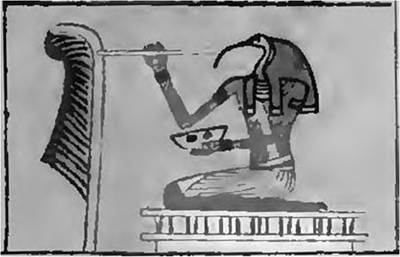
Figure 8.1. Thoth writing the hieroglyphic sign for mict
The link between writing and maat underscores how integral the scribal art was perceived for maintaining the cosmic order in Egypt (Hodge 1975). The spoken word too was capable of packing power in Egypt, as countless ritual and “magic” texts make clear. In the words of Geraldine Pinch, “In the hieroglyphic script, the power of the image and the power of the word are almost inseparable” (Pinch 1994: 69).
According to Isaac Rabinowitz, the Israelites shared this ontological understanding of words:
...
words were not merely presumed to have the properties of material objects, but might be thought of as foci or concentrations of dynamic power. They were plainly regarded as not only movable but mobile, not only susceptible to being acted upon, but capable of acting upon other entities in ways not confined to communication, of producing and enacting effects, conditions, circumstances and states (Rabinowitz 1993: 16).modern approaches to this topic, see Leick 1994: 23-55; and Greaves 1996. On the relationship between Mesopotamian conceptions of words as power and the later Greek doctrine of the logos, see already Langdon 1918; Hehn 1906; Bohl 1916; and more recently Lawson 2001. Images, like text, could also
serve as loci of divine power in Mesopotamia. See Bahrani 2008: 59-65.
6 All references to Egyptian signs follow the sigla of Gardiner 1988.
7 Maat was also personified as Thoth's wife.
The conceptual link between a word and an object is reflected most clearly in the Hebrew word Tl® (dabar), which means “word” and also “thing, object.” Of course, this notion of words contextualizes Yahweh’s creation of the universe by fiat in Genesis 1 (Moriarty 1974).8
Like the Mesopotamians and Egyptians, the Israelites also attribute a cosmologically powerful role to writing (Rabinowitz 1993: 33-36). One could cite many proof texts, such as the role that divine writing plays in issuing the Ten Commandments (Exodus 31:18), or Yahweh’s heavenly text in which he keeps the names of the sinless (Exodus 32:32-33), or the priestly curses that must be written on a scroll, dissolved in water, and imbibed by a wife tested for unfaithfulness (Numbers 5:23-24), or the many prophecies that Yahweh orders his prophets to utter before an audience and put into writing (e.g., Jeremiah 36:18, 36:27-28).
Perhaps one of the best demonstrations of the cosmological dimension of the written word in Israel appears in Numbers 11, in which we hear how Yahweh gave a portion of Moses’ spirit to seventy leading Israelites so they could help bear the people’s burdens (Numbers 11:17).
In this story, the names of the seventy men are written on a list at the Tent of Meeting, outside the camp. As the text tells us:Now two men stayed behind in the camp, one named Eldad, the second Medad; but as they were among those written (on the list), the spirit rested upon them even though they had not gone out to the Tent; so they were prophetically possessed within the camp. Thereupon a lad ran and told Moses, and said, “Eldad and Medad are prophesying within the camp” (Numbers 11:26-27).
This text illustrates that the written names of the seventy men alone sufficed to bring on the spirit of prophesy (Rabinowitz 1995: 34). The expectation was that prophesying would occur close to the Tent of Meeting and not in the camp.9 *
Such references could be multiplied, but these should suffice to show that speaking and writing in the ancient Near East, especially in ritual contexts, could be perceived as acts of cosmological power. This ontological conception of words would appear to be a necessary starting point for understanding the perceived nature of language, writing, and text in the ancient Near East. Nevertheless, it is seldom integrated into studies of scribal culture or textual production, and even more rarely into studies of ancient divination, despite the importance that language, writing, and text play in the ritual process (see Noegel 2004).