CULT IMAGES: THE FIGURINES
One group of widely distributed European Neolithic finds which has received considerable attention are small anthropomorphic and theriomorphic figurines. The following archaeological data have been hitherto employed to analyse these objects and their meaning: their spatial and temporal distribution, abundance, material, size, appearance, state of preservation, fragmentation and, finally, the find contexts.
In light of this complex situation, it is appropriate to study three different geographical levels: within an archaeological culture, the intra- and inter-cultural level, and the European level.More than anything else, one is struck by the clear cultural affinity of the finds and the frequency of the figurines. The spatial (from south-east to north-west) and temporal (from the Early Neolithic through the Early Bronze Age) distribution is significant. In south-east, eastern and central Europe figurines are characteristic features of the various cultures. In northern and western Europe they are rarer - and in large areas completely absent.
A further typical characteristic of the figurines is the cultural affinity which determines their appearance. This is particularly easy to recognize in the cases of the Lengyel and Vinca Cultures (Vasic 1936; lion 2007). During each period, the figurines are dominated by clear formal rules, which are very strictly observed in several respects. However, they differ from phase to phase to such a degree that the typological characteristics of the figurines can be used as chronological indicators in exactly the same fashion as pottery forms and decoration.
The eponymous site of the Vinca Culture (ca. 5500-4500 BCE) was excavated early in the twentieth century with the then usual methods. Thus the figurines are assigned a depth in terms of the excavation, but not particular layers - and the archaeological context is not documented.
Thus, although there are more than 1300 figurines from this site, the possibilities for interpretation are correspondingly limited (Hansen 2007: 203-16). Some of the 1600 figurines of the Moravian Painted Ware (MMK = Moravske Malovane Keramiky) - the northwestern group of the Lengyel Culture (ca. 4800-4300 BCE) - come from older excavations, but some also come from modern research excavations (Podborsky 1985). Based on the richly decorated pottery, it has been possible to establish a very fine chronology (Kazdova 1984; Doneus 2001), where some of the individual phases probably lasted less than a century. An important characteristic for the description of the temporal variations of the standing female figurines is the position of the arms and hands. The horizontally outstretched arms of the MMK la develop into slightly raised “apotropaic” arms, held in front of the torso, and then through the forms with arms “receiving offerings” to those which become the worshippers in MMK lib (Fig. 7.1; Podborsky 1985: 64-100, pl. IV).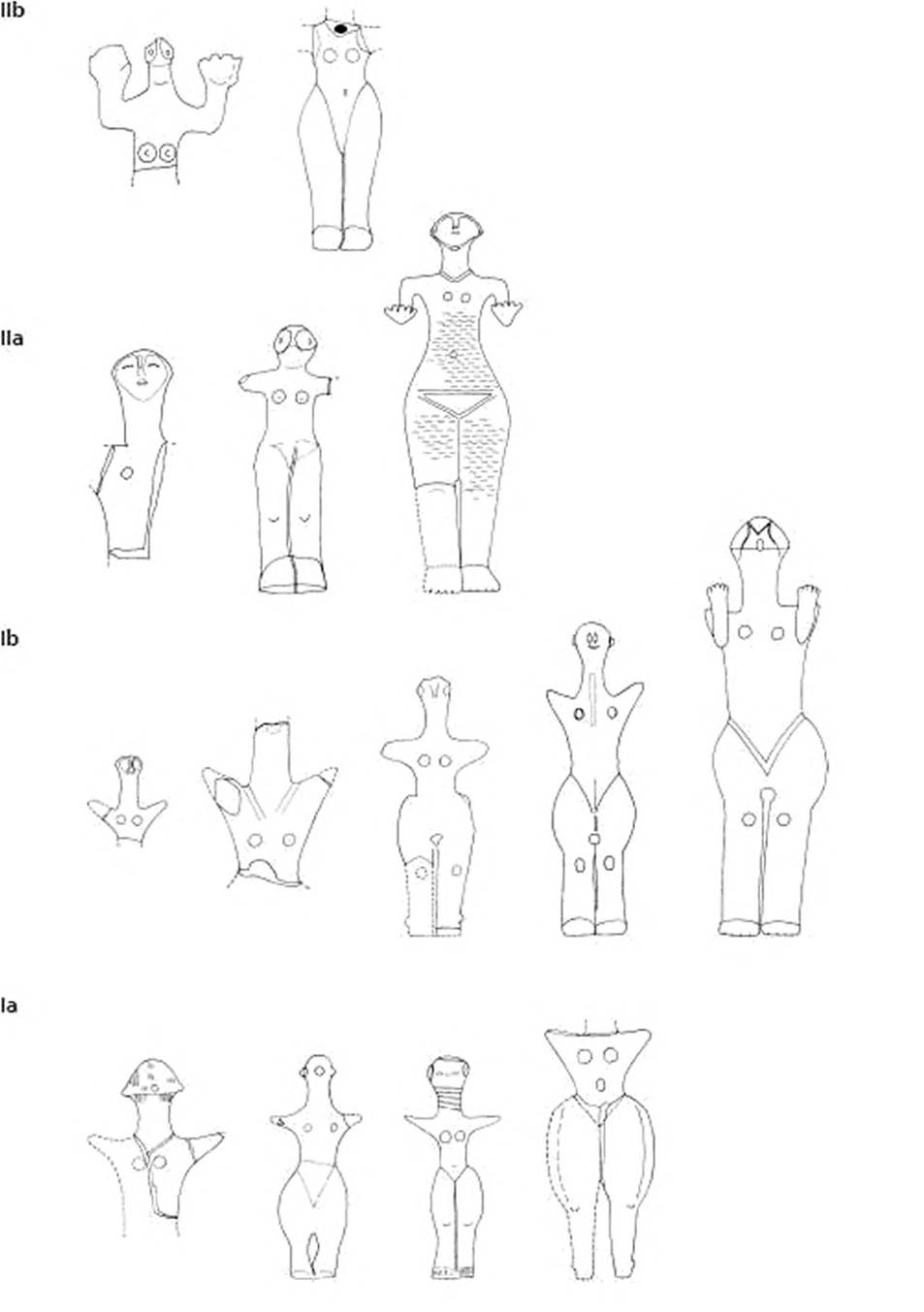
Figure 7.1 Temporal variation of the anthropomorphic figurines of the Moravian Painted Ware (after Podborsky 1985: plates 3.3-103.2). © J. Petrasch.
However, all of the figurines share a peculiar combination of naturalistic and stylized elements, such as realistic legs with impossibly short arms. Beyond this, it is striking that - at the same time and in the same places - alongside artistically perfect figurines, there are others which lie at the opposite end of the aesthetic spectrum. These two characteristics are not only typical of the Lengyel Culture, but also of all of the Neolithic communities in central, south-east and eastern Europe.
In the European Neolithic, with very few exceptions, the figures are generally made of baked clay. Thus the relative frequency of stone figurines in the MMK is in the order of parts per thousand (Podborsky 1985: 120-21).
Only in the megalithic cultures of north and west Europe does one find generally stylized anthropomorphic and theriomorphic representations in stone. Equally rare are anthropomorphic figurines of bone or antler, being more common only in some small clearly defined and limited cultural spaces, such as the western periphery of the Linear Pottery Culture (LBK = Linearbandkeramik, ca. 5300-5000 BCE), or in the later Chalcolithic in the eastern Balkans (Allard et al. 1997: 33 figs 4-5; Hansen 2007: 224). Wooden figurines do not appear to have existed at all. In most parts of Europe, the necessary conditions for the preservation of wood are generally absent, and thus statements about this material are difficult as a matter of principle. Only the lakeside villages of the areas around the Alps offer ideal conditions for the preservation of wood, and excavations of such sites have produced the expected treasure troves of wooden objects (Muller-Beck 1965; Wesselkamp 1980; Gross-Klee 1995). It is therefore striking that no wooden figurines have been found, and that the very few figurines that have been found are made of clay (Winiger 1981: fig. 8).Given the present state of research, the size of the figurines is best judged on the basis of the MMK. V. Podborsky (1985: 101-4) divided the figurines into five classes based on size. Roughly half of them fell into the medium range of between 12 and 15 cm in height, with very small (less than 6 cm) and very tall (over 35 cm) figurines making up, respectively, only 2 per cent and 5 per cent of the corpus. In terms of size, the figurines of south-east central Europe and south-east Europe appear to match a corresponding distribution pattern (Hansen 2001). The very tall figurines merit particular attention when making supra-regional comparisons, as these are least likely to have been children’s toys or other mundane objects. Most of the very tall figurines are badly fired (or not fired at all) and they come from tell sites (from Hebrew tel and Arabic tall, “mound, hill”).
In the area between the Great Hungarian Plain and the Sea of Marmara, statuettes ranging from 50 cm to even a metre in height have been found, seldom but regularly; these are clearly taller than those of the Lengyel Culture (Hansen 2001; 2007: 211-12). Fragments of modelled clay found in the Vinca Culture also allow the reconstruction of representations of “life-size” bucrania (skulls of oxen).These may have been fixed to a post alone, or they could have been the upper part of “monumental” clay statues (Jovanovic 1991; Lazarovici et al. 2001).
Together, the characteristics of the European Neolithic figurines suggest that an interpretation in terms of religious images is more probable than that they are merely children’s toys or other mundane artifacts. Cross-cultural comparisons of historical and recent communities reveal that figurines have been worshipped as religious entities in those state societies known from written sources, but are also produced and used in segmentary societies and even among bands (Gullov 1988). Most of the Neolithic cultures of Europe will have been segmentary societies consisting of several separate segments living side by side. Analogies from such communities are particularly enlightening for the interpretation of the European Neolithic in terms of the study of religion. In those segmentary societies for which ethnographic data are available, the segments are generally lineages, with the members united through descent in a direct line from a common ancestor (Durkheim 1893; Evans-Pritchard & Fortes 1940). This leads to a cultural logic assigning the common ancestor a central role, determining the structures of the society and the actions of the individuals. At least occasionally, recent segmentary societies use objects rendering ancestors symbolically visible. Apart from ancestor figures in human or animal form there are those of imaginary creatures, masks, trees, stones or other objects which could have been the seats of the ancestral spirits.
Given the nature of the archaeological record for the central European Neolithic, it is impossible to formulate any propositions about ancestors having been projected into natural objects. Where the ancestor images were clay figurines, they have been preserved. As every lineage will have worshipped its own ancestor, it is plausible to assume that the images of the ancestors will have varied greatly.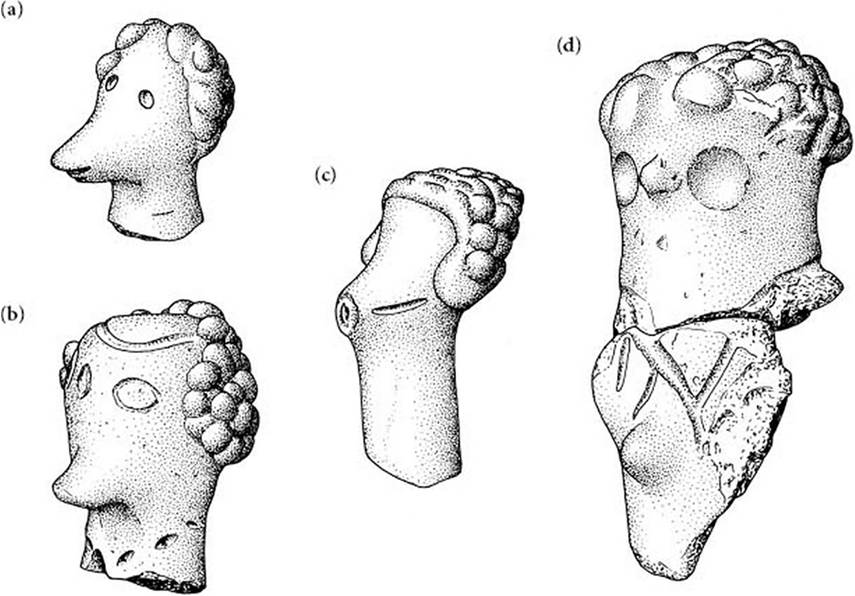
Figure 7.2 Anthropomorphic figurines of the earliest Linear Pottery Culture, (a) Frankfurt am Main-Niedereschbach; (b) Vel’ky Grob, southwest Slovakia; (c) Aba “Angyihegy”, Transdanubia; (d) Eilsleben, Saxony- Anhalt (after Hampel 1989: figs 3-4; Vladar 1979: fig. 6; Makkay 1969: fig. 14; Kaufmann 1986: fig. 6). ©J. Petrasch.
We will examine this proposition using the example of the figurines from the earliest LBK (ca. 5500 BCE). From Frankfurt am Main-Niedereschbach (western Germany) and Vel’ky Grob (south-western Slovakia) are two figures which are strikingly similar for finds separated by a distance of seven hundred kilometres. Both of the anthropomorphic clay heads are characterized by large, exaggerated duck-like beaks and modelled red locks of hair (Fig. 7.2, 1-2). Only the representation of the eyes distinguishes them. The degree of similarity shared by the two figurines is particularly clear when compared with the other figurines of the early LBK, such as those of Aba “Angyihegy” in Transdanubia and Eilsleben in Saxony-Anhalt (Fig. 7.2, 3-4).
Apart from the clearly depicted locks of hair common to all the figurines, they do not share any common traits. According to current scholarship, the key to the interpretation of these clay figurines is the assumption that the earliest LBK expanded rapidly across central Europe, well beyond its original area of origin in Transdanubia. This expansion will have been based on significant population growth and waves of migration into areas which the LBK people had not yet penetrated (Petrasch 2001; Frirdich 2005). Thus, the figurines from Frankfurt am Main-Niedereschbach and Vel’ky Grob are probably ancestor figurines of the same lineage, or at least closely related lineages, despite the great distance separating the two sites. Correspondingly, the figurines from Aba “Ängyihegy” and Eilsleben will have belonged to groups with different ancestor figurines.