Cult objects and practices
Among the most prominent features of Minoan traditions are (a) the “horns of consecration”, (b) the double-axes, (c) small stone altars, (d) female figurines, (e) “lustral basins” and (f) scenes which seem to imply some ecstatic rites or divine epiphanies (as in Fig.
12.5). Whatever they are, the “horns of consecration” come in a variety of sizes and materials, and are abundant, being prominently displayed in both “ritual” (sanctuaries, deposits, tombs) and “political” (palatial) contexts. To a lesser extent, the same is true of the “double axes”, and some of these made of gold have been recovered from contexts which imply ritual use and deposition. The lustral basins played a role in various purification ceremonies.In some cases, elements can be combined into single scenes (Fig. 12.6). There are also scenes where the activities clearly take place outdoors, some of which can be interpreted as rituals, such as saffron gathering. Aside from this, plants (or trees) can also appear on altars, approached or touched by adoring humans (occasionally as a sign of grief). Other scenes are ambiguous but an outdoor context can be assumed. Processions are among the most prominent features of Aegean religion; these can also be related to the divine epiphany (as, e.g., perhaps in Fig. 12.7). This allows one to conclude that the depictions imply that divine epiphany took place outdoors (in nature and not in temples). If so, flimsy structures will have been erected for temporary ceremonies, and disassembled afterwards, the various cult utensils being removed with due care.
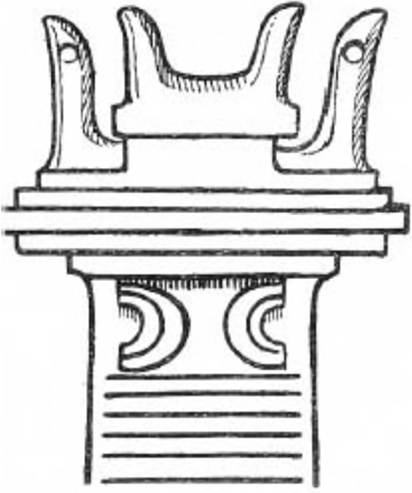
Figure 12.6 Evans’s reconstruction of a small altar surmounted by “horns of consecration”, Mycenae (Evans 1921-35: II. 187).
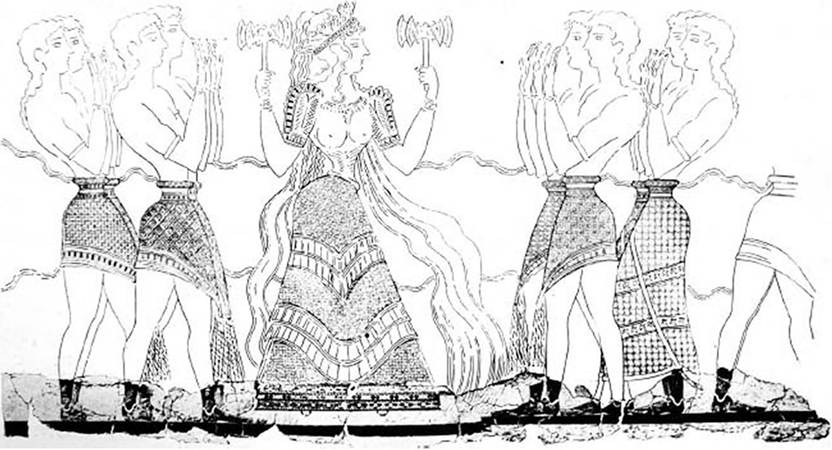
Figure 12.7 Evans’s reconstruction of a procession or adoration scene where the youthful male worshippers face the goddess or her priestess who is holding the typical Minoan double axes (this section of the total scene is ca. 5 m long) (Evans 1921-35: II. 723).