Cultural Memory and Roman Identity in the Hymns of Prudentius
Peter Kuhlmann
Within the fourth century ad a fundamental cultural and religious change took place in the Roman Empire. Emperor Constantine began to Christianize the Roman Empire and relocated the imperial residence from Rome to Byzantium, the νέα 'Ρώμη.
Before the ‘Constantinian shift’ Christianity was only a minority religion within the empire, but now it was particularly promoted by the imperial dynasty.1 The Christian emperors oppressed the pagan cults more and more until they were forbidden finally under Theodosius around 380 ad. Christianity had become the state religion.2Rome and Christianity in the Fourth Century ad
Originally, Roman identity - especially within the nobility - was inextricably linked with the polytheistic cults and with a specific system of values.3 A core value is pietas, that is, the commitment of the Romans to the gods as the foundation of Roman rule. Moreover there are additional terms of values like victoriousness (victoria) in the context of the typically aristocratic canon of values (virtutes). This canon of values promotes military capabilities and selfdenial as well as political involvement in the service of the res publica. Due to these values or virtues (virtutes) the members of the nobility obtain glory (gloria) during their lives and fame after death (memoria), which is a strong incentive for further achievements in favour of state and society. According to the pagan conception, the consolidation and the extension of Roman rule over the oikumene contributes to Roman identity within the upper class. An important basis of this rule is the pursuit of glory and memory as a social standard.4
Christianity threatens this traditional system of values. The rejection of the polytheistic cults (in the sense of a civic religion) called into question the cultural system of Rome because the pagan gods warranted Rome's salus and victoria in return for the cult.5 From the fourth century onwards the leading Christians of the state were no longer willing to tolerate pagan cults.
The new universal monotheistic religion claimed a monopoly in the Roman state and, by pagan perception, thereby put the salus rei publicae at risk.6 For the individual Christian, the well-being of the state was replaced by individual salvation in the afterlife. The political Roman universal rule was replaced by a spiritual universal rule, that is, a Christian fides catholica. Because of this paradigm shift, the traditional system of values of the nobility seemed to lose its significance because the dedication to a this-worldly state and its rule did not originally mean anything.Prudentius and His Works
Despite this evident clash of cultures we can observe a kind of cultural synthesis of pagan and Christian cultures in the literature of around ad 400.7 In particular, the poet Prudentius, who was born in Spain,8 tried to create a novel synthesis of the values of the traditional Roman state and the Christian conception of the world.9 He incorporated the aristocratic canon of virtues into Christianity and thus created a concept that could be called a ‘Christian mos maiorum as it was based on the cultural repertoire of the pagan past of Rome.10 Therefore in this article the following questions will be considered. How does Prudentius transform the pagan and primarily aristocratic canon of values (virtutes) to fit into a new Christian system of Roman identity? And what is his relation to pagan literature and culture?11
The textual basis for this investigation will be the Peristephanon, a collection of 14 hymns in honour of martyrs, which Prudentius composed or at any rate published shortly after ad 400.12 Not much is known about Prudentius as a person. A short poetic praefatio precedes the edition of his collected works and gives only little information about his life. The works of Prudentius, all of which are poems, are concerned with Christian faith. In the poems contra Symmachum, Prudentius condemns belief in polytheistic gods, and in his epic works Apotheosis and Hamartigenia he defends the true catholic faith against contemporary heresies.
The epic Psychomachia describes the war of the virtues against the vices. Much blood is shed in this merciless battle, and often the reader will feel pity for the vices which are mostly cruelly mutilated, until eventually the virtues prevail.Much blood is shed in the hymns to the martyrs as well. Tongues and breasts are torn from living bodies, intestines are ripped out, martyrs are drowned, burned or decapitated, or all at once. A particularly well-known hymn is the martyrdom of St Lawrence (Pe. 2), a patron saint of Rome. Lawrence, who lived in the middle of the third century, was a deacon under Pope Sixtus II. He was forced to hand over the treasures of the Roman church to the greedy pagan praefectus urbi. Lawrence gathered all the beggars, sick and needy people who were under the protection of the church, and presented them to the prefect on the day he was to hand over the money, shouting, ‘Behold the treasures of our church!' Enraged by this, the prefect sentenced Lawrence to be roasted alive. But even shortly before his death, Lawrence said to the prefect from the stake: ‘My flesh is done, eat it up, try whether it is nicer raw or roasted.'13
The texts of Prudentius are not only interesting examples of the grim Christian humour of late antiquity; they also exhibit a Manichaean outlook typical of early Christian literature. The Christians and the saints are positive examples; the heathens of Prudentius' hymns are always members of the Roman nobility - city prefects, governors or judges - but their character is depicted as negative throughout. In spite of this polemic attitude towards the pagan Roman elite, Prudentius took over a number of traditional Roman values and created a synthesis of the pagan mos maiorum and Christian values. This topic will be approached by addressing language, culture and space.
Aspects of Language: Semantic Fields, Intertextuality and Prosody
In the opening lines of the Lawrence hymn, Prudentius emphasizes the power and the glory of the - by then Christian - city of Rome:14
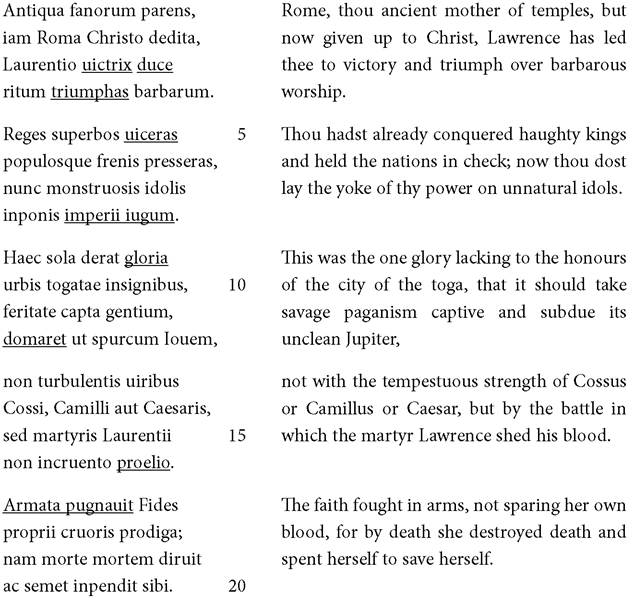
Remarkable are the many expressions from the semantic field ‘war’ or ‘military’.
If the words Christo in the second verse and martyris Laurentii in verse 15 were replaced by names of pagan gods or heroes, the passsage could be an ordinary description of a victorious war fought by the city of Rome against her external enemies in a pagan epic text. The active subject is Roma in the first four stanzas, but in stanza five suddenly it is Fides. It is only here that it becomes evident that the text is primarily a religious one, although, of course, fides is a typical term of value in the pagan Roman culture, too. In Christian texts, however, fides generally means ‘Christian faith’.15 In Prudentius’ writings this Christian faith is characterized by rather militaristic features: she is armed and able to fight. So the acting subject Fides appears as a personification and an allegory like, for example, Fama, in the works of Ovid and Vergil.16 Saint Lawrence, too, is presented as a soldier: his martyrdom is a bloody battle. This metaphor is also frequently used otherwise in the texts,17 for example, in the hymn to Lawrence (verses 501-8):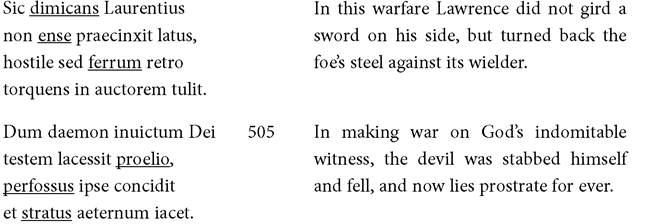
The martyr has waged war against the enemy or the evil demon of heathendom respectively, and he has defeated him. Prudentius uses military terminology here again in order to illustrate the victory of Christian faith over pagan cults.
This choice of words distinctly reminds the Roman reader of literary models from pagan literature within a real military context. A particularly interesting passage in this context is one from the first hymn, which is dedicated to the Spanish soldier martyrs Emeterius and Chelidonius (Pe. 1.24-30 and 51). The text shows strong intertextual references to Horace; compare Prudentius:
dulce tunc iustis cremari, dulce ferrum 51 Sweet was it then for the perpeti. righteous to be burned or to
suffer the sword.
This can be compared with the famous verse of Horace: dulce et decorum est pro patria mori.18 Like in the works of Horace or in early Greek elegy, death is presented as inevitable for man; death on the battlefield brings eternal glory and ennobles the one who sacrifices himself for the patria or for his faith. In Prudentius' Christian metaphoric language the two real soldiers Emeterius and Chelidonius become soldiers of Christ due to their martyrdom. This militia Christi also occurs in the writings of other Christian writers,19 but Prudentius is downright obtrusive in using these military metaphors.
Here and in several other passages, the well-read reader is reminded of the pagan model of Horace. It is especially one of the Roman odes that reflect on the topics of Roman state and Roman values. Intertextual allusions to Roman odes can be found in many other passages of Prudentius' work.20
Besides, even the metres in the hymns of Prudentius show his relatedness to Horace. Unlike other contemporary Christian lyricists, Prudentius uses the classical, purely quantitative, metres which are mainly taken from the odes and epodes of Horace.21 This is remarkable because around ad 400, the quantitative vowel system collapsed: most Latin-speaking people were not able to accurately tell long vowels from short ones. This is why Saint Ambrose in his poems used those metres in which the natural accent to a large extent coincided with the ictus of the verse. Medieval Latin lyrics subsequently only complied with the natural accents of the words, as is the case in most modern languages. With regard to linguistic aspects, too, Prudentius was a poet who wrote for an educated audience which still was familiar with the classical metres and uses a very traditional Latin pronuncition when reciting orally.
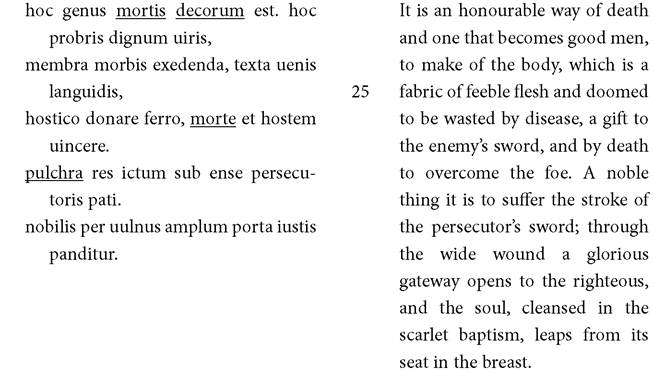
Unlike Ambrosius' works, in Prudentius' poems the coincidence of the natural word accent and the invariable elementa longa of the metre is apparently rather accidental, perhaps in some cases even avoided.22 This can be shown in two passages selected by chance, where the discrepancy between natural accent (') and metrical longa (underlined) is marked:
Antiqua fanorum parens, iam Roma Christo dèdita,
Laurentio uictrix duce
ritum triumphas barbarum.
(2 ia)hoc genus mortis decorum (e)st. hoc probris dignum uiris (4 troA)
For the appropriate auditory impression, a careful realization according to classical phonetics is crucial. The iambic dimetres have a hammering and martial rhythm; the catalectic trochaic tetrameters have their origin in triumphal poetry and evoke a triumphal procession in the listeners' minds.
Cultural Identity: Society, Roman Values and Religion
As the remarks on his style have shown, Prudentius uses figures in his poetry which meet the literary taste of a noble audience. Even the choice of certain genres can be linked to this. The epic genre with its metre, the hexameter, gives the Psychomachia a heroic character like the Iliad or the Aeneid2 The lyrical poems with their difficult metres and complicated hyperbata are - by the time of c. ad 400 - fully intelligible only for a highly literate audience, who is familiar with these figures through aristocratic education.
Aristocratic and Christian norms
To this aristocratic flair of the poems belong the Roman terms of values, which appear in all hymns, such as virtus or gloria and related attributes and manifestations24 - the high frequency of military terms and concepts has already been pointed out in the texts treated above. In the traditional Roman society, the military career was a mandatory stage in the life of a nobleman. The term vir-tus originally denoted the very qualities that constitute a man, among which were especially achievements on the battlefield. By means of these achievements, a nobleman attained gloria, that is, fame, for the ages. A non-nobleman could hardly attain virtus in this sense because the term gloria, according to the traditional mos maiorum, is applicable only to the class of the nobiles. Interestingly enough, even Christ and God himself play a role in this system of values. In the first hymn, Christ commands the cohorts of faith.25 In the hymn to Lawrence it is the saint who is a commander in Christianity's war against the heathens.26 Virtus is a property which God as well as the saints or potentially even ordinary men have. Hence in the hymn to St Vincent mention is made of the virtus Dei;27 in the hymn to Hippolytus a mother says to her little son:28
omnes capaces esse virtutum Deus The Father has ordained that all ages mandavit annos should be capable of courageous deeds...
By this she means to say that people of every age - adults and children - can attain virtus in the Christian sense.
This last example shows the reassessment of Roman values by Prudentius. On the one hand the traditional system of virtus and gloria is fully present with respect to terminology; on the other hand it does not seem to be tied to the social group of the Roman nobiles necessarily.
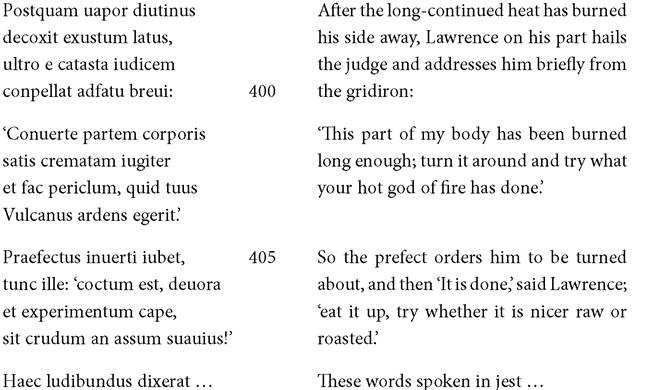
This can be confirmed by examining the acting characters in the hymns and their dispositions and behaviour. As already indicated, Prudentius portrays the characters of the hymns rather one-sidedly: the saints are the good guys and the pagan Roman officials are the bad guys. The Christian martyrs have exactly the traits a nobleman should have according to ancient moral values. They have what is called enkrateia in Greek - roughly ‘self-control’ in any situation; they never lose their serenitas - even if roasted alive, dismembered or tortured in any other way; and they can distinguish clearly between true goods in life from false ones.
In the hymn to Lawrence this can be seen in the famous scene in which Lawrence makes the macabre joke already mentioned:29
The Roman officials, in contrast, act quite differently: their behaviour is characterized by the terms ira, furor or furere. When in the hymn to Lawrence the prefect, expecting great treasures of gold, sees the crowd of beggars and sick people, he loses his temper and verbally abuses the holy priest Lawrence:30
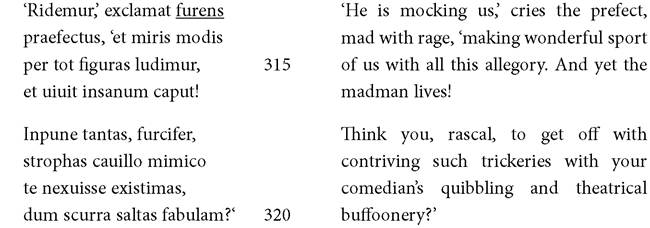
In the hymns to Eulalia and to Agnes the officials react to the Christian convictions of the two young girls in a similar way. The virginal Eulalia does not want to marry but rather dedicate her life to Christ as a chaste virgin. The infuriated judge orders that the girl be tortured in order to force her into marriage and the pleasures of matrimony,31 but - of course - without success. Saint Agnes - she is a young girl, too - refuses to worship the pagan gods. Despite her youth she adheres to Christianity. Because of this the judge is caught by rage and sends her into a brothel.32 Agnes can keep her virginity even there, though not without divine intervention.
In both cases the judges are either provincial governors (Pe. 3: Spain) or Roman city prefects (Pe. 14) and consequently members of the highest Roman nobility. But their conduct in no way suits the aristocratic code of behaviour: they let themselves be carried away by their affections and react in an unrestrained and inappropriate way.33 This is particularly obvious in the case of the the two young girls. In the hymns to Lawrence and to Eulalia we see Roman officials who value exterior gifts offortuna - like gold or honour - higher than the true and eternal values in life. The martyrs, on the other hand, realize what a true good is and what a false one, and they are willing to die for this true good. They are happy even in the agony of torture - as the Stoics demand from the ideal sage. This corresponds with the Stoic doctrine of the value of things. Saints recognize life as a mere adiaphoron and have attained virtus as the summum bonum and hence gloria by their conduct.
This is interesting because Stoicism was a somewhat fashionable philosophy among the Roman nobility,34 and the Roman upper class was familiar with the guiding principles of the important philosophical systems due to their rhetorical and philosophical education.35 Especially Stoicism and its teachings about virtus were in great accordance with the nobility’s code of honour, and many features of Stoic philosophy were accepted by Christian authors such as Lactance, Ambrose and Jerome.36
Besides, the saints meet the aristocratic standards of the upper class in what is - at first glance at least - an external way: they show eloquentia. This can be concluded indirectly from the very long speeches of the martyrs in the hymns. These speeches have a dual addressee: they are addressed to the Roman officials mentioned in the text, but of course also to the reading audience of the hymns. In these thoroughly polished speeches, the martyrs outline the principles of their belief and their actions. Multiple times the narrator frankly calls the Carthaginian church father Cyprian facundus37 and eloquens38. This facundia or eloquentia in the person of Saint Cyprian is united with his great wisdom and learning;39 so here - in the person of a saint of the Christian church - Cicero’s ideal of the union of sapientia and eloquentia40 has come to life.
To sum up, Prudentius does not abandon the traditional Roman canon of values; on the contrary, he retains it largely unchanged. He transfers it to the Christian church and shows that it is precisely the pagan upper class who have lost virtus and the values of the mos maiorum. The saints of the church carry on these values in a Christianized form. The term of nobility lives on as well; however, it is not noble origin or wealth that ennobles men, but Christian faith. Thus, the holy martyr Romanus tutors his pagan Roman judge in the tenth hymn:41
... absit, ut me nobilem Far be it from me that the
sanguis parentum praestet aut lex curiae: blood of my parents or the law
generosa Christi secta nobilitat viros. 125 of the senate-chamber should make me noble; it is Christ’s noble teaching that ennobles men.
Religion and cult
Another complex belonging to the Roman system of values in the broadest sense is the field of cult and religion.42 As we have seen, in the hymns of Prudentius anybody can launch a career as a nobilis. By dying as a martyr, the saints even gain eternal gloria and are venerated like Roman heroes. This parallel between heroes and saints is illustrated explicitly, for example, in the hymn to Lawrence. At the beginning of the hymn we have:43

Due to this social and spiritual advancement the saints can act as advocates or patrons of man in heaven and help man achieve salvation.44 Compare the end of the hymn to Lawrence where it says:45

But this requires correct worshipping, as the narrator explains in the hymn to Saint Vincent:46
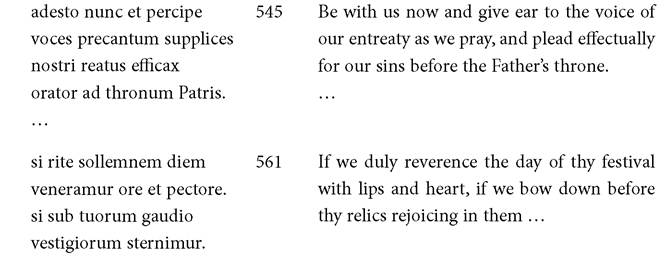
This means that the observance of the feast days and the worship of the relics, among other elements belongs to the correct exercise of the cult. In a way, not much has changed compared to the ritualistic pagan cult. There is a kind of clientship between the saints or the gods on the one side and man living in this world on the other. If humans as clients of the saints or gods exercise the cult correctly they will receive blessings from their heavenly patroni in return.
The veneration of saints was organized locally, just like the traditional cults of gods and heroes, which means that a god or a hero in the beginning was exclusively linked with his home town. Similarly, this remains true for the saints in Prudentius' world, as Saint Agnes of Rome exemplifies in the last hymn (Pe. 14.1-4):
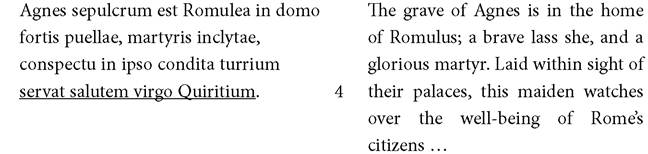
Just as the pagan gods and heroes are responsible for the salus rei publicae, the local saints protect their respective towns. The choice of the expressions Romulea domus for Rome, inclyta for St Agnes, and Quirites for the Roman citizens gives this passage a Roman-pagan and at the same time heroic- aristocratic ring.
Aspects of Space: Rome and the Empire
The last passage deals with the question of space. Pauline Christianity is a so-called ‘universal religion', that is, it is not confined to a particular space in the sense of a town or a nation, which is quite unlike Judaism or the local cults of pagan Rome, Greece or Egypt. Especially in the hymn to Lawrence, however, the city of Rome is of particular importance, which is conspicuous because Prudentius himself is from Spain and so are most of the martyrs (headdresses) in the Peristephanon. Prudentius resolves the paradox of local relatedness and Roman centralism by adopting and Christianizing the idea of Rome developed in Vergil's Aeneid. In several passages of Prudentius' work there are intertextual references which are recognizable for the literate reader, for example, to the speech of Anchises in the sixth book of the Aeneid. Therefore it is necessary to compare the passage already discussed above with Vergil:47
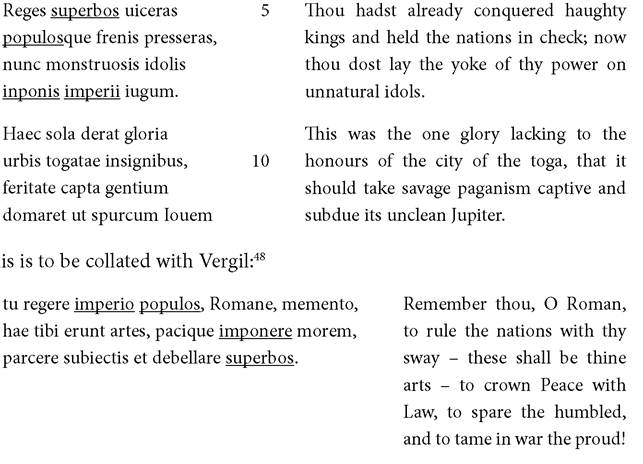
The conceptions of the two authors are similar: the many peoples of the world are connected to Rome through Rome's rule over them. This matches the somewhat martial idea Prudentius has of Christianity rather well. To him Rome has become Christian and now has the task to utilize its rule over the world to spread and protect Christian faith (around the world).
Another important point, which is literarily manifest most notably in form of the hymns, is the physical presence of certain saints in Rome. The two central martyrs, Peter and Paul, who - alongside Jesus - in some sense founded Christianity as a religion, are buried there. The martyrdoms of these two heroes of Christianity in Rome and the presence of their relics and tombs as new Christian lieux de memoire makes the city of Rome a ‘sacred (memory) landscape’,49 as the hymn to the two apostles50 shows in particular. At the beginning of the hymn to Lawrence, Prudentius praises the city of Rome as a sacred space as well because of its many sanctuaries.51
In fact the two apostles are not even Romans, but have rendered the city a sacred place simply by their presence. It is Rome that becomes a central attraction for saints from around the world, combining foreign and Roman elements within its walls. This integrative power of the city of Rome is explained in the hymn to St Romanus (Pe. 10) - nomen est omen. This deacon was originally from Antioch and had served as a priest in Caesarea for a long time. In his long speech to the judge Romanus refers to Rome as the capital of the world.52 Earlier, the saint is referred to as the leader of the Christian army, to which all groups of men belong:53
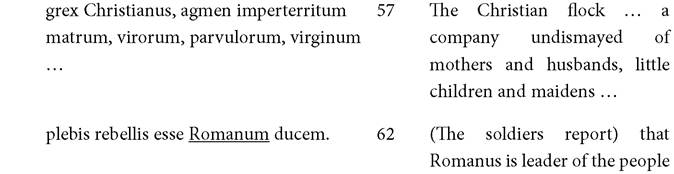
In verse 62 the reader cannot necessarily decide whether the ambiguous Romanus is a proper name or an ethnic appellative term ‘the/a Roman' - nor can he do so at any other point in the text. The sentence could theoretically be translated as: ‘that the leader of this insurgent people is a Roman'. Because of this semantic ambiguity the Roman reader can have the connotation ‘Roman’, whenever he reads Romanus. To an extent, this Romanus is a kind of prototype for the ideal Christian by Prudentius' standards. His local origin does not matter; by being a true Christian and sharing the true Christian- Roman values he becomes a Roman.
As is known from Livy or from the fourth book of Propertius,54 Rome as a city and also as an empire has always been a melting pot of different ethnicities, the consequence being that all are Romans because they shared the same values. The city of Rome has a prominent function, because it is the local origin of these values and has made the founding and the expansion of the empire possible through its military strength.
The existence of the Imperium Romanum in turn made the spread of Christianity possible in the first place, as observed by the church father Meliton of Sardes or St Eusebius of Caesarea.55 In this regard, Rome is also of great importance for salvation.56 First and foremost, however, in Prudentius' work the city of Rome was, still is and continues to be the bearer of a certain canon of traditional values which significantly contributes to the identification of the Christian citizens of the Roman Empire.
The Intended Audience of Prudentius’ Hymns?
Finally the question arises as to who was the intended reading audience for the hymns. Of course, this question invites speculation, but from what has been said above, plausible conclusions can be drawn.
The hymns are probably aimed primarily at an audience whose education had stirred a desire for sophisticated poetry. Before Prudentius, this audience did not possess much literature with Christian stories; the biblical epic of luvencus (fourth century) is an example of such a literary Christian text.57 So we can image Christian readers with an aristocratic education as the most likely audience. Since the Constantinian shift in the fourth century, there had been many Christian aristocrats without exceptionally Christian beliefs - an example is Apollinaris Sidonius (431/2-479).58 In addition, there certainly were many religiously indifferent noblemen like Claudian, Ausonius or the author of the Historia Augusta. The traditional Roman cults were not permitted anymore, and Christianity in the conception of St Paul, Augustine and others - with its in many cases anti-Roman and anti-aristocratic views - was at first unappealing to this social group. The concept of a Roman- Christian outlook in the works of Prudentius gave this group the possibility to identify with Christian faith in a Roman garment. For the many members of the upper class who were not of Roman-Italian origin, Prudentius’ conception of Rome was attractive, too. Prudentius was born in Spain and had become a Roman magistrate all the same. Therefore Prudentius is certainly the best example for the identification of a provincial person with the Christian idea of Rome.
On the other hand, Prudentius seems to maintain the claim that he secondarily offers opportunities of identification to a non-aristocratic audience. This is indicated by the many passages in his work in which - just as in Livy’s works - the concordia ordinum, that is, a community of plebs and nobiles, is invoked. It has to be acknowledged that not all poems are equally difficult to understand. An uneducated audience was perhaps not able to comprehend all the metrical and stylistic subtleties, but was still able to enjoy the vivid and spectacular accounts of martyrdoms. It is therefore probably fair to say that this poem might nevertheless be aimed at a greater audience.
Conclusion
The hymns of Prudentius combine aspects of pagan memory culture, including aristocratic values and virtutes or pagan aspects of a civic and ritualistic religion, with a Christian memory culture based on a martyr cult and Christian orthodoxy. Prudentius' programme clearly differs from Augustine's rejection of most of the traditional Roman values such as memoria, victoria, gloria and pagan virtus. In this respect, Augustine, in spite of his dogmatic influence in other theological questions, represented an old tradition from well-known orthodox church fathers like Tertullian or Cyprian, which did not fit his own time. Prudentius' new synthesis, on the other hand, led to a truly Roman church that could be attractive to the old elite, too.
Notes
1 An overview is given by MacMullen 1997; Pietri 2005: 193-237.
2 Pietri 2005: 462-96.
3 On the general topic, see Braun, Haltenhoff and Mutschler 2000; on the special values, see Haltenhoff 2000: 15-30; Haltenhoff 2005: 81-106; on the mos maiorum, see Bettini 2000: 303-51.
4 On memory, see Walter 2004: 26-37 and 118-30. The connection between memory culture and identity is discussed comprehensively by Giesen 1999.
5 Wlosok 1970: 54f.
6 Wlosok 1970: 53-67; Barcelo and Gottlieb 1992: 3-59; Kuhlmann 2002: 173-6.
7 Dopp 1988: 25-43; on the Romanization of the Christian culture see MacMullen 1997: 103-51.
8 On the person Prudentius, see Palmer 1989: 6-31.
9 Paratore 1980: 51-86; Kah 1990; Evenepoel 1996; DeProost 1999.
10 On such processes of constructing identity, see Giesen 1999: 119.
11 Giesen (1999) gives a typology of such semantic reconstructions of culture codes that create identity within societies.
12 Fuhrmann 1994: 232-5.
13 Pe. 2.401-4.
14 Pe. 2.1-20. The English versions are based on H. J. Thompson's translation in the Loeb Classical Library.
15 Thesaurus Linguae Latinae s.v. ‘fides' (especially under III: ‘fides Christiana').
16 Verg. Aen. 4.174-97; Ov. Met. 12.39-63.
17 The most striking examples are the soldier-martyrs Emeterius and Chelidonius in the first hymn (Pe. 1).
18 Hor. c. 3.2.13-16; for the intertextual reference, see Luhken 2002: 243f.
19 This concept is already present in 2 Tim. 2.3-5; 1 Clem. 37; and well-known in the writings of Tertullian and Cyprian. See Brennecke 2002: 1231-3.
20 For an overview, cf. in Luhken 2002: 320.
21 Palmer 1989: 58-67.
22 Fuhrmann 1994: 239-41.
23 On the Psychomachia, see Malamud 1989: 47-77.
24 On the term virtus in Prudentius, see Luhken 2002: 242-6; Palmer 1989: 140; Roberts 1993: 182-7; Paschoud 1967: 227.
25 Pe. 1.67.
26 Pe. 2.3: Laurentio duce.
27 Pe. 5.473.
28 Pe. 10.743f.
29 Pe. 2.397-409.
30 Pe. 2.313-20.
31 Pe. 3.95-105.
32 Pe. 14.10-30.
33 Prolingheuer 2008: 155-60.
34 Fuhrmann 1994: 134-56.
35 The most important philosophy in late antiquity was Neoplatonism. On the role of Stoicism, see Fuhrmann 1994: 135-56.
36 On the influence of Stoicism on some Christian authors of late antiquity, see Fuhrmann 1994: 178, 184-6. On Stoic elements in the philosophy of Augustine and Boethius, see Flasch 2000: 44-52 and 82-4.
37 Pe. 13.10-20.
38 Pe. 13.97.
39 Pe. 13.15-20.
40 For example, in Cic. de inv. 1-5; de orat. 1.1-23; or. 11-19.
41 Pe. 10.123-5. See also Henke 1983: 155-63.
42 On some features of Romanization in the Christian cult based on archeological evidence, see Heid 2007.
43 Pe. 2.13-16.
44 Generally on the concept of the saints as patrons, see Brown 1981: 54-64.
45 Pe. 2.579f.
46 Pe. 5.545-68.
47 Pe. 2.5-12.
48 Verg. Aen. 6.851-3. Concerning the parallels in detail, see Mahoney 1934: 31; Buchheit 1966; Palmer 1989: 128f.; Lühken 2002: 172-84.
49 Concerning the term, see Assmann 1997: 60; Cancik 1985/6.
50 Pe. 12.7f.; 29f.
51 On the general concept of lieux de memoire as a part of memory culture, see Nora 1990 and Assmann 1999, who uses the term ‘Erinnerungsräume’.
52 Pe. 10.167: saeculi summum caput.
53 Pe. 10.57f. and 62.
54 Concerning the multi-ethnic origin of the Romans (Troiani, Aborigines, Latini, Sabini, Etrusci), see Liv. 1.1-13; Prop. 4.1; 2; 4.
55 Eus. laud. Const. K 16; theoph. 3.1f.
56 On this topic, see Buchheit 1966: 129.
57 Gemeinhardt 2007: 389, 416.
58 On Sidonius, see Küppers 2005.
Bibliography
Assmann, J, 1997. Das kulturelle Gedächtnis, Schrift, Erinnerung und politische Identität in frühen Hochkulturen. Munich.
—1999. Erinnerungsräume. Formen und Wandlungen des kulturellen Gedächtnisses. Munich.
Barcelo, P. and G. Gottlieb, 1992. Christen und Heiden in Staat und Gesellschaft. Munich.
Bettini, M. 2000. ‘mos, mores und mos maiorum. Die Erfahrung der “Sittlichkeit” in der romischen Kultur', in Braun, Haltenhoff and Mutschler, 2000, 304-52.
Braun, M., A. Haltenhoff and F.-H. Mutschler (eds), 2000. Moribus antiquis res stat Romana. Munich.
Brennecke, H. C., 2002. ‘Militia Christi’, in H.-D. Betz (ed.), Religion in Geschichte und Gegenwart 5, 1231-3.
Brown, P., 1981. ne Cult of the Saints. Chicago, IL.
Buchheit, V., 1966. ‘Christliche Romideologie im Laurentius-Hymnus des Prudentius', in Festschrift Dolger, Heidelberg, 121-44.
Cancik, H., 1985/6. ‘Rome as a Sacred Landscape', Visible Religion 4/5, 250-65.
DeProost, P.-A., 1999. ‘Le martyre chez Prudence: sagesse et tragèdie', Philologus 143, 161-80.
Dopp, S., 1988. ‘Die Blütezeit der lateinischen Literatur in der Spätantike’, Philologus 132, 19-52.
Evenepoel, W., 1996. ‘Le martyre dans le Liber Peristephanon de Prudence', in SEJG [Sacris Erudiri: a journal on the inheritance of early and medieval Christianity] 36, 5-35.
Flasch, K., 2000. Das philosophische Denken im Mittelalter. Stuttgart.
Fuhrmann, M., 1994. Rom in der Spätantike. Reinbek.
Gemeinhardt, P., 2007. Das lateinische Christentum und die antike pagane Bildung. Tübingen.
Giesen, B., 1999. Kollektive Identität. Die Intellektuellen und die Nation. Frankfurt/M.
Haltenhoff, A., 2000. ‘Wertbegriffe', in Braun, Haltenhoff and Mutschler, 2000, 15-29. —2005. ‘Romische Werte in neuer Sicht?', in Haltenhoff, Heil and Mutschler, 2005, 81-105.
Haltenhoff, A., A. Heil and F.-H. Mutschler (eds), 2005. Romische Werte. Munich.
Heid, S., 2007. ‘The Romanness of Roman Christianity', in J. Rüpke (ed.), A Companion to Roman Religion. Oxford, 406-25.
Henke, R., 1983. Studien zum Romanushymnus des Prudentius. Frankfurt/M.
Kah, M., 1990. Die Welt der Romer mit der Seele suchend: Die Religiosität des Prudentius. Bonn.
Küppers, J., 2005. ‘Autobiographisches in den Briefen des Apollinaris Sidonius', in M. Reichel (ed.), Antike Autobiographien. Werke - Epochen - Gattungen. Koln, 251-77
Kuhlmann, P., 2002. Religion und Erinnerung. Die Religionspolitik Kaiser Hadrians und ihre Rezeption in der antiken Literatur. Gottingen.
Lühken, M., 2002. Christianorum Maro et Flaccus. Zur Vergil- und Horazrezeption bei Prudentius. Gottingen.
MacMullen, R., 1997. Christianity and Paganism in the Fourth to Eighth Centuries. New Haven, CT.
Mahoney, A., 1934. Vergil in the works of Prudentius. Washington, DC.
Malamud, M. A., 1989. A Poetics of Transformation. Prudentius and Classical Mythology. Ithaca, NY.
Nora, P., 1990. Zwischen Geschichte und Gedächtnis. Berlin
Palmer, A.-M., 1989. Prudentius on the martyrs. Oxford.
Paratore, E., 1980. ‘Prudenzio fra antico e nuovo', in Da Teodosio a San Gregorio Magno. Rome, 51-86.
Paschoud, F., 1967. Roma Aeterna. Rome.
Pietri, C. et al. (eds), 2005. Die Geschichte des Christentums II. Freiburg/Breisgau.
Prolingheuer, E., 2008. Zur literarischen Technik bei Prudentius’ Peristephanon. Hamburg.
Roberts, M. J., 1993. Poetry and the Cult of the Martyrs. Ann Arbor, MI.
Thomson, H.-J. (ed.), 1943. Prudentius, with an English Translation (Loeb Classical Library). London.
Walter, U., 2004. Memoria. Munich.
Wlosok, A., 1970. Rom und die Christen. Stuttgart.