As far back as we can trace it, Roman religion was multi-cultural. Archaeological evidence demonstrates that in terms of religion and other cultural components early Rome was influenced by Etruscans, Greeks and even Carthaginians.
It is thus illusory to believe that it is possible to remove different layers of foreign cultural influence and extract an original core of pure Roman religion: from the very beginning, Roman religion was a result of acculturation.
The significance of foreign cultural contacts and the perception that Roman religion was based on traditions that went back to before the foundation of the city are stressed in literary sources. The Aeneid, Virgil’s national epic, tells the story of the Trojan hero Aeneas who escaped from burning Troy and sought safety in Italy. Bringing with him the household gods (Penates) of his native land, Aeneas founded Lavinium and became a mythical ancestor of the Romans. Religion was also embedded in the foundation of Rome itself: when the twin brothers, Romulus and Remus, disputed which of them was to found the new city, the issue was settled by augury. Taking the auspices on the Aventine hill Remus saw six vultures; Romulus, however, observed twelve vultures flying across the Palatine hill and according to the tradition this was interpreted as divine approval of his founding of Rome, on 21 April 753 BCE (in our system of reckoning). Religion also defined Rome and early Roman culture in a physical sense as Romulus established the sacred boundary (the pomerium) by ploughing a furrow to mark out his new city, built the first temple in the city and established some of the major festivals of Rome.
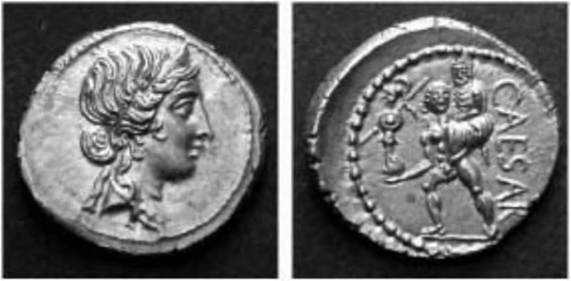
Figure 16.1 Roman Republican coin (47-46 BCE). Obverse: Diademed head of the goddess Venus, who was regarded as the mother of Aeneas and ancestress of the Romans. Reverse: The hero Aeneas escaping from burning Troy carrying his father and the household gods. © A. Tkalec AG, reproduced with permission.
Ancient Roman religion included a variety of different types of gods and goddesses, ranging from the great gods Mars, Jupiter, Juno, Minerva, Apollo, Saturn, Ceres, Venus, Vulcan, and so on, each having a number of functions, rituals and traditions, to deities who represented a particular idea, quality or force in Roman life, such as Concordia (Concord), Spes (Hope), Ops (Wealth), Salus (Safety), Virtus (Virtue) and Honos (Honor).
In some cases these abstract ideas were presented in anthropomorphic form, but in others they were impersonal abstractions.THE SOURCES
Several types of source make it possible to reconstruct various aspects of Roman religion, and several types of problem are tied up with such reconstructions. First of all, most of the literary sources are written around the first century BCE or later. Consequently, we have to reconstruct early Roman religion from much later Greek and Roman literary sources, and from various types of epigraphic and archaeological evidence, such as the remains of temples, votive terracottas, bronze mirrors, coins, and so on. This situation raises a number of critical considerations and questions concerning the history and religion of Rome before and during the early Republican era.
How should we interpret the literary sources regarding early Roman religion, taking account of the fact that they were written as much as six centuries after the alleged events they describe? What material in these accounts can be considered mythical and what constitutes actual history? Were, for instance, King Romulus or his successor King Numa (who was the purported father of the Roman priesthood and many other religious institutions) historical or mythical figures? And what motivated ancient historians such as Livy and poets such as Virgil or Ovid when they wrote about early Roman religion and culture?
In most cases it seems rather pointless to focus strictly on questions of fact or fiction and modern standards of historical accuracy. The ancient writers idealized - and sometimes invented - their reconstructions of the past as explanations of and guidelines for their own present. Consequently, the ancient accounts, true or not, reveal many aspects of what one might call a Roman self-image or collective identity, that is, Roman society’s internalization and classification of norms, attitudes and actions which were characterized as fundamental and unique in relation to other non-Roman cultures.
Using ancient stories in an ongoing debate, the writers explained to themselves (and others) what social, religious and political values, military ideas, behaviour patterns and knowhow contributed to the constitution of Roman society and history. The purpose of the ancient writers’ (re)construction of the Roman past was to provide definitions and ideals to their present, in order to secure the future of Roman society. And the relationship and interaction between humans and gods was one of the key aspects of this (re)construction of the past. The ancient stories about the great gods and mortals, as well as the traditions, norms and values of Roman society, were firmly rooted in the concept of mos maiorum, meaning the traditions established by the ancestors. In the hands of ancient historians and poets, the mos maiorum constituted an ideal societal model according to which they could judge and mould their own age.In this perspective, distinctions between myth and history seem blurred and questions of reliability (in the modern sense) seem largely irrelevant. Another problem tied up with the source material is the fact that the existing literary evidence is rather one-sided. What we know about religious life primarily concerns the socio-political elite of Rome and not the religious practices of the masses or people in rural areas. This does not, however, necessarily imply that there was a clear-cut distinction between the religion of the Roman elite and that of the masses: it simply means that there is a gap in our knowledge and that we are left with few clues regarding the religious perspectives of the common people.
In addition, the literary sources are written almost entirely by men, resulting in biased and stereotypical views on women. An example would be the claim of an extreme female credulity and preference for superstitio and foreign religions. One could therefore say that women were sometimes associated with the “Other”, representing foreignness, wildness and a potential threat to civic life.
This is seen, for instance, in a story told by Livy (8.18) concerning the year 331 BCE - a year he denotes as particularly horrible because of the instability of the weather as well as the fickleness of the women! That year the mortality rate among men in the Roman aristocracy suddenly rose, and all the victims displayed the same symptoms. A female slave disclosed that the cause of death was poisoning, and she claimed that Roman matrons were poisoning their husbands en masse. The case was immediately brought before the Roman Senate and during the subsequent inquiry twenty matrons were caught concocting a special brew. They were brought to trial in the forum and two women of patrician families swore that the brew in question was not poison but medicine. In order to prove the women’s innocence, however, it was suggested that they taste the medicine themselves. They drank the brew - and died. Consequently, many reports against Roman matrons followed, and about 170 women were convicted. Moreover, the Senate decided that the whole case was so serious that it had to be regarded and treated as a public prodigy, requiring expiation to the Roman gods. In the end, Livy adds that he prefers to believe that the account was made up. However, true or not, the story reflects a perception (and fear) of drastic female initiatives as a potential threat to Roman society.A group of sources used in the reconstruction of Roman religion is collectively known as “the calendar”, consisting of more than forty copies of a ritual calendar of Roman festivals. The various lists, inscribed in stone or painted on walls in Rome and other towns, differ slightly from each other, but nevertheless reflect the same group of festivals. The calendar was a central institution of Roman religion and throughout Roman history it was regulated by one of the major colleges of priests, the pontifices (see the section “Priests and politics” below). Even though the calendar provides us with a list of names and dates of the various festivals celebrated in Rome over the centuries, it tells us little or nothing of the festivals’ religious contexts and meanings. Here again we must turn to other fragmentary sources for information. Moreover, although we are sometimes able to piece together a fairly clear picture of the rituals involved in a festival, the rituals are generally not handed down with specific myths or explanations attached to them. This might reflect the fact that mythological materials often change character repeatedly with the passing of time. By contrast, ritual actions and procedures are generally more closely attached to concrete social situations and patterns of interaction and tend to change much less over the course of time.