Funerary Rites
When the death of a Buddhist approaches, family and friends will often sit in the dying person’s room to offer comfort. Knowing that it is best to die with a mind that is calm and pure, they might chant sutras, recite the name of Amitabha Buddha, or simply offer assurances that death is a natural part of the human experience.
When death has come, family members generally follow the dictates of tradition. Theravada Buddhists dress the deceased person in white clothing, which represents virtue, and lay the body out in the home so that visitors might come to say goodbye. Much the same pattern is followed in Chan Buddhism. In the Pure Land tradition, friends and family chant the name of Amitabha Buddha before and after a death in order to help the deceased person find the way to his Pure Land. The body is not disturbed in any way for up to an entire day so that the journey will not be made more difficult. In Tibetan Buddhism families keep vigil over the body of the deceased for four to nine days. During this time, a monk guides the deceased person to a good rebirth, or possibly enlightenment and freedom from rebirth, by reading from the Tibetan Book of the Dead.
VISUAL GUIDE
Buddhism
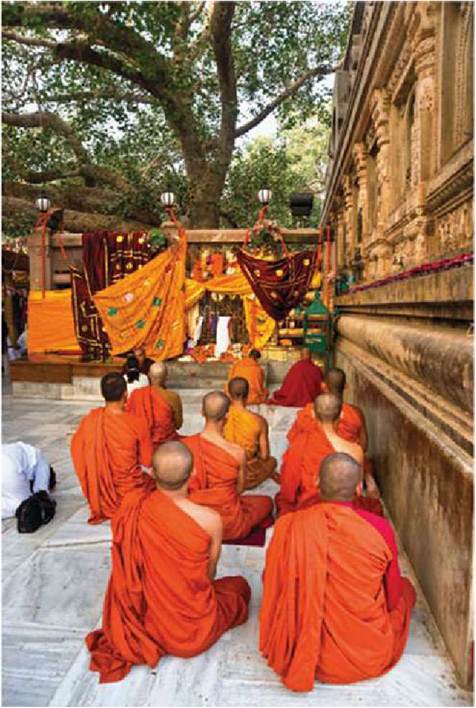
The Buddha achieved enlightenment while seated beneath a fig tree that came to be known as the Bodhi tree (“Enlightenment Tree”). Here, monks gather at Bodh Gaya in India, the site of the Buddha’s enlightenment.
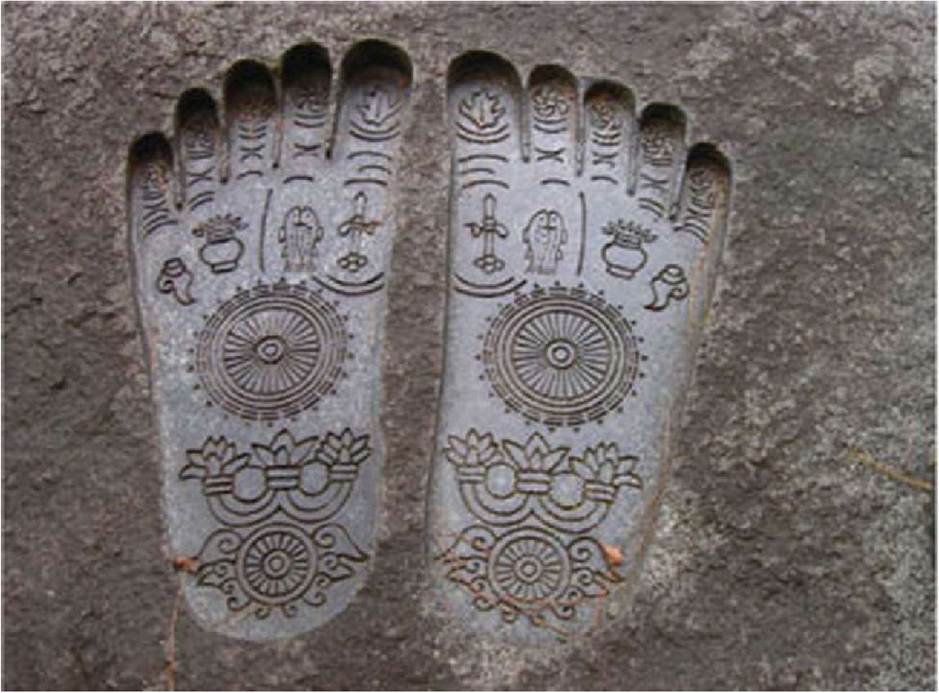
Before the Buddha himself was first depicted in works of art, Buddhists venerated his footprints, which symbolized his path into nirvana. The convention of venerating his footprints continues today.
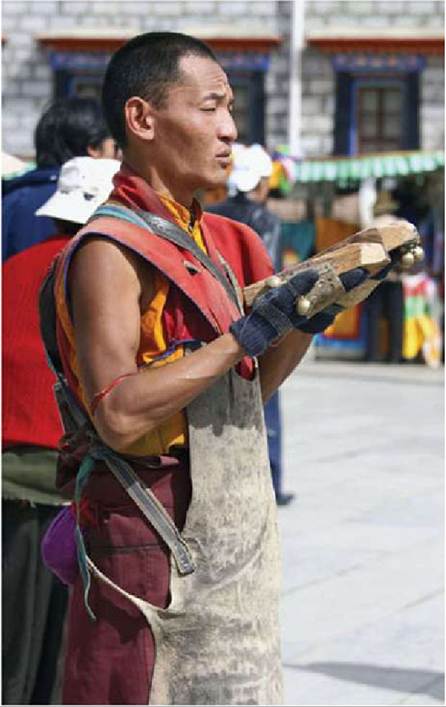
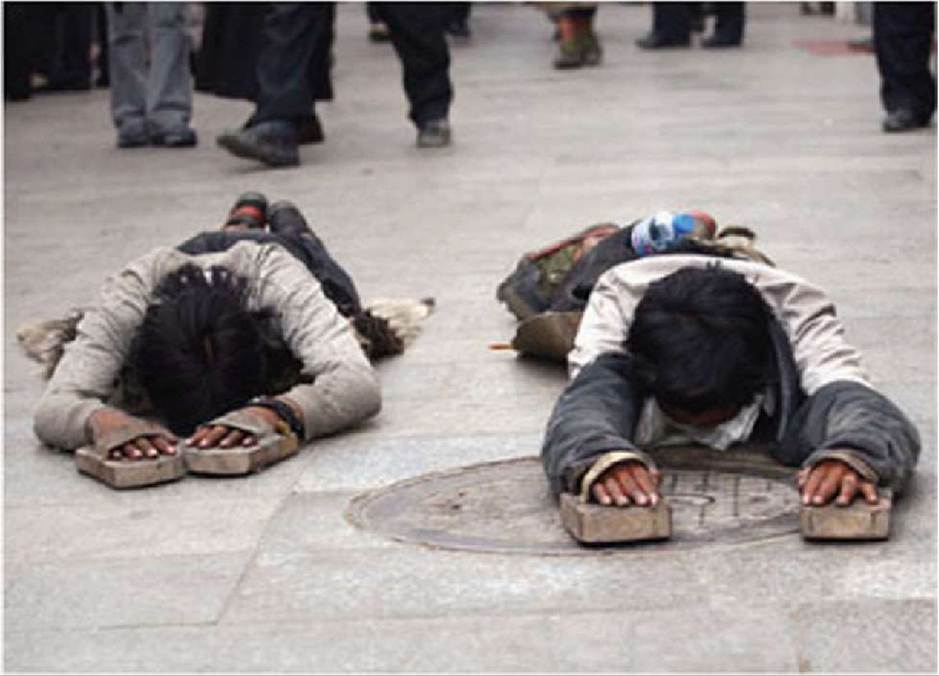
Buddhists of all sects demonstrate their reverence for the Buddha by bowing and prostrating themselves.
Some show reverence while walking to a sacred site by bowing or prostrating themselves every step of the way.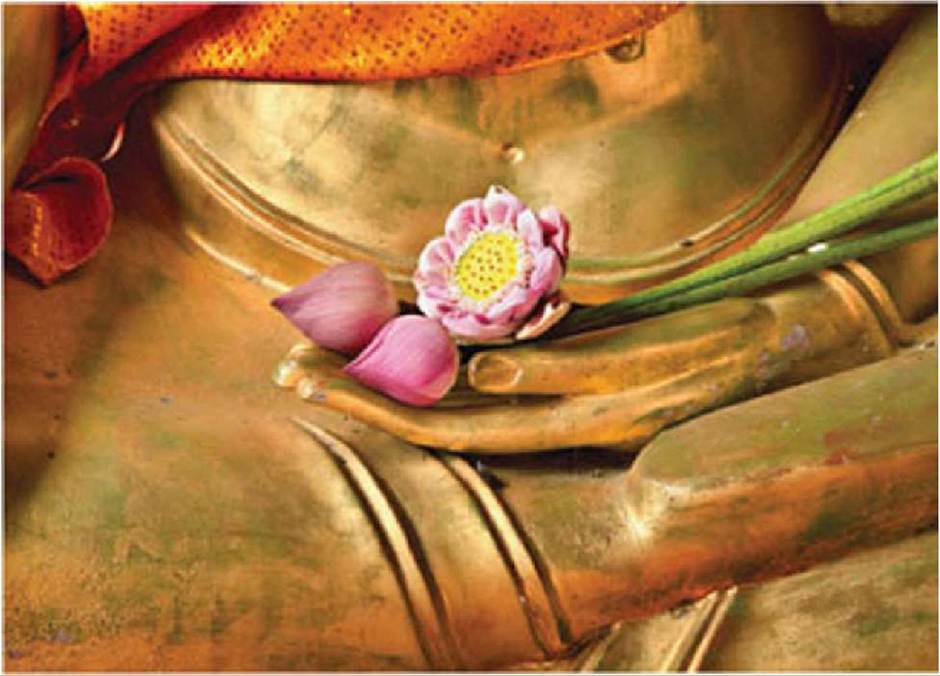
As in Hinduism and Jainism, the lotus in Buddhism is a symbol of both purity and enlightenment.
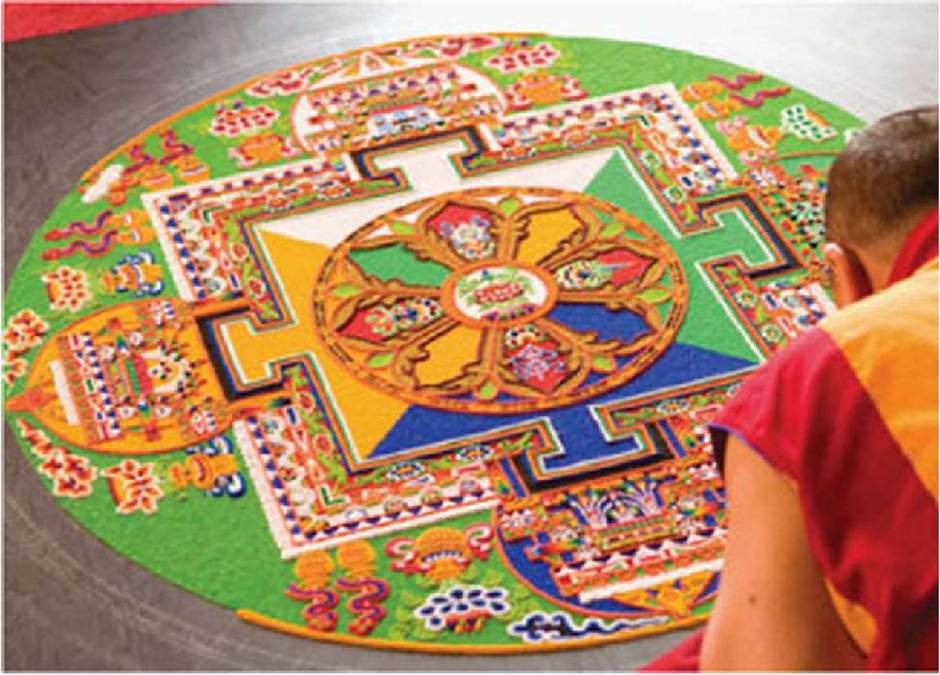
In Vajrayana Buddhism, monks spend weeks constructing sand mandalas such as the Avalokiteshvara Mandala shown here. The sacred image will then be swept toward the center and destroyed as a reminder of the impermanence of all things.
Buddhists practice both cremation and burial. Funeral services may be held either before these events or, in the form of a memorial service, after them. Whatever form a funeral takes, it is always a solemn affair. A photograph or some other image of the deceased is usually set upon an altar at the front of the room in which the service is held, as are flowers provided by family and friends. When entering the room, mourners approach the altar, bow with their hands pressed together in a prayerful manner, spend a moment in quiet reflection, and then take their seats. It is customary for monks, family, and friends to speak, offering eulogies to honor the deceased. In most cases monks or family members lead those in attendance in the chanting of sutras.
Self-Assessment 5.3
[Please note: You must be using an online, browser-based eReader in order to view this content.]
Buddhism in the Twenty-First Century
There are approximately half a billion Buddhists in the world today. About 56 percent are Mahayana Buddhists, 6 percent belong to the Vajrayana tradition within Mahayana, and 38 percent are Theravadins. More than 98 percent of Buddhists live in Asia, half of them in China.-
Buddhism’s position in Asia varies from country to country. It is the state religion and receives government support in Thailand, Cambodia, and Bhutan.
Buddhist minorities are persecuted in Afghanistan and Pakistan. In China, Mongolia, Vietnam, and Laos, Buddhism was suppressed early in the communist era but is making a comeback now. In Japan and South Korea, Buddhism continues to be a central feature of traditional culture. In North Korea, it is discouraged by an authoritarian government that has reduced it to a cultural relic.Buddhism’s recent growth in Europe, the Americas, and Oceania has made it a global religion. In the United Kingdom, for example, the number of Buddhist organizations increased from seventy-four to 400 between 1979 and 2000. In Germany, the number of organizations grew from approximately forty in 1975 to 600 in 2005. As of 2010, there were 280,000 Buddhists in the United Kingdom and 210,000 in Germany. Similar growth is evident elsewhere in Europe and in Australia, where Buddhism is the fastest-growing religion in terms of percentage increase. There are also clear indications of growing interest in Buddhism in South America. With nearly 250,000 Buddhists, Brazil has the largest Buddhist population in Latin America.
The importance of Buddhism in Asian cultures has always been well-attested in their classical art forms. With a very short history in the West, Buddhism is largely absent from its arts. But Buddhism does have a considerable presence in contemporary popular culture, a globally shared culture made possible by technology. Today, Buddhists throughout the world listen to Dharma teachings on podcasts and use apps that allow them to time meditation sessions, read sutras, and keep up with the Dalai Lama’s teachings and travels. The lives of buddhas and bodhisattvas are featured in Japanese and Chinese anime. Buddha, a multivolume story of the Buddha drawn by Osamu Tezuka, “the god of manga,” has been translated into numerous Asian and Western languages. Western films with Buddhist themes include the Star Wars saga, Kundun, Little Buddha, and Seven Years in Tibet and contemporary music with Buddhist connections is available on YouTube and other websites.
American comic book heroes such as Xorn of the X-Men are Buddhists. Even Batman is said to have received instruction in Buddhism in Tibet. Those who wish to learn more about Buddhism visit websites such as BuddhaNet and the online magazine BuddhaZine.1 The demographic information cited here is available at “The Global Religious Landscape,” December 18, 2012, Pew Research Center: Religion and Public Life ( www.pewforum.org/2o12/12/18/global-religious-landscape-exec.), and at the Pew-Templeton Religious Futures Project ( www.globalreligiousfutures.org).
We began this chapter with the life of the Buddha whose teaching is intended to dislodge the mind from clinging to the illusion of permanence and to empower each individual to find the joy and freedom this brings. For twenty-five centuries, the Buddha’s teaching has been elaborated by different schools and sects, each developing its own insights and perspectives on the Dharma. Buddhism has also adapted itself to diverse cultural settings. Its versatility has been fostered in large part by the words of the Buddha himself, who insisted that wherever the Dharma is taken it should exist in harmony with local customs and conventions.
As the world addresses new issues of global significance, Buddhism’s teachings about the interconnectedness of all things and the importance of compassion will likely be supportive of efforts to solve them. These imply our shared unity and responsibility for caring selflessly for others. Indeed, it seems reasonable to hope that the Dharma will combine with the higher teachings of other systems of thought, religious and otherwise, to inspire the changes that will ensure a promising future for ourselves and our world.
SEEKING ANSWERS
What Is Ultimate Reality?
According to the doctrine of interdependent origination, reality is a web of interrelated and interdependent phenomena in which nothing comes into existence independently of other things. Instead, the origination or coming-into-existence of things depends on all other things.
All things are constituted of elements of other things. Nothing exists in and of itself. Further, according to the Buddha’s doctrine of impermanence, all things are in a constant state of flux and without any underlying or enduring essence or identity.How Should We Live in This World?
Believing that there is stability and permanence in the world, we desire to possess what we want and to avoid what we do not want. Our inability to do so results in suffering that arises from our ignorance of the true nature of reality. Accordingly, the Buddha’s guide to life, the Noble Eightfold Path, begins with the acceptance of reality as it truly is. By striving for goals consistent with the Buddha’s teaching about reality and living in accordance with the ethical principles he taught, we build lives that bring happiness and satisfaction.
What Is Our Ultimate Purpose?
For Buddhists, our ultimate purpose is to achieve the end of suffering that is found in nirvana. But Buddhists also recognize that suffering is a condition that afflicts all sentient beings. Moved by compassion for others, they seek to live in a way that encourages them to follow the path that will lead to their own enlightenment and liberation from suffering.
REVIEW QUESTIONS
For Review
1. Describe two ideas of practices that make Vajrayana Buddhism different from Mahayana.
2. Why does the Buddha’s doctrine of interdependent origination require us to think of ourselves and reality as a whole in a new way?
3. What are the Three Marks of Existence? How do they relate to the doctrine of interdependent origination?
4. How does Zen differ from Pure Land Buddhism?
5. What did the Buddha mean by “suffering” (dukkha)? How does following the Noble Eightfold Path bring an end to suffering?
For Further Reflection
1. It is sometimes said that Buddhism is a philosophy rather than a religion. Do you agree?
2. What are the most significant ways in which the teachings of the Buddha deviated from those of Hinduism?
3.
In what specific ways do the teachings of Mahayana and Vajrayana Buddhism elaborate on those of Theravada?4. Why is the principle of the Middle Way essential to Buddhism?
5. To what extent are the Buddha’s teachings about the nature of reality in agreement with those of modern science?
6. Would you find it difficult to accept the Buddha’s doctrine of no-self? Why or why not?
Chapter 5 Self-Quiz
[Please note: You must be using an online, browser-based eReader in order to view this content.]
Chapter 5 Flashcards
[Please note: You must be using an online, browser-based eReader in order to view this content.]
ar
SUGGESTIONS FOR FURTHER READING
Lopez, Donald. The Story of Buddhism: A Concise Guide to Its History and Teachings. New York: Harper, 2001. An excellent introduction to the history of Buddhism and Buddhist thought and practice.
Prebish, Charles, and Damien Keown. Introducing Buddhism. 2nd ed. London: Routledge, 2010. An authoritative introduction recommended as the first text to be consulted by those who are new to the study of Buddhism.
Skilton, Andrew. A Concise History of Buddhism. Birmingham, UK: Windhorse Publications, 1994. An excellent and accessible history of Buddhism.
Suzuki, Shunryu. Zen Mind, Beginner’s Mind. New York: Weatherhill, 1997. An excellent introduction to meditation practice.
Williams, Paul. Mahayana Buddhism: The Doctrinal Foundations. 2nd ed. New York: Routledge, 2008. A history of Mahayana that places emphasis on the veneration of certain Buddhist texts.
Click here for more suggested readings, weblinks, and other media for this chapter.
ONLINE RESOURCES
The Wikipedia Buddhism Portal
en.wikipedia.org/wiki/Portal:Buddhism
Collection of articles in the Wikipedia Buddhism series that is generally quite reliable and extensive in scope.
Access to Insight: Readings in Theravada Buddhism
accesstoinsight.org/canon
Readings that include helpful summaries and substantial translated portions of the Pali Canon.
The Berzin Archives
berzinarchives.com/web/en/index.html
An excellent collection of translations, teaching, and scholarship on the Vajrayana tradition.
Click here for web links to sacred texts.
LIST OF KEY TERMS
anatman
arhats
bodhisattva
Buddha
Buddha nature
Chan Buddhism
Dharma
dukkha
emptiness
Four Noble Truths interdependent origination karma
lamas
Mahayana Buddhism mandalas
Mantras
Middle Way
Nichiren Buddhism nirvana
Noble Eightfold Path
Pali Canon
parinirvana
Pure Land Buddhism samsara sangha
shunyata
skandhas
skillful means
stupas
sutras
Theravada Buddhism
Three Refuges
Tiantai Buddhism
Tipitaka
trikaya
Vajrayana Buddhism
Zen Buddhism