Gender, Identity, and Life-Cycle Rituals
Most African religions emphasize the life cycle. Celebrations and ceremonies that mark the transitions from one phase of existence to another are an important part of religious practice.
These ceremonies define individuals as new members of the human community, as adults with full responsibilities and privileges of adulthood, or as having departed the living for the world of the spirits. African religions frequently believe that the life cycle begins before birth and continues after death. Rituals (Chapter 1) are formal religious practice. They are repetitive and rule-bound, and people often enact them with a specific goal in mind. The goal could be to please a deity, encourage a good crop, or smooth the transition between phases of the life cycle. As you learned in Chapter 2, rituals that facilitate this transition are called rites of passage. These rituals may be performed after a birth, during the transition from childhood to adulthood, or at death, when the deceased transitions to the world of the spirits.Birth: The Transition to the Human World
In many African religions, birth is the first important spiritual transition in a person’s life. It is the moment a new individual enters the living community of humans. Preparing for a birth and welcoming a child are part of a process that often begins long before the child is born. Among the Bambuti people of the central African rainforest, a pregnant woman will offer food to a god as thanks for the pregnancy. In other African cultures, a pregnant woman is expected to observe certain rules and restrictions as a means of protecting herself and the child. For example, a woman may avoid certain foods or sexual relations with her husband while pregnant.
Practices surrounding the birth of a child vary tremendously from culture to culture in Africa. However, there are some common beliefs surrounding birth.
One of these is the belief that birth marks the transition of the newborn from the world of spirits to the world of the living. Ceremonies after birth designate the child as belonging to the entire community, not just the mother. In many cultures, the placenta symbolizes the link between the child and its mother in its dependent state in the womb, and special care may be taken with its disposal after the child is born. The disposal of the placenta can symbolize the necessary separation of the child from its mother. The Yansi people of the Democratic Republic of Congo throw the placenta into a river. This act symbolizes that the child no longer belongs only to his or her mother but now belongs to the entire community.-9 The Gikuyu of Kenya practice a rite with a similar meaning. After she has given birth, a mother’s head is shaved. This represents the severing of the exclusive tie between her and the child and also represents renewal: the mother is now ready to bear another child. Like the Yansi, the Gikuyu then recognize the child as a member of the wider society.32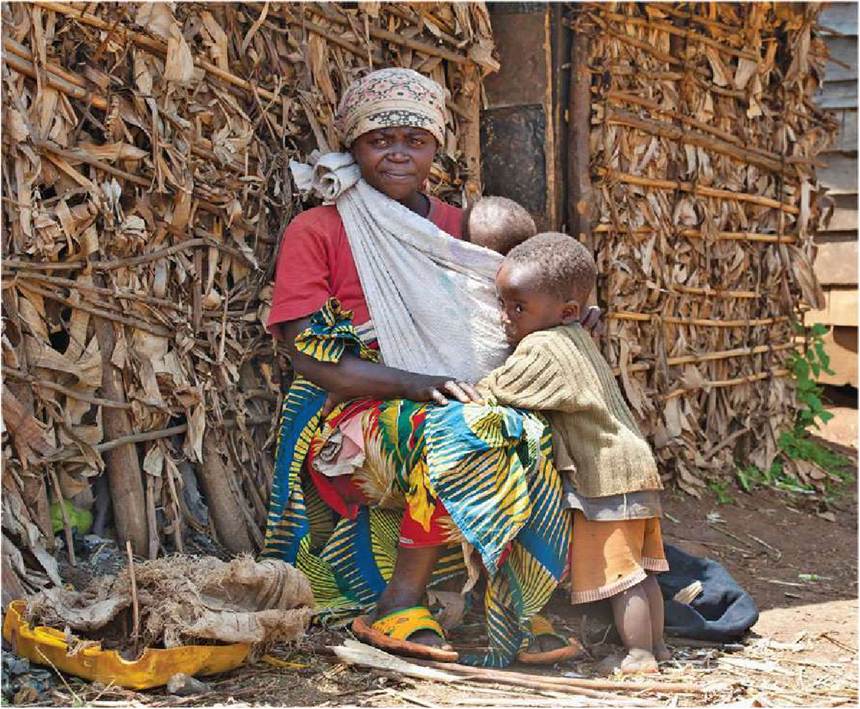
Bambuti woman and children in Uganda.
Many African cultures have special naming ceremonies for children to mark their transition from the spirit world to the human world. The Akamba people of Kenya name a child on the third day after he or she is bom. The next day, the child’s father presents him or her with a special necklace, and the parents have ritual intercourse. Together, these events mark the transition of the child from the spirit world to the world of living humans.31 The Yoruba name their children after a special birth ritual called “stepping into the world.” The ritual teaches parents how to raise their new child. At the request of the new parents, a diviner uses the If a divination system (discussed earlier in this chapter) to determine the baby’s future. Using special tools, foods, and texts, the Yoruba diviner will try to determine the nature of the infant and will select a name based on what is divined.
In one of the most important parts of the ritual, the diviner holds the baby’s feet in the center of a special divination tray, which represents the entire world. This act places the baby symbolically in the center of the world and lets the diviner understand the baby’s nature.3-Gender Identity and Initiation Rites: The Transition to Adulthood
Rites of passage marking the transition from childhood to adulthood are extremely important in African religious traditions. Although they differ significantly in the details, rites of passage focus on successfully initiating a young person into adulthood and setting him or her on the path to becoming a complete member of the community. The new adult will have new privileges and responsibilities and will be expected to behave with maturity and wisdom appropriate to this new status. Often, it is rites of passage at adolescence that create a fully gendered adult. In many cultures, young people are able to many only if they have been initiated. Sometimes, young people acquire special religious knowledge during initiation. Rites of passage also form important bonds for young people who go through them together. Among the Ndembu people of Zambia, for example, boys going through initiation are secluded for circumcision rites. Their mothers bring them food, which all the boys share. The boys spend all their time together and develop close friendships, which are intended to last their entire lives.
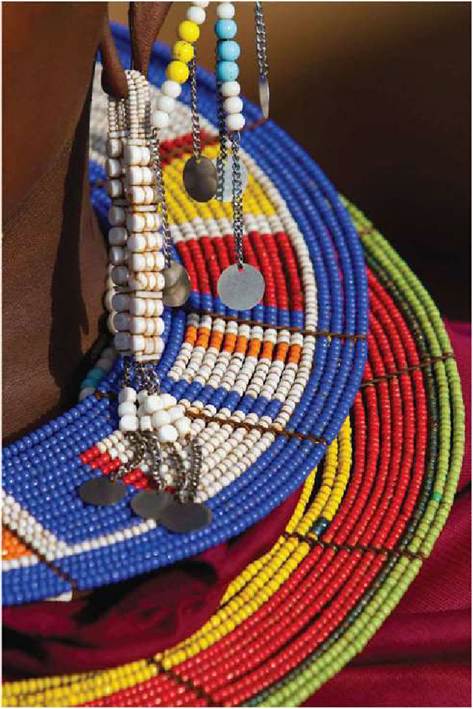
Maasai women often wear intricately beaded necklaces.
Young Maasai men Qike Tepilit, whose story begins this chapter) become warriors when they go through initiation. Much later, when men are in their thirties, they will be initiated as elders and be allowed to many. Maasai girls are also circumcised when they reach adolescence. However, they do not transition into an intermediate warrior stage but become ready for marriage.
Young women change the way they dress, and they create beautifully beaded necklaces and head ornaments to wear. Many of these young women marry soon after they are circumcised, and they most often move away from their homes to the villages of their husbands. As with the young men, girls become fully socially mature when they transition through these important rituals. For both, the coming of age rituals express important community values, such as strength, responsibility, and maturity.In recent years, much controversy has surrounded female circumcision. In some communities, it is understood to have a religious basis, sometimes to maintain the sexual purity of women. In Africa, followers of many different religions practice female circumcision. This includes Christians and Muslims, in addition to followers of indigenous religions. Circumcision can take many forms. It can range from a simple incision on the clitoris to draw blood to what is known as infibulation. In infibulation, most of the external female genitalia are removed, and the incision is then sewn together. Because the more extensive types of circumcision such as infibulation can endanger the health of young girls, many people have called for an end to the practice. Some countries, such as Uganda, have banned it. However, reaction to these calls is mixed. Many women in Africa argue that circumcision is an essential part of their cultural identity.33 They stress that a girl would never be considered a marriageable adult without undergoing the procedure during initiation. Others resent what they see as a movement led by Western activists, who remain silent about male circumcision because it is also prevalent in the West. Still others have succeeded in replacing circumcision with different kinds of rituals to mark the transition from girlhood to adulthood.
Gender Identity and Other Transition Rites
Initiation rites also mark other transitions in the life cycle, some of which are gendered in important ways.
For example, until the colonial period, among the Igbo of Nigeria, certain women who achieved a great deal of wealth and economic independence were chosen by the goddess Idemili to receive the title of Ekwe. The scholar Ifi Amadiume researched this phenomenon extensively in her hometown of Nnobi. Amadiume tells us that Idemili was thought to have the ability to possess a woman and give her wealth. When Idemili chose a woman to receive the title of Ekwe, rituals involving the distribution of food and feasting marked this transition to a new status. The entire process took several months to complete, and the final ritual included wives in the Ekwe’s extended family crawling through her legs to show their recognition of her high status. The new Ekwe would wear her hair combed out instead of braided and cease performing manual labor. She would then become a female “husband” and take one or more wives, who worked for the Ekwe and bore children in her name. This relationship did not necessarily include a sexual component, yet it indicates that, historically, some African communities recognized gender identities beyond the male-female binary. Among the Igbo, women had the potential to achieve a very high economic and religious status as Ekwe. However, colonial administrators actively discouraged or prohibited expressions and practices of gender beyond the male-female binary, and with Christianization and British colonialism, the Ekwe title was eventually banned in Nigeria.34Death: The Transition to the Spirit World
Many African religions understand death not as an end to existence but as the transition to the spirit world. Funerals and other rituals surrounding death are important because they have the ability to ease the transition of the deceased from one state of being to another. In many cultures, the spirits of the dead cannot make the transition to the spirit world without the proper rituals. Normally, the living relatives of the deceased must facilitate the performance of these rituals.
The LoDagaa people of Ghana hold complex funeral rites to facilitate this transition. The LoDagaa carve a special tree branch that represents the deceased. Ideally, a son cares for the branch as a representation of his late parent. While the symbolic branch is being cared for, the soul of the dead person is believed to travel to the world of the dead. The ritual is very important. If the living relatives do not perform it properly, then the soul of the deceased will be trapped in his or her village instead of moving to the realm of the dead.35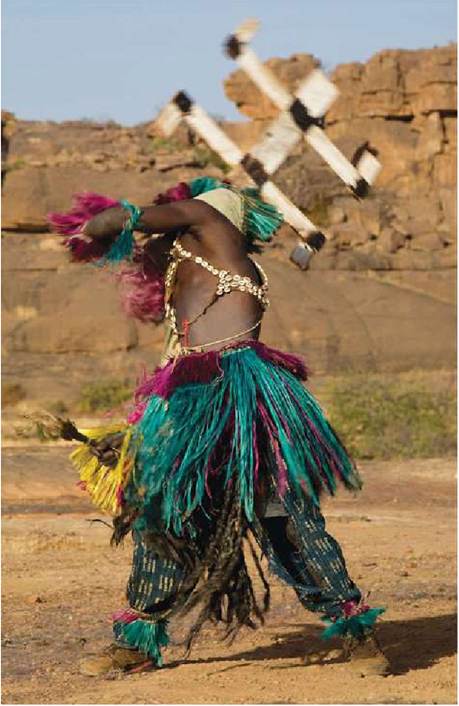
A Dogon masked dancer.
Among the Dogon, a rite of passage for young men also helps the recently deceased enter the state of being ancestors. This rite is known as the dama, and the basis for it is laid out in myths. In the dama, which happens only once every several years, masked participants dance to usher the recently deceased into the world of the spirits. The masks prepared for the dama are elaborately carved and represent animals and the mythical ancestors. The dama is also important for the living. If the dead do not enter the world of the spirits, they can cause problems for the living. Therefore, a successful dama frees the living from misfortune caused by the spirits of the dead and restores the normal balance of life and death. Today, these masked dances are used not only for ritual purposes but are also performed to entertain tourists; versions of the masks are produced for the tourist trade.
The rituals surrounding death are not always sad; they may even be joyful. Among the Yoruba, for example, if a person over forty years of age dies of natural causes, then the death is regarded as an important and happy transition to the world of the spirits and gods. This world is called orun, and the spirit of the deceased person will remain there and be called upon to assist in the affairs of her living relatives. However, if someone is under the age of forty at the time of death or dies of unnatural causes, the Yoruba consider it to be a great tragedy. Their spirits cannot enter orun but are rather doomed to wander the earth unhappily forever.