4 Hinduism
Jeffrey Brodd
California State University, Sacramento
Layne Little
University of California, Davis
Bradley Nystrom
California State University, Sacramento
Robert Platzner
California State University, Sacramento
Richard Shek
California State University, Sacramento
Erin Stiles
University of Nevada, Reno
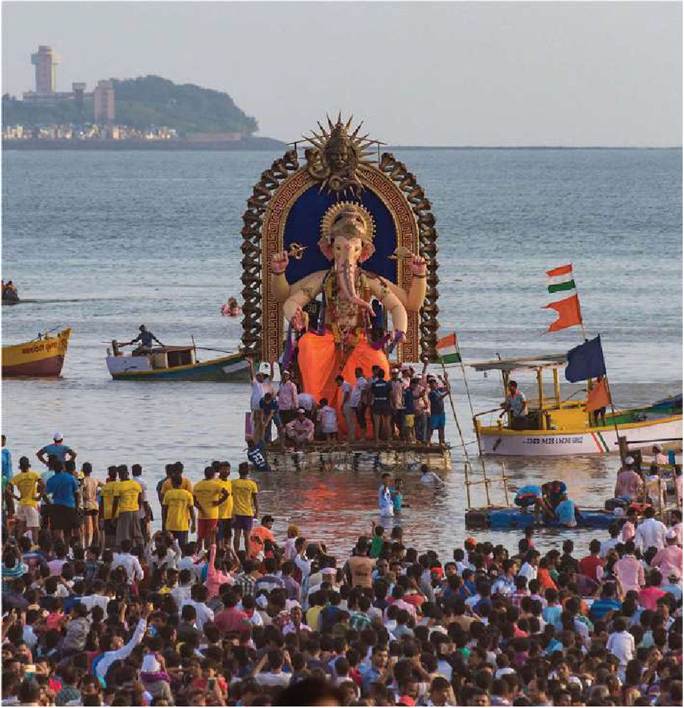
A Ganesha sculpture is about to be submerged at the seashore in Mumbai on the tenth and final day of Ganesh Chaturthi, a celebration of the elephant god’s birthday.
THE SKIES OVER MUMBAI are clearing and the sun is poking through the clouds, shedding rays of light on the throng of worshipers that crowd to behold the Lalbaugcha Raja sculpture of Ganesha, the elephant god. It is the last day of Ganesh Chaturthi, the ten-day festival celebrated across India in honor of Ganesha’s birthday. Most of those gathered had already performed puja, or worship, in their homes this morning, praying before temporarily installed clay idols of the god. There and in the presence of the Lalbaugcha Raja Ganesha sculpture and many other sculptures located around the city, all having been specially prepared for the festival, Ganesha is offered his favorite foods.
At this unique temporary shrine, an exquisite idol of the god, created by a master sculptor especially for this year’s festival, is colorfully painted and adorned with flowers. Bhajan and kirtan, sacred devotional songs, are performed in the god’s honor. The shrine is alive with the music and the vibrant colors that seem to adorn most everything, including the worshipers. The entire city of Mumbai teems with life during Ganesh Chaturthi, one of India’s most popular celebrations. Neighborhoods like Lalbaugcha sponsor their own production of Ganesha sculptures, competing with each other over the best artistic creation.
With his elephant head and human body, Ganesha is one of Hinduism’s most easily recognized deities. As the patron deity of arts and sciences and the god of wisdom, new beginnings, and commerce, he is especially venerated by students, writers, travelers, and businessmen. He is worshiped at the beginning of every new undertaking, and he is the first deity invoked in almost any Hindu ritual context. Ganesha, known as the Remover of Obstacles, is often depicted as carrying objects in his four arms (including an axe, a noose, and an elephant goad) that he uses to destroy, subdue, or control the obstacles of life. He also often holds a bowl of sweets, symbolizing his benevolent and loving nature.
Later this afternoon, at the conclusion of Ganesh Chaturthi, the shrine’s clay idol will be carried in a procession to the seashore and, to the accompaniment of music, will be submerged in the ocean where it will soon dissolve, becoming one with the natural world and thereby nourishing it. The worshipers celebrate this event, as Ganesha is believed now to return home to his parents, Shiva and Parvati, who live on Mount Kailash high in the Himalayas.
TIMELINE
Hinduism
| 2600-1700 bce | Indus Valley Civilization. |
| 2000-1300 bce | Migration into Northwest India of Indo-Aryans. |
| c. 1200 bce | Rig Veda. |
| c.1200-900 BCE | Later Vedas. |
| c. 900-200 bce | Upanishads. |
| 400 bce-400 ce | Mahabharata. |
| 200 bce-200 ce | Ramayana. |
| c. First century CE | Bhagavad Gita. |
| 100-500 CE | Expansion of Hinduism into Southeast Asia. |
| c. 320-540 | Gupta Dynasty; rise of Hindu temple culture. |
| 300-500 | Earliest Puranas; Hindu law books. |
| 700 | Flourishing of bhakti in the South. |
| 999-1226 | Mahmud of Ghazi; repeated raids of India. |
| Fifteenth century | Bhakti movement begins in northern India. |
| c. 1398-1518 | Kabir, bhakti poet. |
| 1526-1757 | Mughal rule in India. |
| 1651 | The East India Company opens first factory on the Hugli River in Bengal. |
| 1786 | Sir William Jones lectures on the common ancestry of Sanskrit and many European languages. |
| 1828 | Brahmo Samaj founded by Ram Mohan Roy. |
| 1834-1886 | Sri Ramakrishna. |
| 1869-1948 | Mohandas (Mahatma) Gandhi. |
| 1875 | Arya Samaj founded by Swami Dayananda Saraswati. |
| 1893 | Swami Vivekananda at the World Parliament of Religions, Chicago. |
| 1925 | RSS (Rashtriya Swayamsevak Sangh) founded. |
1947 India gains independence; partition with newly established nation of Pakistan.
| 1964 | VHP (Vishwa Hindu Parishad) founded. |
| 1992 | Destruction of Babri Masjid and widespread riots. |
| 2014 | BJP (Bharatiya Janata Party) wins Indian elections by a landslide. |
Click here to learn more in an interactive timeline.
Click here to compare to other Indian religions.
Unlike many other religions discussed in this book, Hinduism has neither a single founder nor a single sacred book. There is no single historical event that marks its birth. The history of Hinduism embodies both continuity and change. Having never had a sole central authority, Hinduism’s fluid character has always allowed it to adapt to a variety of social and cultural contexts. This diversity has led many scholars to argue that Hinduism is not one religion at all but a constellation of many religious sects that share some common aspects. Others see enough by way of common beliefs and practices to regard Hinduism as a single religious tradition. In this chapter, we will explore Hinduism’s variety of sects, beliefs, and practices and seek to understand what unites a tradition that is the religion of over i billion of the world’s people.