Indigenous Religions of Africa
Jeffrey Brodd
California State University, Sacramento
Layne Little
University of California, Davis
Bradley Nystrom
California State University, Sacramento
Robert Platzner
California State University, Sacramento
Richard Shek
California State University, Sacramento
Ehn Stiles
University of Nevada, Reno
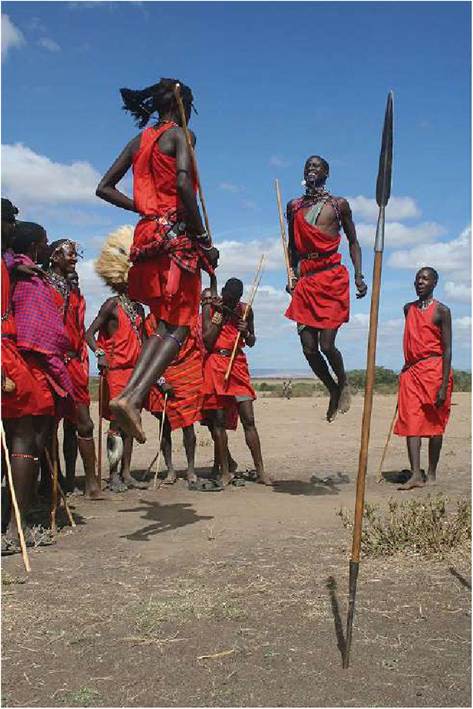
Competitive jumping can be part of the young Maasai warriors' rite of passage ceremonies.
TEPILTT OLE SAITOTI is a Maasai man from Tanzania, a country in East Africa, The Maasai are a cattle-herding people, most of whom live in Kenya and Tanzania. As a promising young student, Tepilit eventually studied in the United States and Europe. In 1988, he published his autobiography, The Worlds of a Maasai Warrior. In the book, he describes the initiation ceremony that transformed him from a young boy into a warrior.
When Maasai boys reach adolescence, they are circumcised in a public ritual to mark their transition to the status of warriors. Different ceremonies mark the transition of Maasai girls into womanhood. In the Maasai culture, warriors are known as moran. The moran are a special group of young men who have particular responsibilities. They are usually between the ages of fifteen and thirty-five and are traditionally responsible for protecting the community and for herding the cattle and other animals. Boys who become moran together form a special bond that continues throughout their lives. But first, a young man must survive his circumcision. For Tepilit, undergoing the circumcision ceremony was an intense and transformational experience:
Three days before the ceremony my head was shaved and I discarded all of my belongings such as my necklaces, garments, spear, and sword. I even had to shave my pubic hair.
Circumcision in many ways is similar to Christian baptism. You must put all the sins you have committed during childhood behind and embark as a new person with a different outlook on life.1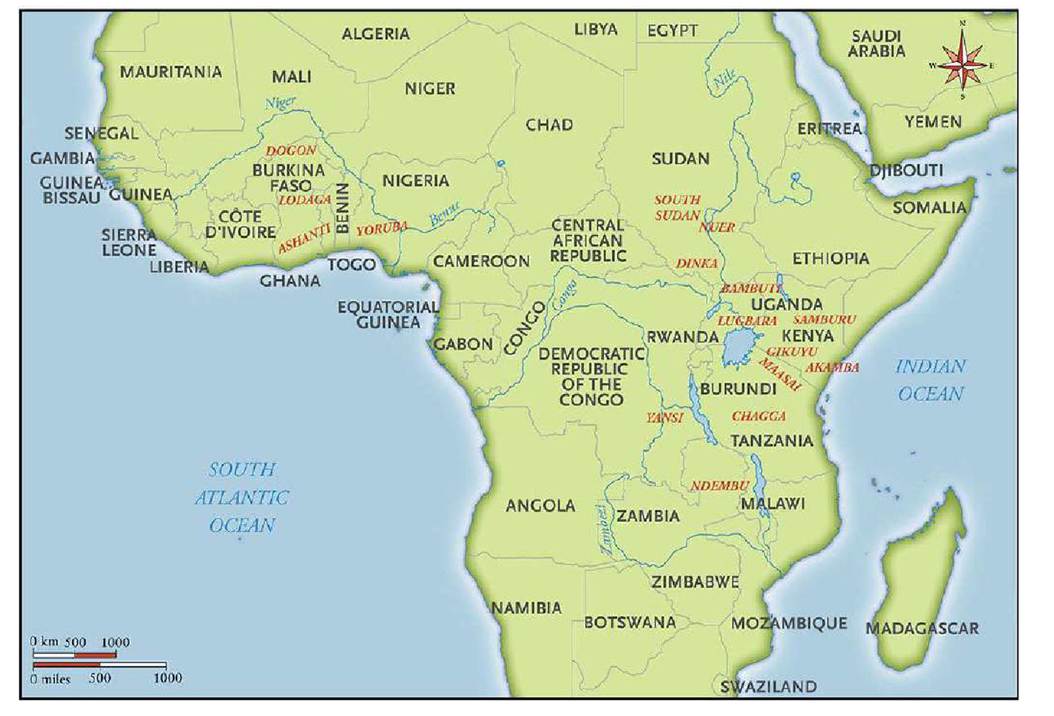
African peoples and cultures that are discussed in this chapter.
Click here to learn more in an interactive map.
Tepilit describes the apprehension he felt as the day approached. The circumcision was important not just for Tepilit but for his entire family. His father and brothers warned him that he must not cry, scream, or kick the knife away when the circumciser removed his foreskin because that would embarrass his family. It could even jeopardize his future. Bravery is highly valued in the Maasai culture, and people would lose respect for Tepilit if he showed himself to be a coward. He would never be considered for a position of leadership if he became known as a “knife-kicker.’’
The circumciser appeared, his knives at the ready. He spread my legs and said “One cut,” a pronouncement necessary to prevent an initiate from claiming that he had been taken by surprise. He splashed a white liquid, a ceremonial paint called eniuroto, across my face. Almost immediately I felt a spark of pain under my belly as the knife cut through my penis’s foreskin.-
Tepilit made it through the ceremony bravely, and his friends and family congratulated him. Two weeks later, his head was shaved again to mark his new status as a man and a warrior.
As long as I live, I will never forget the day my head was shaved and I emerged a man, a Maasai warrior. I felt a sense of control over my destiny so great that no words can accurately describe it.3
TIMELINE
Sub-Saharan African Religions
| 2000 BCE— 1500 CE | Bantu migration from West Africa to Central, East, and Southern Africa. |
| 100-600 CE | Kingdom of Axum thrives in northeast Africa. |
| 700s | Arab Muslims extend control across North Africa. |
| 1000s | Islam begins to spread throughout West Africa and coastal East Africa. |
| 600-1100 | The empire of Ghana rises. |
| 800-1400 | The rise of the great cities and empires of Mali. |
| 1000-1400s | Great Zimbabwe thrives in southern Africa. |
| 1500-1800s | Muslim Swahili city-states thrive on the East African coast. |
| 1500s-1800s | Atlantic slave trade; African religions begin to spread to the Americas. |
| 1884 | Berlin Conference; European colonial powers divide Africa. |
| 1800-1900s | European colonization and Christian missionary work in Africa. |
| 1804-1809 | Usman dan Fodio leads campaigns in northern Nigeria to rid Islamic practice of indigenous religious elements. |
| 1905 | Kinjiketele organizes Maji Maji revolt against German colonizers in Tanganyika (today’s Tanzania). |
| Early 1900s | Several new African Christian churches are founded. |
| 1920s | Josiah Oshitelu founds an independent Yoruba Christian church, known as the Aladura Church. |
| 1950s-1990s | Decolonization: sub-Saharan African countries gain independence. |
| 1962-1965 | Vatican II permits local church leaders around the world to be more accepting of local practices. |
Click here to learn more in an interactive timeline. Like the Maasai, most African cultures (and cultures everywhere) have rituals that mark the transition of young people into adulthood.
Although details of the ceremonies vary from culture to culture, they share the public recognition that a young person has entered a new phase of life. Often, this new phase of life is understood through a religious worldview. In African religions, other phases of life are also marked through specific ceremonies. For example, birth marks the journey of an individual soul from the spirit world to the human world, and death is the transition back to the spirit world.In this chapter, we will explore the indigenous, small-scale religious traditions of Africa today and in recent history. Although many Africans are Muslims and Christians, we will concern ourselves here with religions that originated in Africa. Because North Africa (Egypt, Libya, Algeria, Morocco, and Tunisia) has been predominantly Muslim for about 1,000 years, this chapter explores Africa south of the Sahara, where indigenous religions have remained more prominent until the present. This region is often referred to as “sub-Saharan Africa.”
Today, about 1 billion people live on the African continent. There are thousands of different African cultural, ethnic, and linguistic groups. This cultural diversity is reflected in the religious diversity of the continent. There is not one single “African culture” or “African religion.” Because African religions are so numerous, we will not attempt to discuss them all in this chapter. Instead, we will explore examples from a few religions that reflect African cultural and geographic diversity. And although we address them together in a single chapter, it is important to remember that not all African religions are the same. Because of this diversity, it is not easy to generalize about them in a textbook chapter.
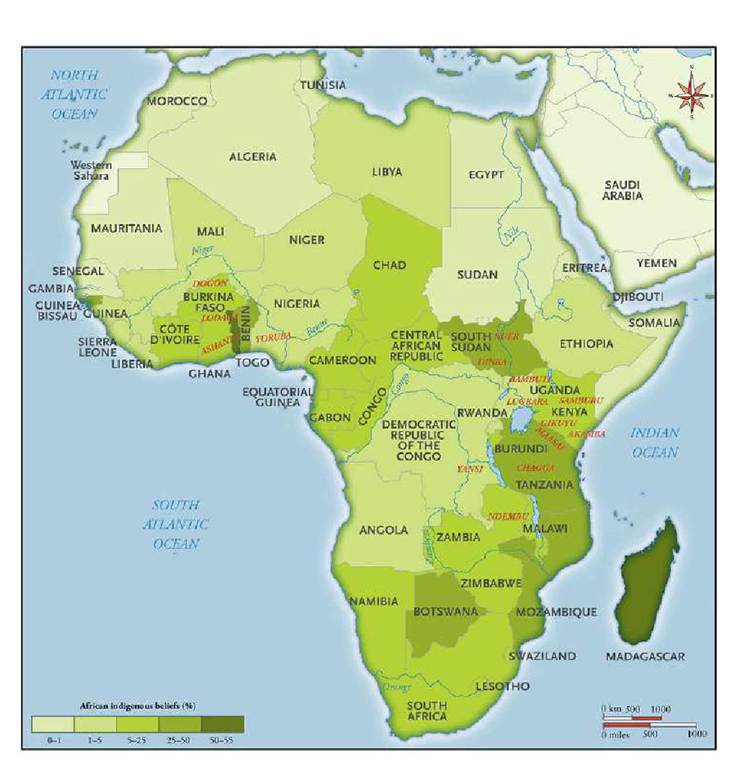
The prevalence of indigenous African religions today.
And yet, despite this diversity, it is possible to identify some common characteristics in the realms of practice, teaching and beliefs, and historical development. The story of Tepilit’s initiation explores one of these characteristics: many African religions have specific ceremonies that mark the transition from one social state of being to another.
Many African religions also share some elements of belief and worldview. For example, many share the belief in a supreme deity, or creator god. Also, many African religions are primarily concerned with life in the here and now, rather than with what comes after death.African religions also share a great deal in terms of historical development. Most African religions originated in small-scale communities and thus maybe connected intimately with a particular culture in a particular place. And although some followers of African religions live in small-scale societies today, many more have been incorporated into large political systems and market economies in the modem, global era. Furthermore, in the nineteenth and twentieth centuries, African religions faced the reality of widespread European colonialism on the continent. In addition, the influence of African religions has spread far beyond their places of origin. This was primarily a result of the Atlantic slave trade, which lasted from the 1500s to the 1800s. As we will learn in this chapter, certain religions of the Americas, such as Vodou and Santeria, were derived from and share a great deal with African religions.