Italy, 1920s-1930s: Pettazzoni's two-fold gamble
Despite Pettazzoni's efforts, Schmidt's legacy was not the only tough nut to crack. Any institutional proposal for the reorganization of the discipline had to mediate between phenomenological approaches based on ahistorical uniformity, historiographical approaches based on differential analysis, philological thoroughness in the study of each religion, and the Kulturkreiselehre’s historical continuity between ethnology and history.
A successful mediation, according to Pettazzoni, could ‘resolve' - or ‘reduce', as stated in a personal note from 1920 - all the previous ‘science of religions' to ‘history of religions' (from Gandini 1998: 131; see Pettazzoni 1924: 10; cf. Spineto 2012: 98-9). Pettazzoni's proposal took the name of historicism, a bridging branch methodologically engineered to appeal to all those different branches, comparative and functionalist, dedicated to the discovery of the existential sense of religion(s) in a psychological framework to study human beliefs and desires (Spineto 2010: 1273; Figure 11).In order to achieve this extremely ambitious goal while appeasing and, at the same time, keeping at bay the more unscientific or anti-scientific branches of the field (e.g. like those inspired by Creuzer's meta-historical symbolism and Schmidt's theological approach), Pettazzoni disregarded the Victorian science of religion and resorted to Vico's ‘poetical metaphysics' as a sort of unifying psychological framework and ultimate explanation for the birth of religious ideas, specifically referring to Vico's anthropomorphism (‘corporeal imagination'), according to which ‘the more violent weather-phenomena suggested the first notion of divinity' (Pettazzoni 1956b: 22; see Spineto 2012: 97). And yet, as we have already seen, Vico's primordial history rested on
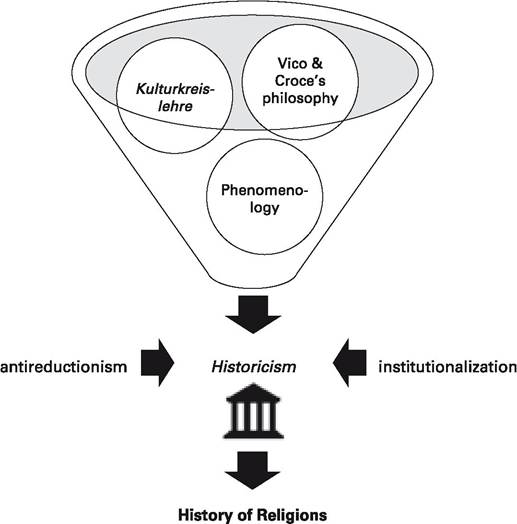
Figure 11 Pettazzoni's history of religions: original features, influences, and main themes
a Providential development of humankind which incredibly sabotaged Pettazzoni's own solution by resorting to the very same supernatural a priori adopted by Schmidt - i.e.
God (see Chapter 2, ^Rationality as cumulative by-product of comparison). Another ambiguous statement maintained a distinction between ‘true stories' and ‘false stories', with ‘myth [as] true history because it is sacred history', whose ‘origin' is not logical or historical, but magical and religious at once (Pettazzoni 1954a: 15-16). Being an ‘absolute truth because a truth of faith', myth is believed by the members of the community ‘because it is the charter of the tribe's life' (Pettazzoni 1954a: 21). However, this sociological perspective is merely hinted at (for the autonomy of the HoR prevented any in-depth extra-disciplinary analysis), and a socio-cultural evolutionary perspective on the degradation of myth from truth to falseness adds to the confusion if we really take out ‘logic' and ‘history' as explanans (see Pettazzoni 1954a: 22-3). Such a tautological statement appears as another concession to those unscientific and theologically oriented branches, and its vagueness engineered to provide all the different areas involved academically in the study of religion with a common ground - most of all, as we will see shortly, phenomenology (on Pettazzoni's ‘contradictions' and Vico's influence see di Nola 1977a: 292). Since its very beginning, historicism was a two-fold political and disciplinary gamble because the discipline itself was still a faceless neverdiscipline without epistemological identity. Would this gamble pay off in the end? To understand the odds, we have to delve a bit deeper into the political history of the Italian academic study of religion.Preceding by 4 years the Dutch Higher Education Act, the Italian Parliament officially abolished theology chairs in 1873 (Jordan and Labanca 1909: 156). Following the gradual process of annexation of the State of the Church by the Kingdom of Sardinia (soon to be upgraded to Kingdom of Italy) between 1860 and 1870, three concomitant factors contributed to the gradual extinction of theology from university curricula (cf.
di Nola 1977a: 292; Prandi 2011: 65-7; Spineto 2012: 9-10):1. the vanishing numbers of students enrolled in theological faculties from 1859 onwards;
2. the Catholic intellectual opposition to the new Italian state and its cultural reorganization, sanctioned by Vatican political activity in particular between 1868 and 1874, with the official prohibition for Italian Catholics to engage in political activity at a national level;
3. the general indifference towards theological matters as a long-term consequence of the Counter-Reformation top-down control of religious education.
However, due to a compromised implementation in the first place caused by the continuous interference of the theocratic Vatican enclave, in less than 20 years, ‘partly to avoid troubles that might arise from the group of fanatical Catholics, partly to gratify some of the liberal Catholics, and partly for yet other reasons which have to do with finance, the Government [...] allowed University instruction in religion to lapse and [...] proceeded to wash its hands of the whole matter' (Jordan and Labanca 1909: 185). A faulty distinction between professional and confessional theology and its impact on the academic teaching of religion(s), the persisting focus on Christianity in spite of the institutional advocacy for the establishment of a comparative discipline, the debated presence of Catholic priests and scholars as teachers in such a politically heated context, and other socio-political considerations that could not be severed from the very presence of the Vatican state and its influence (e.g. how should ‘religion' itself and its study be operationalized in such a new national context?), all these problems contributed to hinder any proposal and prevent any major steps forward towards the establishment of the academic and comparative study of religions (Jordan and Labanca 1909: 287-8; Spineto 2012: 8, 13-14).
At last, after ‘a much prolonged apathy', something started slowly to change (Pettazzoni 1912a: 110; in Gandini 1994: 232).
Uberto Pestalozza (1872-1966) became lecturer at the University of Milan in 1911, where he led an interdisciplinary team whose aim was the allegedly pre-Indo-European religious substrate and the reconstruction of a primordial, pre-Neolithic Indo-Mediterranean Great Goddess under racial assumptions and sexist wishful thinking (Di Donato 2015; cf. Casadio 1993, and Carozzi 1994). Although Pestalozza became full professor in 1939 at the same University, Pettazzoni preceded him by being appointed as the first Italian tenured professor in the History of Religions in 1923, just one year after the fascist coup, at the University of Rome, where he previously served as lecturer in 1913-1914 (Gandini 2005; Spineto 2010: 1272-3). Despite ‘Pettazzoni's reputation as an antifascist’, political involvement and compromise in the form of ‘consent and opportunism’ drove Pettazzoni’s academic career under the fascist regime (Junginger 2008: 62-3), in a mutually ‘fruitful working relationship’ where the regime extended his academic legitimacy and Pettazzoni, publicly subservient to fascist policies and eager to recognize the institutional role of the new HoR as auxiliary to state and colonial policy, obtained funds and honours (Stausberg 2008: 375, 381-8; cf. Gandini 2001a: 40, 131).22Upon his appointment, Pettazzoni immediately started working on a virtual common ground for a new international HoR (hence the confrontation with Schmidt’s works) while struggling with a complicated national context. As summarized by Marcello Massenzio, the Italian branch of the discipline was ‘the product of a subtle intellectual ability to correlate two apparently irreconcilable schools of thought’, that is, ‘religious phenomenology’ and neo-idealism, in particular that of Benedetto Croce (1866-1952), a most influential anti-positivistic yet agnostic philosopher, conservative yet (mostly) anti-fascist, literary critic, and politician who was a firm critic of both the comparative method and the autonomy of religion as a subject (Massenzio 2005: 213).
Religion, according to Croce’s view, should have been included in a unique, historically grounded, neo-Hegelian philosophy: ‘religious history resolves itself, firstly, into the history of ideas [ storia delpensiero], that is, of philosophy’ (Croce 1947: 227; cf. Spineto 2012: 102-3). Another neo-idealist philosopher, Adolfo Omodeo (1889-1946), stated that ‘the comparative method is the absolute contradiction of history’, which is based upon absolute individuality of human beings and facts (Omodeo 1929: 85; from Spineto 2012: 103). Before such mighty institutional opposition, Pettazzoni entertained a double or nothing gamble, compromising all the way down to the very label of his HoR, for historicism - quite confusingly - was also the label used by Croce himself, a label which, interestingly enough, was already designed as a complicated, conservative and moderate middle ground between philosophical, social, moral and political opposites (Roberts 1987: 3, 145). On the other hand, Pettazzoni was to enjoy the institutional support of another neo-idealistic philosopher and Croce’s frenemy, fascist Minister of Public Education Giovanni Gentile (1875-1944), who issued a competition for the new Roman chair of History of Religions aimed at Pettazzoni less than two months after he was appointed in October 1922 (Gandini 1998: 163-6; Stausberg 2008: 367-70).23Woefully for the field, and for Italian culture in general, science had been long depreciated and obliterated by neo-idealism, with Croce deriding it as a collection of ‘pseudo-concepts’, i.e. hypothetical abstractions useful for practical purposes but historically and philosophically useless - such, for instance, was the comparative method for Croce (Collingwood 1946: 198; cf. also Ambasciano 2013: 157-8). Therefore, conceptually embedded within a neo-idealist culture, and deprived of scientific references (apart from some psychology which he never seemed to have fully mastered; see Spineto 2012: 105), Pettazzoni nevertheless needed something more to justify and ground methodologically the reference to the existential and experiential dimensions of religion, which the Italian scholar, ‘in the wake of Vico, conceived as the product of human “fantasy” ’ (Filoramo and Prandi 1997: 76).
From the 1930s onwards, this psychological ‘something’ (or ‘psychologism’) was to be found in van der Leeuw’s Religion in Essence and Manifestation, hailed as a ‘classification of religious phenomena by structures and types; yet, this typology is not purely descriptive and empirical, but rather, and conditioned by, the psychological comprehension of religious phenomena' (Pettazzoni 1933: 243). Notwithstanding the many criticisms Pettazzoni reserved for van der Leeuw's ahistorical, theological and ‘static phenomenology', to which he added a complementary ‘dynamic phenomenology' (that is, historically oriented and focused on the internal development of each single religious tradition), the final judgement is more than positive, for now Pettazzoni has found a ‘precious working tool for any scholar of the religious sciences, no matter their orientation' (Pettazzoni 1933: 243). Van der Leeuw reciprocated by stating that Pettazzoni was ‘one of the most outstanding scholars of religion today' (van der Leeuw 1933: 478; from Gandini 2001a: 157).
More on the topic Italy, 1920s-1930s: Pettazzoni's two-fold gamble:
- The Cognitive (R)evolution: The End?
- AMBIGUOUS STATEMENTS
- Viewpoints of analysis on the International Order of Asia in the 1930s