A MULTITUDE OF ARCHAEOLOGICAL MATERIALS
My first more serious contact with any archaeological material was rock art, which I experienced as very multiplex: abundant and present in different topographies and settings, with varied forms or styles, format, and so on.
Aside from that, different states of physical preservation also posed a problem (Nordbladh 1980a).Gradually I understood that there were plenty of other archaeological materials which could be connected to, or contrasted with, the petroglyphs. An outstanding category was provided by objects cast in shining bronze, most of them belonging to a sphere closely related to the human body, such as ornaments and weapons, but also to horses. Thanks to the surviving bronze metal, today we are able to see that with the Bronze Age there seems to have been an appreciation of new sounds in the form of the clatter of thin bronze plates attached to riding and draught animals, to musical instruments, and even on costumes. As these objects were often found in graves and bogs, they were well preserved and may have become the most sought-after antiquities on the market for nineteenthcentury collectors. As it was the very objects which were in focus, the circumstances of the discovery were usually neglected; subsequent efforts at contextual interpretation were difficult or impossible.
A special group of objects consists of small miniatures of humans, animals and vehicles, which might have been used in some kind of drama, where grouping, movement and timing could have been played out to illustrate and explain events or predict future situations. This miniature world may have created an occasional theatre for small groups of people (see Fig. 3.1).
Large mobile constructions such as boats, ships and wagons could have stressed speed, range and carrying capacities, which could be part of planning work, communication preferences and mythical narratives. Such myths are not necessarily part of a religious sphere, but may have integrated references to many practices and beliefs.
In the past twenty years, our knowledge of the archaeological remains of houses and farm constructions has expanded significantly. These once large and impressive buildings can be used for an understanding of how landscapes were created and maintained, and human life organized. Stone architecture seems to have been reserved for burials.
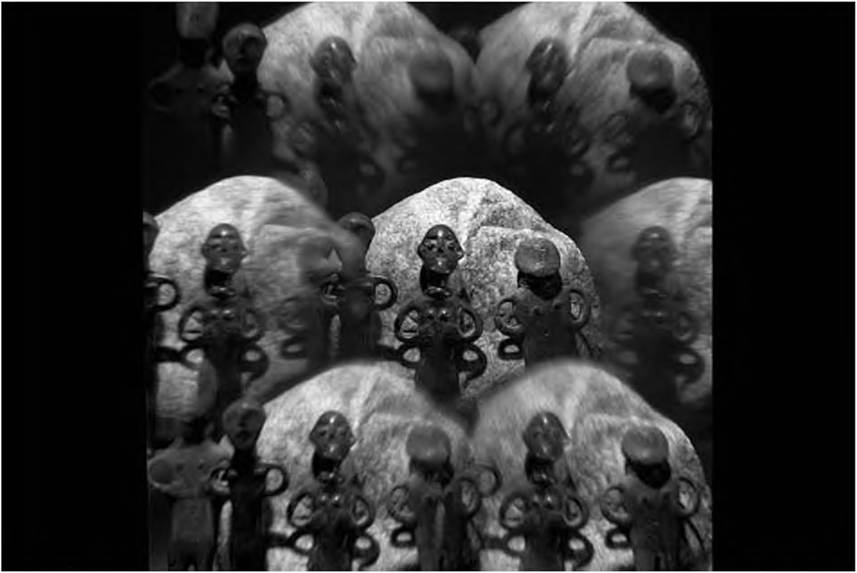
Figure 3.1 Museum arrangement of idols from the late Swedish Bronze Age (700-500 BCE), illustrating possible scenic and theatre-like manipulations for social purposes (Knape 1996: cover). The Museum of National Antiquities, Stockholm. Photo: Christer Ahlin 1996. © Christer Ahlin/Statens historiska museum, reproduced with permission.
Exacting technologies were necessary for the advanced handling of textiles, gold, bronze and iron, and possibly these works were surrounded by secrets, rules, security and protection. It should be mentioned that bronze objects were more numerous in the Bronze Age than the preserved archaeological finds might lead us to expect. Many objects were - perhaps for reasons other than wear and damage - melted down and given new forms and functions. Also too few of the tools have been preserved for archaeological analysis, probably melted down as scrapmetal. Casting bronze is dangerous work, involving high temperatures and poisonous fumes, so to protect bronze-smiths there may have been rituals to prevent injury and sickness.
From the enumeration of phenomena above, it is quite obvious that there is a multitude of archaeological remains to be used for further interpretation. Rock art is hardly the only way to reflect on phenomena which could have a bearing for the history of religion.