New Directions
Production
In review, the major interpretive models highlight the “household” context of figurine rituals, either by discussing figurines in domestic contexts or by associating the breasts of the figurines with females and activities in the home.
Few studies focus on the production processes that generated JPFs and the fact that figurines were probably produced by a local ceramic industry. The very fact that figurines were fired in kilns and had a relatively standardized design shows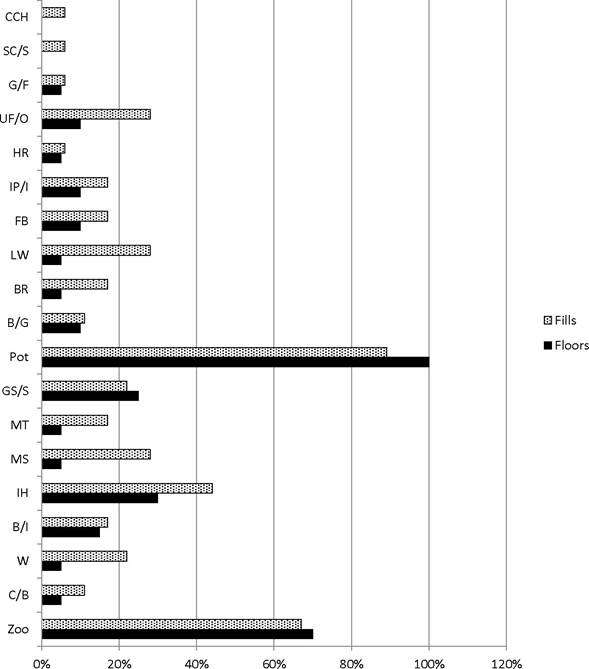
Figure 4. Percentages of Loci Containing Both JPF Fragments and Other Objects in Area E South, West, and North in Strata 12-10
Key to figure 4: Zo: zoomorphic figurines, C/B: couch/bed fragments, W weights, B/I: bone/ivory, IH: inscribed handles, MS: mollusks, F: faience, MT: metal, GS: ground stones, Pt: pottery (S: some, m: minimal, M: much), B/G: beads/gems, LW: loom weights, BR: botanical remains, FB: fish bones, IP/I: inscribed pottery/inscriptions, HR: human remains, UF/O: unidentified fragments/ other fragments, GL: glass, S/SC: imported stamp handles/scarabs and seals, CCH: concentric circle handles
that they were not made on an ad hoc basis by women or by families for their own personal use, as has sometimes been claimed (McCowan 1947, 248; Keel and Uehlinger 1998, 325; Bloch-Smith 1992, 78; Hadley 2000, 197; Schmitt 2012, 93). In contrast, figurines were probably created by potters or ceramics specialists who had access to the necessary equipment, and they were subsequently procured for domestic use. Unfortunately, interpreters have largely ignored the implications of large-scale manufacture when reconstructing the role of JPFs in Israelite religion (with the exception of Kletter 1996, 81 and Byrne 2004, 37-51).
In particular, petrographic testing can provide valuable information about provenience and production processes, as a recent petrographic study performed by this author and David ben Shlomo makes clear.
The study includes 120 items with 66 fragments from Shiloh's City of David excavations, 45 from Eilat Mazar's City of David excavations, and 9 from Nurit Feig's Mevesseret excavations, a site nearby Jerusalem. All figurine types are represented including pinched heads, molded heads, various body fragments, base fragments, and zoomorphic fragments. Consideration is given to the samples' loci and area distributions throughout the City of David with the intent of comparing areas of excavation. The study only includes figurines from datable loci, and samples cover the stratigraphic sequence established for Shiloh's excavations. Finally, a small control group of pottery from all three sites is included to compare with the figurine finds (Darby 2014, 183-212; Ben-Shlomo and Darby 2014).According to the findings, the majority of the figurines are made of local rendzina soils (67-68 figurine samples) from the vicinity of the City of David, the Kidron Valley, the western slope of Mount Zion, or other places in the area of Jerusalem to the east. The study found that terra rossa (Group 3), also the most common material used for pottery vessels sampled, is second in frequency (21 figurine samples). It probably comes from soils of the Judean hills in the vicinity of Jerusalem, primarily from the west side. Eight more of the figurines are made of dolomitic moza marl clay from the Judean hills (Group 2). Finally, only 5 figurine fragments seem to come from outside the region of Jerusalem or the central hills, and these are limited to figurines made of loess-type clay originating in the coastal plains of the Shephelah (Group 5).
The provenience data can be used to address the local nature of figurine production, the distribution of figurines in surrounding areas, and figurine trade across Judah at large. First, the data further confirm that figurines were locally produced within each major city center. In past studies, this interpretation was based on petrography at Tel ‘Ira, where figurines made of local Negev loess soil were found alongside pithoi made from moza clay (Kletter 1999a, 384; 1999b, 354-55; Finkelstein and Beith-Arieh 1999, 87).
More recently, the petrographic study of the figurines from Moza, a site close to Jerusalem, includes 18 figurines primarily consisting of Moza ware (50 percent), with only 5 fragments of terra rossa (28 percent), 2 of moza marl clay mixed with terra rossa clay, and 2 unidentified and probably imported fragments. Though, the study has a few drawbacks, including its small sample size (only 18 out of 60 fragments were tested), it is worth noting that more moza marl figurines (9) occur in this small sample than in the entire corpus of figurines tested from the City of David and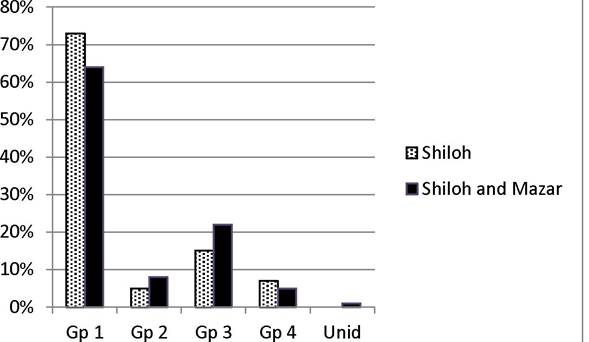
Figure 5. Percentages of petrographic groups in Shiloh's City of David excavations and in Shiloh's and Mazar's City of David excavations combined.
Mevesseret combined (8 of 104 fragments), suggesting that local clays do figure in local figurine production (Peterson-Solimany and Kletter 2009, 116).
Second, examination of the 60 figurine samples from Shiloh’s City of David excavations support the notion of a Jerusalem production center (fig. 5), with 73 percent (44) from Jerusalem rendzina clays, 5 percent (3) from moza marl clays, 15 percent (9) from terra rossa clays, and 7 percent (4) from loess clays. Even when the figurines from Eilat Mazar’s recent excavations of the same area are included to create a larger sample, the relative percentages remain consistent. Given the proximity of the Kidron Valley as a source of rendzina clay to the City of David, the “locality” of production cannot be doubted.
Third, Raz Kletter has already claimed that Judean style figurines were not exchanged in any significant quantity with neighboring peoples (Kletter 1996, 43-46; 1999c, 28-32). The petrographic information adds to this fact that figurines were apparently not even exchanged from one part of Judah to the other. The three highest percentages in Jerusalem, rendzina clays, terra rossa clays, and moza marl clays, are from the immediate vicinity of the city and the nearby hills with almost no figurines from other regions of Judah, such as the Shephelah, Coastal Plain, or Negev.
In the very least, it seems figurines were not regularly imported into Jerusalem from other parts of Judah; and the evidence from sites like Tel ‘Ira suggests Jerusalem did not export figurines outside the Judean hills. This should be contrasted with pottery vessels, which were regularly distributed from Jerusalem (De Groot and Bernick-Greenberg 2012, 100).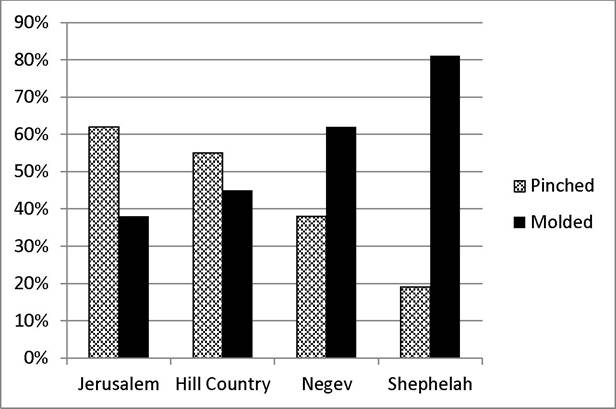
Figure 6. Pinched and molded heads by region in Judah.
Change and Regionality
Despite this evidence for local preferences in figurine production, figurine studies typically interpret all objects with a similar appearance as if they meant the same thing or functioned in the same way, regardless of the length of time the objects were used or the variety of regions that adopted the basic iconographic form. This bias may be a side effect of iconological approaches that disregard archaeological context either at the site or regional level, or it may be the result of approaches to women's religion that commonly assume family religion remained the same over long stretches of time and space. When explicitly stated, one often hears that ancient Mediterranean or Near Eastern religions, especially family religions, were conservative by nature or even change-adverse (e.g., van der Toorn 1996, 4-6).
It is also possible that little variety is found because few are looking for it or looking in the right places to find it. To take JPFs as an example, petrographic data of the production industry in Jerusalem, in comparison with similar studies at other sites, suggests the presence of regional variation. Figurines were not traded from one region of Judah to another, and they were probably only rarely traded from one settlement to another. The clays used are highly local, suggesting longstanding local traditions. Moreover, the iconographic preference for pinched versus molded heads in Jerusalem and the surrounding hills is exactly opposite that in other regions of Judah, also arguing for a regionally specific set of ritual expectations, rather than a simplistic national ritual homogeneity (fig.
6).These results are not unexpected. Even Phoenician figurines were not traded throughout the Mediterranean, though there are iconographic similarities connecting locations along known trade routes (Gubel 1991, 132-36; Markoe 2000, 158-59). The fact that figurines were not traded, as such, is also attested by Neo-Assyrian imperial trade practices, which focused on the movement of elite goods like semiprecious stone, fine wood, metal, and linens (Van de Mieroop 1987; Elat 1991, 23-29; Moorey 1994). This means that while iconographic styles did spread, there were also very strong local traditions that must have affected any adaption of new style, and these might be visible in clay preference, small iconographic adaptation, or ritual implementation. In point of fact, the spread of figurine styles from one region to another belies a complex and dynamic process of interchange in local adoptions of religio-visual cultures and ritual technologies. At the same time, each location partook in a larger regional character that certainly produced an identifiable style group demarcating JPFs from other female figurines of the surrounding polities in the coterminous periods (cf. Kletter 1996; Daviau 2001; Karagoerghis 1991; Waraksa 2009; Pruß 2010; Press 2012).
All of this betrays something of the complicated, flexible, and multilayered nature of ancient religious interactions. Judean pillar figurines, the iconic object of “household” religion, clearly interacted with many levels of society, including the individual houses and neighborhoods where they were used, stored, or discarded, the city's ceramic markets where they were procured, the city's workshops where they were made, the region's artisan cultures that influenced regional patterns in iconographic variation, and the polity that provided infrastructure for figurine production and national identity. While we cannot use the figurines to surmise what ancient women or men thought about them, we can conclude that the figurines are not evidence for a discrete and separate household sphere, but one which interacted in complex ways with all levels of religious experience.