New generations, poststructuralism and Religious Studies
The previous list of scholars is woefully incomplete and could be obviously expanded and perfected. My only aim, however, is to highlight as succinctly as possible the fact that many young historians of religions, during the decades of Eliade's professorship at the University of Chicago, tried hard to update the field according to epistemically warranted perspectives, providing renewed paradigms for their subjects of study.
Moreover, while anthropologists, sociologists, and other historians had already criticized Eliade's approach, some of the most constructive critiques came from the inside of what could be called the Eliadean Chicago school of HoR ( contra Wedemeyer 2010). Confused by the ideological and apodictic methodology of the HoR, and variously troubled by Eliade's past and academic legacy (hence the focus on critical attention and ideological roots), second- and third-generation historians from this school ignited the revolution HoR needed to reform itself (see Table 3; please note that the table is not exhaustive and does not reflect all the areas of research in which the mentioned scholars were involved within the chosen timeframe).Indeed, as Lincoln argued, a significant part of classical HoR could be understood as a way to engender and/or support a politics of nostalgia by providing prestigious, rhetorical storytelling to reactionary, and sometimes extremist and racist, political discourses, emically endorsing the dynamics of social power implied in the study of ancient documents. As historians Jeppe S. Jensen and Armin W. Geertz have remarked in 1991,
some historians of religion have advocated a personal and existentially relevant attitude to the world's religious traditions. Foremost among these is Mircea Eliade who presented modern man's estrangement from tradition as fundamentally detrimental to individual and social balance, hence the politics of nostalgia which seeks, on the basis of a universalist interpretation of religions, to restore Man as a complete and inherently spiritual being.
Jensen and Geertz 1991: 13; from McCutcheon 1997: 32
And yet, all those Chicago scholars were still trained to be historians of religions, thus most of them were unwilling to renounce completely the HoR research programme: if what they did was a deconstruction, the final goal was the reconstruction of the field. But was a reconstruction possible at all after such annihilation of the previous paradigm? Once the power dynamics in the form of ideological biases and preconceived ideas underlying the classical HoR had been revealed, was going back to that field really an option?
Starting from the late 1980s to early 1990s, a new generation of scholars well-read in these critical works, and ready to rescind the umbilical cord that still connected the previous Chicago scholars from the morphological and phenomenological HoR, migrated, so to say, to the field of RS, a vast network of interrelated approaches informed
Table 3 Falsification of the Eliadean Research Programme: Reaction from within the Chicago School
| Chicago scholars, ca. 1960s- | 1990s | |||
| Disciplinary tenets questioned or falsified | Gross Pernet | Ricketts Culianu | Smith | Lincoln |
| Sexism, androcentrism | ü | ü | ||
| Epistemology | ü | |||
| Undisputed sacred ontology | ü | ü | ||
| Morphology (classification) | ü | ü | ||
| Power, politics, ideology | (ü) | ü | ü | |
by poststructuralism.
While in some cases the aforementioned Chicago scholars were merely acquainted with this philosophy, RS scholars adopted it as their user manual to approach religion. Poststructuralism is a loose label which gathers together a vast array of critical approaches and discourses born as a reaction against the previous attempts to study human cultures as epiphenomena of rigorous underlying linguistic, social, economic, psychological and anthropological structures. A poststructuralist approach ideally entails the use of some of the following tools (Figure 14):1. linguistic turn: language is an imprecise and unreliable instrument to describe ontological reality;
2. crisis of representation: the author is an entity not entirely consistent nor coherent;
3. decentring of the subject: everything can be analysed as a textual item;
4. critique of essentialism (not to be confused with cognitive essentialism): ultimate values, whatever they might be, are questionable;
5. cultural turn: a focus on subordinate groups or subaltern social classes and their cultural representations, and a move away from dominant narratives;
6. social constructionism (not to be confused with social constructivism): reality is what culture makes of it (Angermuller 2015: 15; cf. Jameson 1998, and Sokal 2010:94-5).
As far as the HoR was concerned, the knot made up by the entangled strands of disciplinary method and theory and Eliade's persona was to be cut with a poststructuralist axe, dispensing once and for all with the heavy baggage of the discipline. However, the usefulness of the term ‘poststructuralism has been disputed mainly for two reasons. First, poststructuralism is a North American conventional label used to group together many different and cross-disciplinary European trends, in particular from France
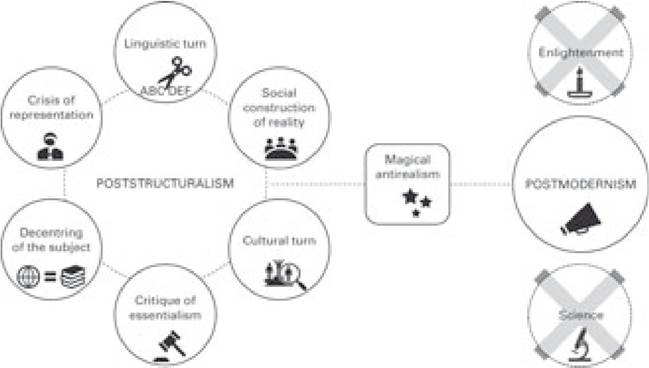
Figure 14 Poststructuralism and postmodernism: a tentative chart
(Angermuller 2015: 16).
In the Anglo-American debate, poststructuralism is sometimes understood in close connection with “postmodernism” and seen as an antipodal project to modernity' (Angermuller 2015: 18). When French philosopher Jacques Derrida (born Jackie Elie; 1930-2004) commented on the US appropriation and reelaboration of the postmodern turn and the proliferation of cultural studies, he acknowledged them as being somewhat radically different from their European roots (Creech, Kamuf and Todd 1985: 2, 4, 29). Therefore, differentiating between poststructuralism and postmodernism might be a useful historical strategy to tackle this argument. Second, many allegedly ‘poststructural' scholars saw themselves as successors and heirs, even if critical, of the allegedly ‘structural' predecessors (cf. Wolfart 2000). Just like most Chicago scholars that we have seen did not sever their ties with the old HoR, poststructuralists recovered, updated and expanded some previous trends from the social sciences, especially those focused on the social ways in which social dynamics produce knowledge (e.g. Marx and Engels' historical materialism, Weber's sociology, Durkheim's institutionalization processes, etc.). In so doing, as Johannes Angermuller has pointed out, poststructuralistshave problematized older philosophical traditions conceptualizing knowledge as a set of pure ideas, abstract concepts and universal truths. If knowledge is constructed by the community which recognizes certain ideas as relevant, legitimate and true, theory too, is involved in social struggles over what counts as legitimate knowledge in which the participants mobilize their non-theoretical resources, such as time, relationships or money.
Angermuller 2015: 84
But what happens when such legitimate critical tools are really applied with the intention of deconstructing the whole modernity package and implement an ‘antipodal project to modernity'? It is not difficult to see how, in the wrong hands, the poststructural set of tools, most of them originally conceived of as instruments of literary and semiotic analysis, might be carelessly used to promote a pseudoscientific stance of rebellion against the academy itself. For instance, the cultural turn is a milestone in contemporary academia: new inter-disciplinary trends like postcolonial studies or gender studies assumed a much-needed critical, if not vitriolic, stance against the cultural hegemony which implied, consciously or unconsciously, the survival of various degrees of topdown political domination and androcentric paternalism. However, when the cultural turn was mixed with social constructionism, forgetting the original literary context of analysis and resulting in the unbridled criticism of scientific research, or the Enlightement tout court, the result put to sleep modern reason. Paraphrasing Goya, it has produced monsters. And postmodernism as well.