Not far into the first volume of Edward Freeman's A History of Sicily, published between 1891 and 1894, there is a section entitled “Sikel sites,” which refers to the sites of an ancient indigenous population recorded by Thucydides.
A few paragraphs in, it becomes apparent that the focus of the section is not on “sites” at all, but rather is on ancient indigenous Sicilian religion. The section poses a series of questions about the extent to which native religious belief and worship changed after the beginning of Greek colonization.
Yet the responses to those questions are surprisingly ambivalent, given that Freeman was very much the Hellenist, one who compared the history of Sicily to that of America, a land that never possessed “strictly a native greatness” and that “became great by colonization from other lands” (1891-1894, 1:6). Freeman asserts, for example, that while the Sikel may have “adopted, if not the religion, yet the mythology of the Greek,” it was also the Greek who “learned to worship the gods of the Sikel, to adopt them into his own mythology, and to turn the legends of Greece into new shapes which better fitted [the] new homes on Sicilian soil” (Freeman 1891, 1:134). Later on, the ethnic or cultural origins of certain gods such as Demeter and Kore are interpreted as equally indiscernible: “One can hardly say,” he states, “whether it was the Greek that led captive the Sikel or the Sikel that led captive the Greek, when the gods of Sikel worship were so thoroughly sunk in those of Greece” (1:170). Perhaps most interesting of all are Freeman's conclusions about the endurance of various native religious traditions: some, like the worship of Hybla “run a course” (1:162) of their own, independent of Greek influence. Others were syncretized with Greek deities and Greek belief, “fusing together... the religious life of the Greek and the Sikel” (1:154). Still others, like the Palici, were readily adopted by the Greeks, but remained for time immemorial a vanguard of native worship.Situated against the backdrop of historiography on ancient Greek colonization, it is evident that Freeman, a British historian and politician who also wrote a history of England, was not the only scholar of his time uncertain of how to represent religion and religious development in ancient colonial Sicily.
Adolf Holm, a German ancient historian appointed as chair of the University of Palermo in the 1870s, stated outright that he believed the Sikels worshiped Demeter prior to the Greeks, and that this explained why the goddess had been so widely revered across the island (1870-1898, 1:77-78). Later, the Italian scholar Biagio Pace, though heavily influenced by fascism, advocated a view of Sicilian religion in which early similarities between colonial and native religious systems had led to “an almost complete fusion” (1935-1946, 1:ix) of the two.The list could go on, but these three examples illustrate the point adequately: in studies of ancient colonial Sicily, religion was repeatedly represented as an aspect of native culture that did not, or was at least slow to, “hellenize.” Indeed, more often than not, religion has been construed as the space where natives exerted substantial influence on Greek colonial culture. Such views diverge from what has commonly been understood as the “traditional” model of ancient colonization used in eighteenth, nineteenth, and early twentieth-century scholarship; that is, of “hellenization” as an acculturative process that took place after colonization and that stipulated the adoption of Greek culture by non-Greeks—including, among other things, the Greek language, food and drinking customs, visual and/or material culture, and religion (e.g., Boardman 1999; Morel 1984).
Hellenization first appeared in studies of Greek history in the early 1800s and, as has been widely noted in recent years, was discursively shaped by the experiences of European colonialism (De Angelis 1998; Dietler 2005, 56; Ne- nci 1983; van Dommelen 1998). As such, the variant treatment of religion in typical hellenization narratives—as an aspect of culture that was more resistant to change, that remained a bastion of indigenous tradition in the face of Greek culture, and that fostered the active roles of indigenous groups in the creation of Greek colonial culture—appears to find more in common with some of the points made by postcolonialist scholarship of the last thirty years than one might expect (cf. Albanese Procelli 2006; Antonaccio 2003, 60-61; Hodos 2006).
The rationale for emphasizing the “resistant” aspects of ancient indigenous religion, however, has been very different for those two bodies of scholarship. Earlier scholars approached the material from the perspective of understanding religion as something that was intrinsically conservative, slow to change and culturally exclusive, following in many respects contemporary perceptions of “primitive religion” as well as the overtures of devout antiquarians trying to align pagan antiquity with the ideological principles of Hellenist Europe. Contemporary scholars influenced by postcolonialism clearly have had a different agenda when attempting to uncover native agency or the melding of local and Greek traditions from the archaeological residue of religious spaces in areas of ancient colonialism. Even so, in insisting on the continuity of indigenous religion, both older and newer interpretations have participated in the same oversight: that is, they overlook the dramatic transformations in religious practice and expression that
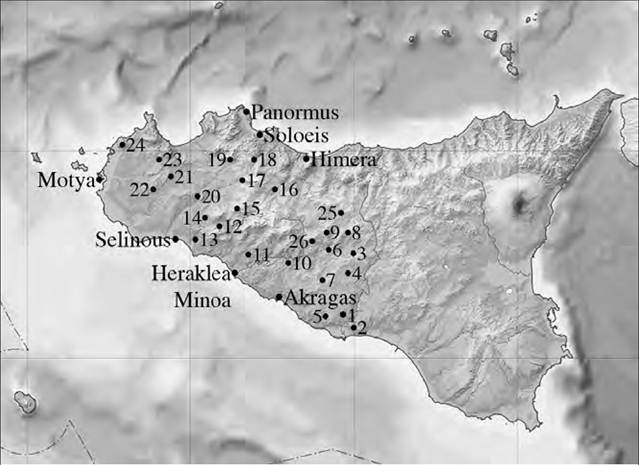
Figure 1. Central-west Sicily, with relevant Iron Age and Archaic-period sites identified.
1. Monte Dessueri 2. Monte Bubbonia 3. Sabucina 4. Caltanissetta 5. Palma di Montechiaro 6. Mus- someli 7. Caltafaraci 8. Valle Oscura-Balate Marianopoli 9. Polizzello 10. SantAngelo Muxaro 11. Sci- rinda 12. Caltabellotta 13. Montagnoli di Menfi 14. Santa Margherita di Belice 15. Entella 16. Colle Madore 17. Corleone 18. Montagnola di Marineo 19. Monte Iato 20. Poggioreale 21. Monte Polizzo
22. Mokarta 23. Segesta 24. Eryx 25. Vassallaggi 26. Casteltermini-Monte Roveto 27. Monte Maran- fusa
took place among indigenous populations subsequent to the arrival of Greeks and Phoenicians.
The goal of this essay is thus twofold. First, it aims to show that indigenous religion in Sicily really did change, and in significant ways, in the years after colonization.
It will focus on a case-study area of central-western Sicily to make this point, marshaling the evidence from roughly forty different settlements situated between the Gela river in central Sicily and the western coast (see fig. 1). It then explores the significance of these changes by examining them under the lens of extratextuality, a concept that draws on the wider theories of thinking about ritual as text and, from there, text as discourse. Ritual, according to Dimitrios Yatromanolakis and Panagiotis Roilos, “is characterized by dense and multilayered extratextuality that reaches out of each specific performative occasion to an all-encompassing semantic traditionality or to communally recognized modes of signification” (2005, 19-20). Moreover, if ritual can be understood as text and text as discourse, then ritual must also be seen as being situated within a nexus of interaction with other social and cultural discourses. This step in theoretical logic is particularly important if we consider what it implies for thinking about religion and ritual in contexts of large-scale demographic, sociopolitical, and cultural change like that of colonization-era Sicily. If one goal is thus to understand how indigenous religion and rituals changed after the arrival of Greeks and Phoenicians, then the other is to identify what discourses the rituals were speaking to beyond the text of religious ritual itself, and connect such interdiscursivity to the region's sociopolitical developments during the Archaic period.