PANTHEON AND MYTHOLOGY
Written sources provide us with two sets of gods’ names, one from Rus and one from Polabia. The already mentioned “pantheon” of Vladimir, that is, the list of effigies erected in Kiev, includes as the main god Perun, a deity of an obviously military character, who is also a god of thunder, as suggested by the etymology of his name (Polish and Kashubian, uniquely among the Slavic languages, retain a reflex of the god’s appellation as the word for lightning; the Polish word is piorim).
Another important divine figure in Russia was Volos or Veles, characterized in the Primary Chronicle (sub anno 971) as a god of cattle (skoti bog), a fact that suggests links to the sphere of welfare and fertility. Also the Slavic name denoting the idea of god in general, bog, suggests historical roots in an Indo-European stratum (cf. the Vedic deity Bhaga) and links to the idea of wealth and plenty (with contemporary derivatives such as Russian bogatyj, “wealthy”, and Polish bogactwo, “wealth”). Veles was, according to the Primary Chronicle, also a god warranting oaths, who could cause sickness, most probably scrofula, as retribution for those who committed perjury. Because of these facts, and because of the etymology of the name Veles, scholars believe that he was first of all a god of magic and the underworld. Associations with magic also seem to fit the connection with welfare.Another god not included in Vladimir’s pantheon is Svarog, who is mentioned elsewhere in Russian sources (Mansikka 1922: 149ff.). His name is echoed in the name of the Polabian god Svarozic, “son of Svarog”, a testimony to the fact that the Slavic pantheon of gods (like so many other pantheons around the world) was conceived of as a family. Russian sources, however, also present Dashbog (literally: “a god giving wealth”), a figure that we do find in Vladimir’s pantheon, as a son of Svarog (Primary Chronicle, sub anno 1114).
It is therefore generally assumed by scholars of Slavic religion that Dashbog and Savarozic are different names for one and the same deity, that is, the son of Svarog. From the etymology of the name it appears that both Svarog and Svarozic were gods of fire, sun and heaven (Gieysztor 2006: 167-79). Some place-names in Poland (including Pomerania), such as Swarz^dz and Swarozyn, suggest that Svarog/Svarozic was a god worshipped also in the area between Russia and Polabia.Among the other Russian gods mentioned in the Primary Chronicle, the deity Khors deserves mention. His name has an Iranian etymology (meaning “the shining one”) and he was possibly a god of the Moon (ibid.·. 180-83). Simargl seems also to have been a deity with an Iranian connection, as his name can be linked to Persian Senmurv, a bird-shaped demon with a dog’s head (ibid.: 187). Stribog is a god attested in the name of the Polish village of Strzyboga.7 Finally, one can mention the god Rod and his female companions, the (usually three) roshanice. These were supernatural beings responsible for birth and destiny (ibid.: 204-7). Such parallels connecting the etymologies of some names of Russian gods to the Vedic and Iranian world may be explained by the fact that the Slavic as well as Indo-Iranian languages belong to same satem branch of the Indo- European languages, with the result that there are numerous similarities in the vocabulary of religious and social life between the two language groups (Golqb 2004).
Only some of the Russian names of deities have relations in other parts of the pre-Christian Slavic territory. In Polabia we find Svarozic, who was the main god of the Lutitians worshipped in Riedegost. In the Lives of St Otto, the god Gerovit is mentioned as a deity of a strongly military character worshipped in Pomeranian Wologost (today Wolgast in Vorpommern). In his temple the god’s shield was stored, and this sacred object was believed to provide protection for the town (Ebo 3.8; Herbord 3.6).
The etymology of the name Gerovit (or rather Jarovit) is derived from a proto-Slavic word jary (“strong, fresh”, as a substantive also used to denote spring and spring wheat), which suggests a connection to fertility. The name of this god furthermore has a counterpart in a Russian agrarian demon, Jaryla, who appears in nineteenth-century folklore (Slupecki 1994: 90-93).The strong military characteristics of all Polabian gods, irrespective of their origins, are related to the political situation of the region after the great uprising of the Polabian Slavs in 983 against Christianity and the Christian Germans (as well as Poles and Danes). It is only from that late period of bitter conflicts and wars that we know much about the local gods.
Military characteristics were typical of Sventovit, the main god of Arcona on Rügen, as well as of the deities Rugievit, Porevit and Porenut who were worshipped in Karentia (today Rugard) on the same island.8 Scholars have surmised that the two last names in the list, and the name of the god Prove who was worshipped in a sacred grove in Wagria, are linguistically related to the name of Perun (although Prove may equally well be derived from a proto-Slavic word with derivatives such as Church Slavonic pravo, “just, equitable”, and, in modern languages, Polish prawo and Russian pravo, “law”). According to this line of reasoning (e.g. Gieysztor 2006: 91), Porenut would derive from *Perunic (“son of Perun”). Similarly, the names of Sventovit (meaning “holy and strong”) and Rugievit (meaning “strong lord of Rügen”), which are in fact epithets, have been interpreted as local hypostases of Perun. The name Perun itself is in the West Slavic area only attested with certainty in some Polabian, Pomeranian and Polish place-names. Most Polabian names of deities end with the suffix -vit, which probably means “strong, holy lord” and seems to connote divine power. The name of the first mythical ruler of the Polish Piast dynasty, Siemovit, includes the same ending.
An interesting case is Triglav (literally “three-headed”), which was the god worshipped in Szczecin and Brandenburg (Slavic Brenna). As his horse, which
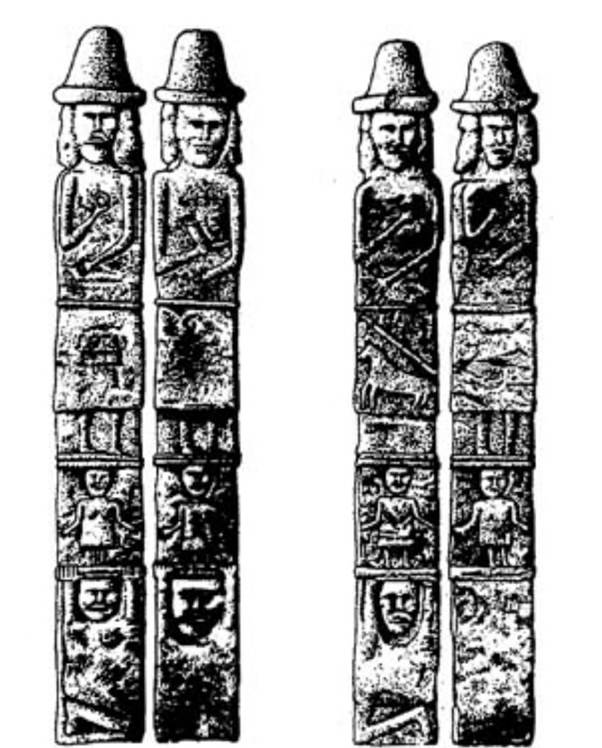
Figure 25.2 Effigy from Zbruch, today in the Archaeological Museum in Cracow (Antoniewicz 1957: 365).
Another huge, quadrangular effigy made of limestone was found in 1848 in the Zbruch River in what is today the western Ukraine (see Fig. 25.2). The upper part shows a god with a four-faced head and displaying specific attributes on three sides (a sword of a type used by nomadic tribes, a horn and a ring), whereas on the fourth side the god is empty-handed. The image is clearly divided into three zones. Below the upper part is the middle one, occupied by four smaller human figures (two male and two female) dancing in a circle. The lower part shows a person with three faces, holding the middle zone on his shoulder. Despite many attempts to identify the deities, the names of the beings displayed in this statue remain unknown (Shipecki 1994: 215-26). The same four-faced being is also represented on small figurines, for example from Slavic Wolin and Scandinavian (Danish) Svendborg (Lamm 1987; Muller-Wille 1999: 81).
There are numerous words for “statue” in the Slavic languages, several of which are directly relevant for understanding pre-Christian Slavic religion. The existence of several such near-synonyms may suggest that images of deities were important in the cult. The most interesting in this context is Polish balwan, which is a loanword from the Persian/Kirghiz/Turkish noun phalvan/palvan/balbal, which meant a hero and his statue, or a god’s effigy, but in time became increasingly pejorative and came to designate a pagan idol, a log, a foolish person and even - in modern Polish - a snowman. As far as the Eastern Slavs are concerned the word kumir is worth mentioning. The Primary Chronicle (sub anno 980, 983, 988) uses it when referring to the statue of Perun in Kiev. No clear etymology of the word has been established. The word that means both “prayer” and the image of deity to which prayer was addressed was modla, the equivalent of “statue” in Old Polish.