Reform and Resistance
Both today and in the past, African Muslim and Christian communities have debated whether practices derived from indigenous religions are an appropriate or authentic part of Muslim or Christian religious practice.
In some cases, disapproval of indigenous practices and customs has led to major reform movements. Such criticisms of indigenous religions have largely been based on the idea that the beliefs, teachings, and practices of indigenous religions are at best “primitive” deviations from Christianity or Islam and at worst heretical and sinful.Beginning in 1804, Usman dan Fodio (1754-1817), a West African Muslim reformer and religious leader, waged a campaign in northern Nigeria to rid Islamic practice of what he thought were inappropriate indigenous elements. One practice that he specifically criticized was spirit possession by the bori spirits, which was widespread at the time among both Muslims and non-Muslims. For over two decades, Usman dan Fodio and his followers tried to rid Muslim religious practice of what they viewed as inappropriate “African” elements such as this. The teacher and scholar Nana Asma’u was a daughter of Usman dan Fodio, and she dedicated her life to encouraging the education of Muslim women. She taught that all women had a duty as Muslims to seek knowledge, and she is still a role model for Muslim women in Nigeria today.14 Nana Asma’u is one example of prominent women’s leadership in Islamic communities in Africa.
How do debates in Africa about the authenticity or appropriateness of religious practice compare with other religions discussed in this book?
Similar campaigns have been launched more recently. Christian and Muslim religious leaders have often targeted initiation rites such as those discussed earlier in this chapter. The rites have sometimes been described as “backward,” “un-Christian,” and “un-Islamic” or have simply been condemned as relics of a past best left behind.
In some cases, Muslims and Christians have been receptive to the criticism and have stopped performing initiation rites or have replaced them with ceremonies that are deemed more appropriate by Muslim and Christian religious leaders. However, elsewhere, Muslims and Christians have continued to participate in the rites, despite the condemnation. Advocates argue that the rites are important means of achieving adulthood and are not in conflict with Christianity or Islam. Later in the chapter, we’ll explore such rites of passage in more detail.Occasionally, religious leaders who criticized the rites in the past changed their approach. For example, at one time the Catholic Church in Zambia strongly restricted female initiation rites in some Zambian cultures. However, in the 1960s, Vatican II (a historic meeting of Roman Catholic Church leaders to address issues facing the church at the time) permitted church leaders to be more accepting of local practices. As a result, Zambian Catholic leaders changed their point of view. They argued that the initiation rites could be used to instill Catholic teachings about marriage and family in young women.15
In the first decades of the twentieth century, African Christian leaders began to develop new Christian churches that spun off from the long-established mission churches, like the Anglican and Catholic churches. African Christian leaders were often frustrated with their inferior status in the mission churches. Their new churches aimed to make Christianity more accessible and appropriate for African cultural contexts. The new independent churches became very popular, and today there are thousands of independent churches in Africa.—
In the 1920s, a man called Josiah Oshitelu (1902-1966) founded an independent Yoruba Christian church known as the Aladura Church. As a young man, he thought witches plagued him. However, a Christian healer explained that it was God testing him and that if he prayed, he could chase away the evil.
Oshitelu began praying. He received visions, and he tried to convince others that the old African religions were disappearing and that they should all become Christians. His teachings focused on the power of prayer and fasting to influence the will of God. Interestingly, many indigenous Yoruba religious beliefs and practices held relevance for Aladura Christians. For example, most of the practitioners maintained beliefs in witchcraft and powerful spirits. The emphasis on prayer is also reminiscent of Yoruba ideas of harnessing spiritual power. Furthermore, the Aladura Church focused on improving life in this world in much the same way as Yoruba religion.17Women have had important roles in the historical development of religions in Africa. Some scholars have argued that women’s active role in spirit possession, as we will discuss later in this chapter, has led to their prominence in new religious movements. Because mission churches such as the Anglican and Catholic churches most often prohibited women from holding leadership roles, women were highly influential in the development of the new African Independent Christian churches, and women founded new churches throughout Africa.— For example, a woman called Grace Tani founded the Church of the Twelve Apostles in Ghana in 1914. Tani was regarded as a prophet, and like many other influential women leaders, she incorporated many local traditions into her Christian practice.19 Although many of these new churches are now headed by men, women have often maintained important roles in preaching, leadership, and healing in the churches. The Aladura Church, for example, has separate male and female leadership structures.—
GLOBAL SNAPSHOT
African Religions in the Americas
During the centuries of Atlantic slave trade (1500-1800s), the religions of the Yoruba and other West African peoples such as the Dahome and the Fon spread far beyond the shores of their homelands. Most of the millions of African people who were enslaved and brought to the Americas followed indigenous religions.
The religious traditions and practices of Africans were suppressed or even forbidden by white slave owners, yet indigenous African beliefs survived and sometimes flourished in the Americas. Throughout the Americas today, many people of the African diaspora—and others— practice religions that have their roots in the African continent.The recognition of Yoruba orisha remains popular in some communities of African descent throughout the Americas. The religious tradition known as Candomble owes much to the enslaved Yorubans who were brought to South America; Candomble has been particularly prominent in northeastern Brazil. Enslaved Africans managed to keep worshiping Yoruba deities in the face of conversion pressure from the European slave master by cloaking the orisha in the guise of Catholic saints. Many of the divination practices of Ifa have been incorporated within Candomble. Santeria is a Cuban religion that bears similarity to Candomble and also incorporates the orisha. The Cuban diaspora has spread the religion throughout the Caribbean region. Today, there are likely hundreds of thousands of practitioners of Santeria in the United States alone.
Another example from the Caribbean is the Vodou religion, which originated in Haiti and then spread elsewhere in the Caribbean and southern United States. Also spelled as voodoo, this religious tradition owes much to both Catholicism and religions of West Africa, especially the religions of the Yoruba, Fon, and Kongo peoples. The term vodou comes from the Fon word vudon, which means “spirit.” Practitioners of Vodou recognize many different spirits. The spirits are called loa and have origins in West Africa. As in Santeria, the spirits are also sometimes identified with Catholic saints. Today, the majority of Haitians claim Vodou as their primary religious affiliation, although earlier in the twentieth century the Catholic Church denounced it as heretical. Vodou is also common in the Haitian diaspora in the United States, Canada, and elsewhere.
r---------------------------------------------------------------------------------------------
Video: Santeria Religion in Cuba
[Please note: You must be using an online, browser-based eReader in order to view this content.]
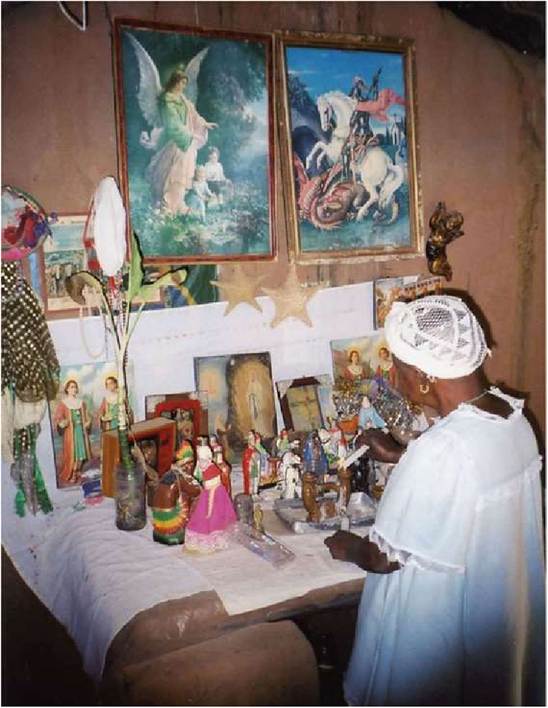
A Benzedeira, or Brazilian traditional healer, tends to an altar in the temple that is also her home.
The Maji Maji Revolt
Throughout Africa, religious groups spearheaded anticolonial movements, and indigenous religious leaders were at the forefront of some of the most important of these movements. In 1905, a religious leader called Kinjiketele organized a rebellion against the German colonizers in Tanganyika Qater called Tanzania). The revolt was known as the Maji Maji (Water Water) rebellion. Kinjiketele was believed to receive communications from the spirit world. One well-known story about him reports that a spirit took him into a pool in the Rufiji River. Later, he miraculously emerged completely dry. Kijiketele carried a message to his people that all of their dead ancestors would come back. Many people came to see him and to take the sacred water, which they believed would make them impervious to the bullets of the Europeans.
Kinjiketele attracted a large multiethnic following that supported his call for rebellion against the German colonizers. His message was compelling because it drew on indigenous religious beliefs in the power of spirits and the power of sacred waters. (The revolt takes its name from this sacred water.) Eventually, a group of Kinjiketele’s followers, impatient with waiting for him to signal the proper time, began the revolt against the Germans without him. The uprising lasted two years and was eventually defeated by the Germans. Early in the uprising in 1905, the German colonial government hanged Kinjiketele for treason; in the two years that followed, German forces killed tens of thousands of his followers.—
Self-Assessment 3.2
[Please note: You must be using an online, browser-based eReader in order to view this content.]