Ritual Instruments Used by the Vestal Virgins
The six Vestal Virgins were the most visible and active priestesses in ancient Rome. Their primary responsibility was to care for the flame on the hearth of Vesta, which burned eternally as a guarantee of the continued well-being of Rome and the Roman people.
But the Vestals performed a far more extensive ritual program than is often assumed.[220] In addition to tending the hearth and guarding the pignora imperii, the “pledges of empire” that resided within the Temple of Vesta, the Vestals prepared mola salsa, the salted grain used to consecrate victims at public sacrifices. They also participated in at least ten annual public festivals, including rites related to the fertility of the fields and flocks, the preservation of the food supply, and the purification of the city.As they carried out their religious obligations, the Vestals wielded a wide variety of sacred objects. They appear as a group, ritual implements in hand, on the altar frieze of the Ara Pacis Augustae in a procession that may depict the anniversarium sacrificium, the annual sacrifice commemorating the safe return of Augustus from Spain and Gaul in 13 BCE (fig. 1).[221] The scene is comprised of nine figures, including two lictors and a third togate figure processing directly behind the first lictor. The six Vestals are arranged according to age, with the youngest on the far right and the virgo maxima, the senior Vestal, on the left (Moretti 1948, 280-81). All six wear a long tunic with a mantle. Although their heads are damaged, they appear to have worn the suffibulum, a short white veil with a purple border that the Vestals wore when they sacrificed (cum sacrificant, Festus 474L).[222]
The youngest four Vestals carry ritual implements, including a spherical incense jar, a simpulum, and two rectangular objects that may represent tablets prescribing the ritual (Ryberg 1955, 41-42).
The distribution of objects clearly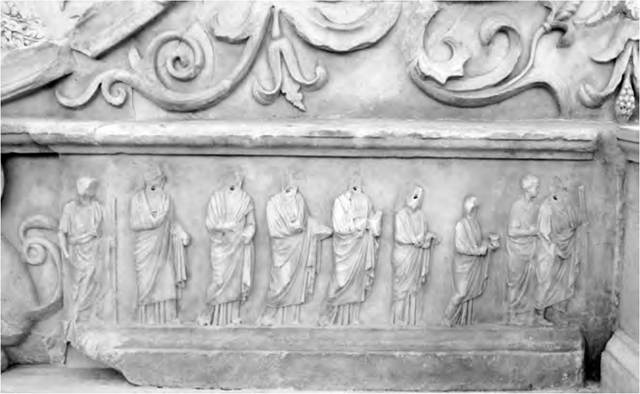
Figure 1. Detail of the procession of Vestal Virgins from the Altar Frieze on the Ara Pacis Augustae in Rome; late first century BCE Museo dellAra Pacis Augustae, Rome; photo by author.
demonstrates that all of the Vestals, not just the eldest set, are participating actively in the sacrifice, a fact that complicates the picture we have received from the ancient literary sources. According to Dionysius of Halicarnassus and Plutarch, a Vestal's thirty-year commitment to the order was divided into three distinct phases, each defined by a different relationship to the sacred rites (Dionysius of Halicarnssus Ant. rom. 2.67.2; Plutarch Num. 10.1). In her first ten years as a Vestal, these Greek authors tell us, a priestess learned her ritual duties. In the second ten she performed the sacred rites, and in her final decade of service she taught those rituals to new initiates. The evidence of the Ara Pacis suggests that Dionysius and Plutarch are mistaken in their belief that Vestals devoted only their middle decade of service to the performance of ritual activities. It appears that at the anniversarium sacrificium, the youngest Vestals performed the tasks normally carried out by camilli or camillae, freeborn children with both parents living who served as ritual assistants at many public rites.[223] While they may have had only a minor role, their participation was nonetheless vital to the success of the ritual as a whole and undoubtedly had a profound impact on the fledgling priestesses. As they processed to the altar carrying their ritual implements, the Vestals took part in an elaborately choreographed public spectacle. Once the sacrifice began, each priestess had a role to play at a different moment in the ceremony. Even though their assignments would have changed over time, their
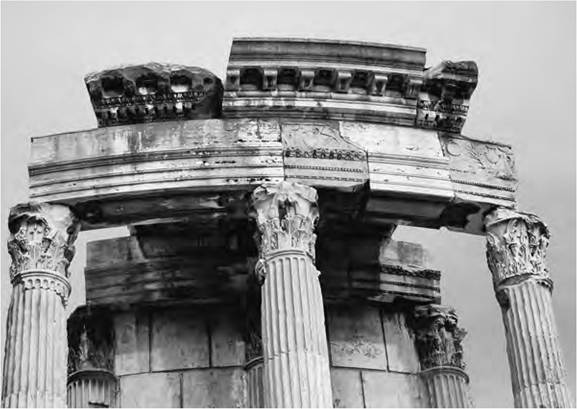
Figure 2.
Surviving Sections of the Frieze of the Temple of Vesta in Rome; Late Second Century CE; Photo by Sergey Sosnovskiyattendance and active participation in the rite remained a constant. The relief on the Ara Pacis allows us to imagine the Vestals in action, and not just at the sacrum anniversarium, but also at a whole range of public sacrifices.
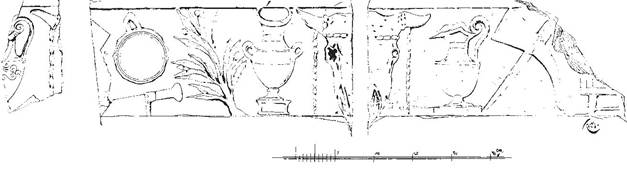
The Vestals also appear as ritual actors, albeit indirectly, on the entablature frieze of the Temple of Vesta (figs. 2-3).[224] This sacred still life belongs to the restoration carried out by the Severan empress Julia Domna in the late second century CE. The extant fragments include a number of familiar implements, including portions of two bucrania (bull skulls), a secespita (sacrificial knife), a dolabra (axe), an urceus (one-handled jug), and what appears to be an acerra (incense box).[225] It is tempting to assume that the assemblage is generic and reveals nothing in particular about the activities of the Vestals. Laetitia La Follette (20112012, 16, 23-24), however, has argued convincingly that the implements on the frieze (and others like it) were specifically tailored to their ritual context. In fact, at least two of the objects represented have a special connection to the worship of Vesta. In place of the standard patera (libation bowl), which appears frequently on Roman sculpted reliefs, a one-handed culigna is depicted suspended above the sacrificial knife as if about to pour out its contents (Siebert 1999, 286; La Follette 2011-2012, 23).11 The culigna was closely associated with the Vestals (Porphyry ad Hor. C. 1.31.10), who would have used it to pour liquid sacrifices, presumably of wine, perhaps on a regular basis, either alone or together with a bloody sacrifice.
On the same fragment, the large vase sitting on a square base has been identified as the futtile, which the Vestals used to draw running water from a spring outside the Porta Capena (La Follette 2011-2012, 23).[226] [227] The futtile was no ordinary water jar: the author of the Servius Auctus commentary on Vergil's Aeneid (11.339) explains that it was designed to spill its contents when set down because it was considered a piaculum (matter for expiation) if water used in the rites of Vesta came into contact with the ground.[228] In the domestic sphere, the task of fetching and carrying water traditionally fell to the women of the family, who were charged with providing for the physical needs of the household on a day-to-day basis. The ritual work of collecting water for the Temple of Vesta, which housed the communal hearth and penus (storeroom), benefited the entire Roman community.[229] It seems very likely that the Vestals performed this task themselves. The mythical Vestals Rhea Silvia and Tarpeia both come to grief while fetching water, which suggests that the Romans imagined that the priestesses carried their own water jars from the spring to the temple (Propertius 4.4.16; Ovid Fast. 3.11-12). The Vestals may have used the water they carried to purify the temple's penus and the objects within it, a task that Ovid and Plutarch claim they performed Figure 3. Surviving sections of the frieze of the temple of Vesta in Rome; drawing after Jordan 1886, pl. VII. on a daily basis (Ovid Fast. 3.11-12; Plutarch Num. 13.2).[230] They presumably employed the futtile to collect water for the production of mola salsa as well, a mixture of ground far (spelt) and salt that was used at every public sacrifice in the city of Rome (Festus 97L; Scheid 1990, 335-36). The Servius Auctus commentator provides the fullest description of the ritual implements involved in the preparation of this substance: Virgines Vestales tres maximae ex nonis Maiis ad pridie idus Maias alternis diebus spicas adoreas in corbibus messuariisponunt easque spicas ipsae virgines torrent, pinsunt, molunt atque ita molitum condunt (ad Ecl. 8.82). The three senior Vestal Virgins from the day after the Nones of May to the day before the Ides of May, on alternate days, place heads of grain in harvest baskets, and these heads the virgins themselves toast, pound, and grind, and then store what has been ground in this way. This passage stresses that the Vestals (ipsae virgines), rather than their ritual assistants, performed the various tasks necessary to prepare mola salsa. They gathered the grain using a corbis (basket) and then processed what they had harvested. Once the three eldest Vestals had roasted and ground the far, they mixed it with “baked salt and hard salt” (sale cocto et sale duro, Servius ad Ecl. 8.82), almost certainly the muries described by Festus in a passage based on Veranius, a well-known authority on the pontifical law:[231] muries est, quemadmodum Veranius docet, ea quae fit ex sali sordido, in pila pisato, et in ollamfictilem coniecto, ibique opertogypsatoque et in furnopercocto; cui virgines Vestales serra ferrea secto, et in seriam coniecto, quae est intus in aede Vestae in penu exteriore, aquam iugem, vel quamlibet, praeterquam quae per fistulas venit, addunt, atque ea demum in sacrificiis utuntur (152L). Muries is, as Veranius teaches, that which is made from unrefined salt when it has been crushed in a mortar, put into an earthen jar, and there covered with gypsum and cooked thoroughly in an oven; to this, after it has been cut with an iron saw and put into an earthen vessel, which is within the Temple of Vesta in the outer penus (storeroom), the Vestal Virgins add continually flowing water, however much (is needed), except that which comes through pipes, and finally they use it in sacrifices. This passage contains a wealth of detail about the ritual objects employed by the Vestals. When they had ground the salt with a mortar and pestle, they baked it in a gypsum-covered clay pot, cut it with an iron serra (saw) and stored it in a vessel known as the seria. At the appropriate moment, they added continually flowing water, presumably collected in a futtile, to create a brine that was added to the ground far in order to produce mola salsa. While no mortar and pestle appear on the extant fragments of the relief on the Temple of Vesta, it is tempting to imagine that they might once have appeared alongside the sacrificial knife. The production of mola salsa was one of the most important ritual obligations assigned to the Vestals. After pouring a preliminary libation, the official in charge at a Roman sacrifice would have sprinkled the victim with mola salsa, poured wine on its forehead, and run the knife along its back (Servius ad Aen. 12.173). This series of gestures simultaneously purified the animal and made it sacer (sacred), transferring it to the possession of the deity to whom it was being offered. In fact, the Latin expression immolatio, which came to signify the sacrificial act as a whole, originally described this preliminary step (Siebert 2005, 744-45). Such terminological slippage suggests that the Romans regarded the act of dedication, which would have been impossible without the mola salsa produced by the Vestal Virgins, as the essence of sacrifice. Through the ritual work of producing mola salsa, they helped to underpin the entire sacrificial system. Male priests may have presided over the majority of Rome's public sacrifices, but the Vestals prepared the mola salsa that made these offerings possible. The sacred still life on the Temple of Vesta, however, reminds us that the Vestals not only provided mola salsa for rituals presided over by other priests, but also presided over animal sacrifices themselves in their capacity as public priestesses. When complete, the frieze was punctuated at regular intervals by the skulls of dead bulls, whose knotted infulae (woolen headbands) clearly marked their status as sacrificial victims.[232] A characteristic feature of Roman religious iconography, this motif provides the key to understanding the significance of the other objects in the sacred still life. Jas Elsner (1991, 58) has described the bucrania on the Ara Pacis as a “momenta mori” a reminder of the animals that had been slaughtered at the altar in order to guarantee the abundance represented by the garlands that hang between them. On the Temple of Vesta, the bucrania recalled the ritual of sacrifice even more vividly through the inclusion of the urceus and culigna, which held the initial libation of wine, the acerra, which contained the incense, and the dolabra and secespita, with which the victims were eventually slaughtered. As Elsner (1991) and La Follette (2011-2012) have emphasized, scenes like this one brought the performance of sacrifice to life and invited the viewer to participate in the ritual by engaging his or her knowledge of the processes involved.[233] A Roman viewer may have envisioned the Vestals and their attendants wielding the ritual instruments depicted on the frieze. The Servius Auctus commentator confirms that the Vestals were permitted to use the secespita, the sacrificial knife that rests on the ground line of the frieze below the culigna:[234] secespita autem est culter oblongus, ferreus, manubrio eburneo, rotunda, solido, vincto ad capulum argento auroque, fixo clavis aeneis, quo flamines, flaminicae, virginespontificesque ad sacrificia utuntur eaque iam sacra est (ad Aen. 4.262). The secespita is an oblong knife made of iron with a rounded ivory handle fastened to the hilt with silver and gold and fixed with bronze nails. The flamines, flaminicae, Vestals, and pontifices use it for sacrifices, and it is itself a sacred thing. This knife is an important symbol of their sacrificial role and status within the priestly hierarchy. As we have seen, the official presiding at a sacrifice ran the knife along the back of the victim (Servius ad Aen. 12.173) before the victimarius (ritual slaughterer) did the actual killing and butchering.[235] The hard work of sacrifice invariably fell to servi publici (public slaves), whose service is represented on the frieze by the dolabra, the ax used to stun the victim.[236] The man or woman who held the ritual knife, however, was the official in charge and the most important human figure present at the rite. We know of a handful of rituals at which the Vestals may have used the secespita. They sacrificed a pig on behalf of the Roman people (pro populo) at the nocturnal rites of Bona Dea (Cicero Har. resp. 12, 37, Att. 1.13.3).[237] According to Tertullian, they also sacrificed alongside the flamen Quirinalis at the altar of Consus in the Circus Maximus (Tertullian Spect. 5.7). In addition to these traditional republican rites, the Vestals acquired new responsibilities during the early principate, including a sacrifice at the altar of Fortuna Redux on August 12 in honor of the safe return of Augustus from the East in 19 BCE and at the Ara Pacis on the anniversary of his return from Spain and Gaul in 13 BCE (Res gest. divi Aug. 11-12). Shortly after he was acclaimed emperor in 41 CE, Claudius ordered the priestesses to offer yearly sacrifices to Diva Livia, the wife of Augustus and grandmother of the new princeps (Cassius Dio 60.5.2). In sum, this literary evidence is in keeping with the testimony of the temple frieze. The Vestals were authorized to offer sacrifices on behalf of the Roman people. The sacred still life on the Temple of Vesta captures a fascinating dynamic at work in the Vestal order. As women, the Vestals were culturally predicted to perform the ritual work of collecting water, tending the hearth, and roasting grain. These activities reinscribed a traditional ideology of gender.[238] At the same time, however, their activities transcended the ordinary world of the Roman matron and her daughters. Through the provision of mola salsa, the Vestals facilitated every public sacrifice that was performed in the city of Rome. Their ritual work at the public hearth and in the public penus kept the city safe and allowed the Roman family to fulfill its obligations to the gods. Their ritual program, moreover, included liquid and blood sacrifices. Like their male colleagues, the Vestals wielded the urceus and the secespita in an official capacity and on behalf of the Roman people (pro populo).