Ritual, Repetition, and Memory
Repetition and vivid detail in the frieze further highlight the connection between the temple and the recurring animal sacrifice conducted at its altar. Priests used the aspergillum to sprinkle lustral water, the patera to pour libations before the sacrifice or over the sacrificial meat cooking on the altar after the sacrifice, and the urceus to pour wine into the patera and to hold wine for the feast to follow.
Significantly, although often referred to as priestly implements, several of the objects depicted in the frieze are integral to the sacrifice but are not used by the priest. Attendants of the sacrificial victims, or victimarii, performed a variety of roles in sacrificial rites. A cultrarius carried the culter on a large tray called a lanx or in his hands. Another attendant, the popa, employed the malleus to strike and stun sacrificial victims. Yet another attendant might carry the securis. The presence of the culter, malleus, and securis recalls not only sacrifice and libations by the flamen generally, but in particular the sacrifice of large victims. In addition to implements held in the hands, typical signifiers of the victimarii such as their bare chests, loin-cloth type garment called a limnus, and proximity to the sacrificial animal clearly distinguished the victimarii from priests within representations of sacrifice on Roman state sponsored historical reliefs.[268] Roman sacrificial practice in satisfaction of the requirements of the pax deorum, or peace with the gods, observed a connection between deity and victim, the hostia propria. Sacrifices to male divi were male bovines, typically a bos mas, a castrated male ox. That the frieze evokes large animal sacrifice conducted on behalf of the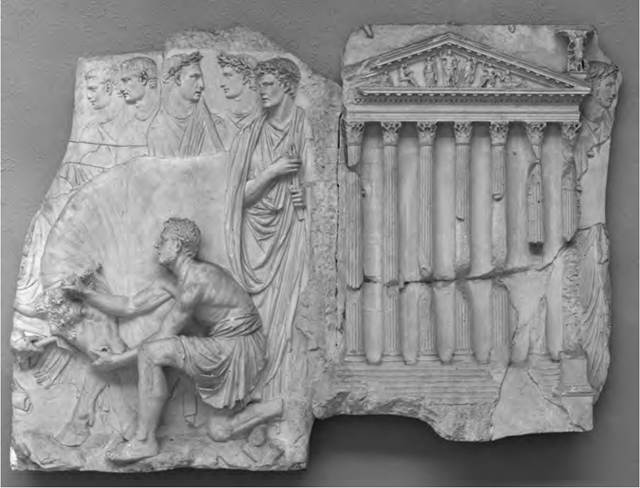
Figure 7. Julio-Claudian relief fragment; Rome, Villa Medici; sacrifice in front of the temple of Mars Ultor in the Forum of Augustus; photo, DAI-Rome, neg.
D-DAI-ROM-77.1739, photographer Christoph Rossa.state in satisfaction of the pax deorum makes explicit the importance of the cult of Divus Vespasian and Divus Titus in the hierarchy of religious practices.
The elongated proportions of the bucrania fill the height of the frieze, also echoing the sacrificial animal led to slaughter. In the relief believed to be from the Ara Pietatis in which the temple of Mars Ultor provides a dramatic sacrificial backdrop, attendants lead a struggling and bowing sacrificial steer (Julio- Claudian relief fragment, temple of Mars Ultor pediment and sacrifice relief, 41-54 CE, Rome, Villa Medici) (fig. 7). Added detail in the frieze of the temple of Divus Vespasian and Divus Titus, such as the fillets adorning the bucrania that similarly decorated the sacrificial victim on festal days, suggests a sacred processional event. As in other visual representations of rites that depict priests in sacrificial processions and the attendants in moments preceding the kill, the frieze may have brought to mind the noisy, chaotic, tension-filled moment before the culminating sacrifice (Grunow 2002, 76). A scene on one of the Boscoreale cups of Augustus and Tiberius depicts just such a moment: poised in front of a garlanded temple a sacrifice, either concluding the triumphal procession of Tiberius or preceding his departure on military campaign, dramatically depicts the popa in front of the temple of Jupiter Optimus Maximus drawing back
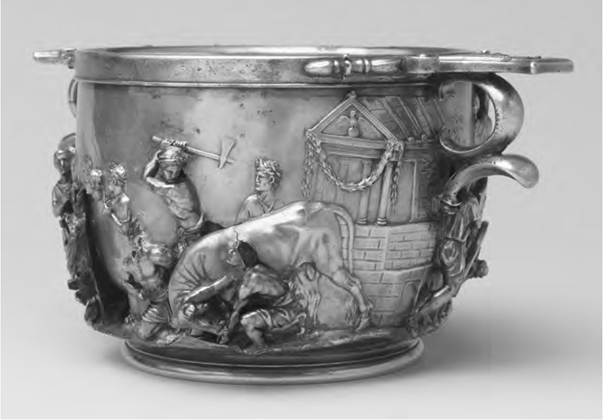
Figure 8. Skyphos, cup of Boscoreale; triumph of Tiberius and scene of preparation of a sacrifice. Louvre Museum, Paris, inv. no. BJ2367; © RMN-Grand Palais/Art Resource, NY, photographer Herve Lewandowski.
his instrument to deliver the stunning blow while two attendants struggle to maintain control of the bowing sacrificial ox (fig. 8).[269]
Within each individual frieze sequence (from bucrania to bucrania), as well as the overall repetition and variation of the sequences within the frieze, the use of additional rhetorical strategies is discernible.
For instance, another aspect of rhetorical ornament was the deliberate arrangement of the words in a speech to repeat or accumulate for the purpose of connecting the form of the sentence to its meaning (Kirchner 2007, 186-190).[270] The rhythmic pattern of each frieze sequence mimics patterns in music and in the movement of the body that Quintilian attests are used to express sublime and pleasing thoughts (Inst. 1.20.22). As in linguistic arrangement, such visual techniques produce a structurally pleasing balance of parts despite the ebb and flow of action that echoes the drama of sacrifice itself.[271] Within each sequence of objects the bucrania create strong vertical elements filling the height of the frieze yet also occupying more horizontal space than any other object, thereby pointing to the death of the animal as the climactic moment. Spaces between the exclamatory representations of the bucrania are constituted by multiple smaller objects (the galerus and instrumenta sacra) in an array of shapes, sizes, and angles implying the staccato series of events and their corresponding actions that build up to the culminating sacrifice.The rhetorical combination of repeating words at the beginning and end of successive sentences, with a visual correspondence in the repeating bucranium at the beginning and end of successive sections of the frieze, was known as symploce, and conveyed discreet, yet repeating and similar instances of a concept. While the arrangement of individual sequences of objects evoked the movement through space inherent in every religious procession culminating in sacrifice, repeating sequences embodied the cyclical repetition of ritual inherent in Roman state religion.[272] While the connection between rhetoric and repetition in speech has usually been discussed in terms of ornament and its benefits in aiding memory, when translated into the spatial environment of the frieze repetition takes on an additional significance.
The repeating sequence of objects on the frieze echo in stone the obligatory recurring ritual sacrifices in favor of Divus Vespasian and Divus Titus recorded in the Roman calendar. It was at temple ritual, renewed annually, that “the conceptual systems of temple, image, and sacrifice had their living embodiment” (Price 1984, 39). During the Imperial period there were, generally speaking, two systems of calendars that operated either based on a linear or a cyclical conception of time. The Fasti Triumphales recorded chronologically linear triumphs granted down to the reign of Augustus, and the Fasti Consulares listed the consuls for each year since the founding of Rome. In contrast, the Fasti Magistrales, Annales, or Historici provided a calendar of events for a twelve-month year, further divided by the eight-day Roman week, and reflecting annual, recurring public religious sacrifices and festivals to the state gods as well as days of celebration associated with the emperor and the imperial family.[273] For example, each year on the anniversary of the dedication of the temple of Divus Vespasian and Divus Titus, inhabitants of Rome participated in games and the flamen of the divi conducted sacrifices to celebrate the dies natalis of the temple. Implicit in the dies natalis was a historical date and year embedded in linear time and on which priests dedicated the temple for the first time, however, the significance of the notation in the Fasti lies in the requirement for recurring, yearly performance of the ceremony. The annual celebration of the dies natalis not only emphasized the importance of place in Roman religion by inextricably linking the satisfaction of cult requirements for each god to a cult structure, but also subsumed Divus Vespasian and Divus Titus within the eternal timeless world of Roman religious practice. Implicit in the calendar anniversary of the dies natalis are all of the instances before the present when sacrifices occurred, as well as after the present when sacrifices will necessarily happen again, in order to properly worship the gods and satisfy the pax deorum, or peace with the gods (Ricoeur 2004, 155).
As repetition is inherent in the formal structure of the frieze, so to it is inherent in the structure of ritual associated with the temple. Significantly, the Roman calendar does not record the year that the dies natalis first occurred, only the day of the year, again emphasizing ritual repetition over the first, or any single, performance of sacrifice.Moreover, the calendar was much more than a storage device recording religious knowledge; it provided a guide to ongoing religious veneration and a structure around which the rituals of the divi and of the Roman state as a whole ensured the performance of remembrance and religious obligations (Williams 2003, 227-31). Time at Rome was a culturally embedded system that relied upon a linear history of military victories, temple dedications and sacrifices, birthdays, adoptions, and senatorial decrees alongside the annual calendar of cyclical time (Laurence and Smith 1995-1996, 133). The calendar inscribed, literally and metaphorically, the eternal, timeless divi into a cyclical time that already included the other state gods. Through the horizontal linear format of the frieze along each lateral side of the temple, punctuated by sequences of objects that repeated in their entirety, the form of the frieze reflected the historical (linear) and cyclical (repeating) nature of Roman religion.
Variation in object detail between the two possible frieze sequences parallels the variation in word order that rhetoricians advocated to provide novelty in repetition (Quintilian Inst. 2.13.8-10). Repetition of the same meaning in speech with a different word form that stands in equivalence with the original is known as synonymous repetition and is intended to intensify the expression (Lausberg 1998, 292). In this case, the frieze incorporates highly particularized object details that differ between the sequences (rather than the schematization of objects frequently evident in other groupings of sacred implements such as those on funerary altars of the Roman Imperial period) to further suggest individual ritual events.
For example, the bucrania adorning the in situ architrave section vary in the configuration of the infula and the number of sections hanging from the skull's horns. The jug in each sequence bears relief decoration in two registers.On the Tabularium example bestiaries with a lance confronts a lion and a leopard in the top register, and the lower register contains an antithetical rhinoceros and a bull. In the in situ example a row of satyrs adorns the upper register, while a winged horse alights in the bottom register. Similarly, varied in decorative and symbolic detail, the paterae with heads of Zeus Ammon (in situ) and Medusa with surrounding leaf patterns (restored fragment in the Tabularium), may be modeled on actual or typical examples in metal (De Angeli 1992, 147). Other decorative embellishments such as the lion's head protome of the culter, suggest fine craftsmanship of the objects represented, and thus their intention for an elite patron rather than mass production. In other words, even though it is impossible to know whether the representations in the frieze were of real objects used in connection with cult ritual at the temple, the high quality and sophistication of the objects represented suggests their production specifically for ceremonial and ritual use.
Also contributing to a performative understanding of the frieze is the dynamism of the objects, a characteristic first noted and described by La Follette. Elements of the composition imply movement and action. Seeming to tilt slightly, the bucrania are not perfectly symmetrical. Sections of fillet hanging down on either side of the skulls differ in length and the loops of the fillet hanging from the horns fall at different angles, appearing to sway as though responding to forward motion. The jugs are not static but tipped to the side, as though someone was in the act of using them and the liquid on the verge of spilling from the spouts. Also arranged obliquely to the ground line, the culter with lion's head protome on the handle implies an unseen hand about to wield it on the sacrificial victim. Finally, the wavy tail of the aspergillum seems to quiver with movement as though being shaken. Only the securis rests on the ground line, however even it remains physically and visually connected to the malleus, which is placed behind it to create overlapping space that confirms for the viewer that these objects exist in three dimensions.
In light of the location of the frieze on the temple of Divus Vespasian and Divus Titus and the implements represented, it is safe to conclude that for most viewers the frieze prompted the recall of large animal sacrifice to Divus Vespasian and Divus Titus that occurred in front of the temple bearing the frieze. The ritual recalled could be either a specific temporal experience (as in one sequence of the frieze) or a typical sacrifice in front of the temple, an amalgamation of all prior experiences (combining all of the frieze sequences). With yearly ritual at the very least on the dies natalis of the temple, an inhabitant of Rome could potentially witness dozens of such sacrifices during her lifetime. Significantly, vivid recall of ritual prompted by the visual rhetorical strategies of clarity, ornament, and repetition, as discussed above would have reinforced the meanings of the performance and, to use Roy Rappaport's phrase, all of the “necessary entailments” of performance, including the gathering of the Roman people to participate in and witness the formal, solemn configuration of Divus Vespasian and Divus Titus as eternal celestial gods of the Roman state pantheon (1999). In terms of the social contract, the public and explicit annual acceptance of the cult through socially binding recurring sacrifice rendered dissenters publicly impotent and ascribed legitimacy to the terms of the cult. In addition, the repetition of object sequences on the frieze implied potentially limitless ritual repetition reenacting the timeless Roman religious order by recalling past sacrifices that reminded viewers of present and future cultic obligations. As Romans were acutely aware, such obligations were essential not only to the continued viability of Divus Vespasian and Divus Titus, but also to the unbroken continuity of ritual performance on which the pax deorum depended. The emphasis in the frieze then, is not on a particular sacrifice or even an ideal event, but rather on the status of the building as a location for sacred ritual conducted by priests of the pontifical college for the benefit of the Roman people.