Sikhism
Jeffrey Brodd
California State University, Sacramento
Layne Little
University of California, Davis
Bradley Nystrom
California State University, Sacramento
Robert Platzner
California State University, Sacramento
Richard Shek
California State University, Sacramento
Erin Stiles
University of Nevada, Reno
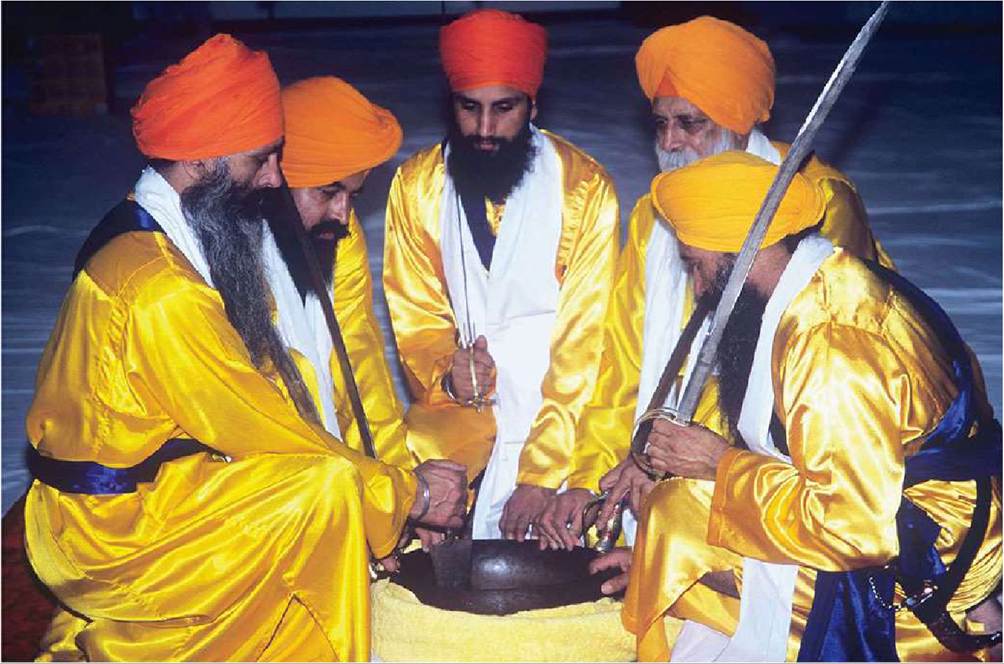
The five Sikh men who participate in the Amrit Sanchar represent the original “Beloved Five" in commemoration of the founding of the Khalsa.
MANJIT KAUR, a sixteen-year-old girl, and Sandeep Singh, a fourteen-year-old boy, stand in the gurdwara, the place of Sikh worship, in their small village in northwestern India. Here in the region known as the Punjab, Sikhism’s ancestral homeland, Manjit and Sandeep are members of the majority religion, and gurdwaras are common sights in the farming villages that dot the land. Most of the village has gathered together to witness the proceedings, and Sandeep and Manjit have spent the morning preparing for this momentous event—their initiation into the Sikh Khalsa, or community of “Pure Ones.” They have both bathed and washed their long hair carefully and have dressed especially for the occasion. Most notably, they both don the five articles of faith, known as the Five Ks: uncut hair, a comb, a steel wristlet, a short sword, and a pair of shorts. (For more detail on the Five Ks, see the section “Teachings of Guru Gobind Singh and the Khalsa.”)
Manjit and Sandeep join a group of five older villagers who also don the Five Ks and who for this ceremony play the part of the Panj Piare, or “Beloved Five.” They are established members of the Khalsa and will oversee the initiation. The grouping of five recalls the founding of the Khalsa centuries ago, when Guru Gobind Singh (1675-1708 ce), the tenth in a line of Gurus going back to Guru Nanak (1469-1539 ce), chose five original initiates who had distinguished themselves for their loyalty to the Guru and for their commitment to Sikh ideals.
On this day of Amrit Sanchar, the Khalsa initiation ceremony, the stirring memory of these founding figures and the ideals they embody is palpably felt. But the most vital presence of all is a large book, lying open on a special platform. It is Sri Guru Granth Sahib, or the Adi Granth, the sacred scripture of Sikhism, and the Sikhs’ Guru, or spiritual teacher, from the time of Guru Gobind Singh forward.Sandeep and Manjit stand before the Panj Piare, one of whom explains the basic principles of Sikhism. They agree to accept these principles by nodding, the ritual action that makes the initiation official. The new members of the Khalsa are then served amrit (“immortalizing fluid”), a special drink made from water and sugar crystals, which the Panj Piare have mixed in an iron bowl and stirred with a two-edged sword. Meanwhile, hymns from the Adi Granth are sung by the congregation. The amrit is drunk and sprinkled on the eyes and heads of the initiates, who recite the Mui Mantra, the summary of Sikh doctrine that comprises the opening lines of the Adi Granth. The Panj Piare then instruct Manjit and Sandeep about the ethical requirements of the Khalsa. These include prohibitions against the cutting of one’s hair, the eating of meat that has been improperly slaughtered, extramarital sexual relations, and the use of tobacco. The initiates are also told that all Sikhs are brothers and sisters and that there should not be any distinctions made on the basis of caste.
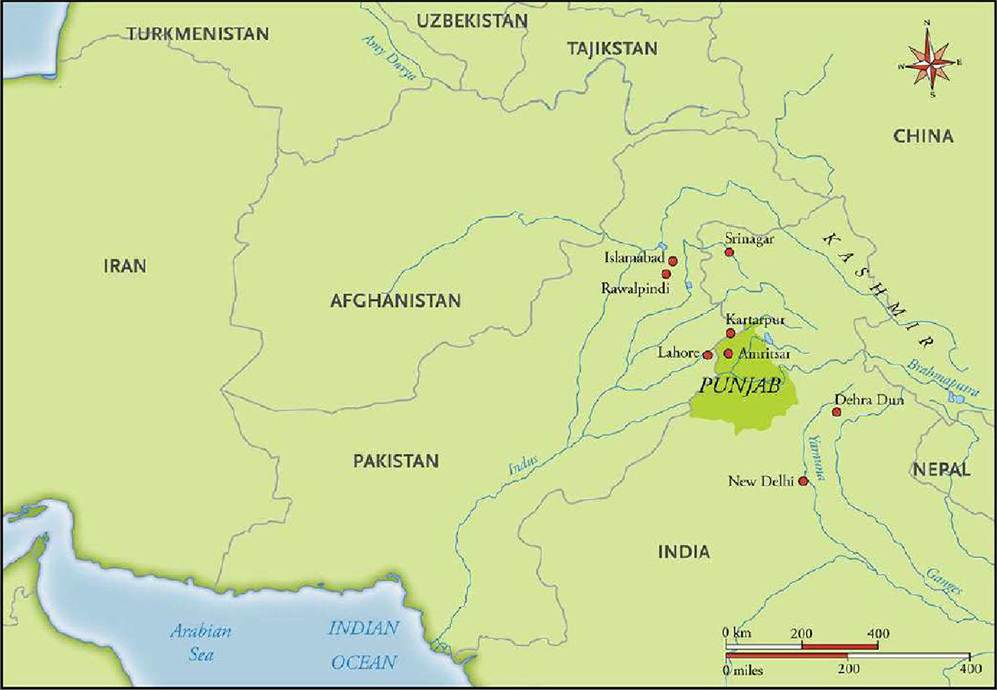
Significant sites in the history of Sikhism.
Click here to learn more in an interactive map.
Manjit and Sandeep are among a minority of Sikhs, approximately 15 percent, who undergo the traditional ceremony of initiation into the Khalsa. Some 70 percent of the approximately 25 million Sikhs in the world,1 however, are popularly considered to be members of the Khalsa, insofar as they observe the Five Ks, or at least the one that is generally deemed most important: not cutting one’s hair.- And regardless of percentages or degrees of membership, the traditional ways of the Khalsa greatly influence the practices and customs of the entire Panth, or Sikh community.
We can thus glimpse in this ceremony, with its powerful ties to tradition and its rich symbolism, key aspects that are at the heart of Sikhism.TIMELINE
Sikhism
| 1469 CE | Birth of Guru Nanak, founder of Sikhism. |
| 1520s | Establishment by Guru Nanak of the township of Kartarpur, the first Sikh community. |
| 1539 | Death of Guru Nanak. |
| 1606 | Death (execution?) of Guru Arjan, under Mughal emperor Jahangir. |
| 1675 | Execution of Guru Tegh Bahadur, under Mughal emperor Aurangzeb. |
| 1699 | Founding of the Khalsa by Guru Gobind Singh. |
| 1708 | Death of Guru Gobind Singh and establishment of the Adi Granth as Guru. |
| 1799 | Establishment of independent Sikh kingdom by Ranjit Singh. |
| 1849 | Annexation of Sikh kingdom by the British. |
| 1947 | Partition of Punjab with the establishment of India’s independence. |
| 1984 | Indian army attacks and occupies Sikh holy sites, including the Darbar Sahib (or Golden Temple). |
| 1999 | The Panth celebrates the third centennial of the establishment of the Khalsa. |
| 2004 | Manmohan Singh elected prime minister of India, the first Sikh to attain this office. |
Click here to learn more in an interactive timeline.
Click here to compare to other Indian religions.
In this chapter, we will study these and other key aspects, attending in turn to the founding of Sikhism and its primary doctrines, its historical development, and its most prevalent rituals
and worship practices. By virtue of its size alone, Sikhism is among the major religions of the world. Theologically, Sikhism’s intermixing of concepts that are common to some Hindu traditions, on the one hand, and to Islam, on the other, make it a very interesting subject for the comparative study of religion. And with nearly 2 million Sikhs living outside of India,3 and Sikh communities being found today in most of the large cities of the West, Sikhism clearly is a global tradition that has a significant impact on the world.