Small rectangular incense altars found in the southern Levant have been considered as a diagnostic cult object (Albertz and Schmitt 2012, 70-71).
Nevertheless, they are not de facto cult objects since their exact purpose and ritual setting have not been specified (Fowler 1985; Haran 1993). Some researchers, therefore, do not identify this type of object as an incense altar but an incense burner or smoking box (Millard 1984, 172-73; Zwickel 1990; Weippert 1988, 715-18; Rowan 2014, 938-40).
The lack of clear understanding of this incense altar type is not limited to its exact nature and function. The origin of the altars, provenience of their raw materials, and their production are still subject for study. For example, while many researchers have insisted on local production of the southern Levantine incense altars, no scientific confirmation has been available (Cymbalista 1997, 17; Hassell 2002, 165; Stern 1982, 186). Of particular interest is the petrographic provenience analysis because by observing the mineral, fossil, and diagenetic compositions of the material (James and Jones 2015, 288) this approach provides a critical way to provenience study of carbonate-rocks, of which many Levantine small incense altars are made. Unfortunately, no petrographic analysis of this type of small rectangular altars has been reported.Tell Halif, located in the northeastern Negev on the border between the hill country and the Shephelah (fig. 1), yielded two small four-legged rectangular limestone incense altars and possibly two additional fragments of similar objects (fig. 2). Although the specimens were recovered from the same stratigraphic phase in relatively close spatial proximity, their raw materials, detailed profiles, and level of craftsmanship appear to be different from each other. These differences among the Tell Halif incense altars and fragments provide an opportunity to have a better understanding of the nature of the small southern Levantine limestone incense altar phenomenon, such as how it was produced and in what
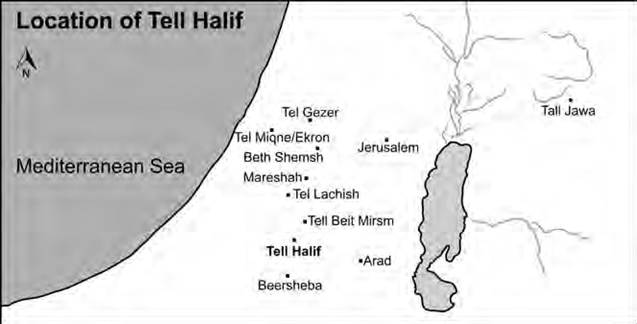
Figure 1. Location of Tell Halif.
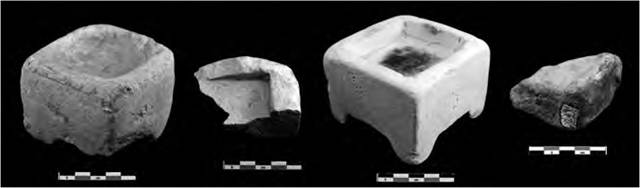
Figure 2. Two incense altars and two fragments (from left, Objs. 3139, 3076, 3191, and 3619); photo by Seung Ho Bang and Oded Borowski; The Lahav Research Project (LRP).
contexts it was used. We will address these questions through petrographic analysis and close examination of the crafting techniques of shaping the four incense altars.1