Smith's heretical accommodationism, 1880s
Smith's editorial participation in the ninth edition of the Encyclopaedia Britannica (1875) was to mark the apogee of his efforts in crafting a ‘scientific theology'. However, his ideas were to be proven extremely controversial within the Free Church.
In 1876, a formal enquiry related to the charge of heresy was started as a direct result of Smith's encyclopaedical entry dedicated to the Bible. In this entry, Smith, notwithstanding his prowess at balancing dogmas and rational academic research, affirmed the non-divine nature of the Bible-as-text and the non-Mosaic nature of the Deuteronomy (Smith 1875). In 1880, after a journey to the Sinai Peninsula and adjacent regions, new entries and articles by Smith were published, and more fuel was added to the theological bonfire (Smith 1880a; Smith 1880b). This time, brilliantly speculative claims which connected totemism with exogamy, polyandry and matrilineal descent, expanded and explained the reconstructed ancient and polytheistic religion of the Biblical peoples (Kippenberg 2002: 69; Maier 2009: 183-4). The Evangelical community deemed such ideas as morally shameful and theologically unacceptable, and 1876 marked the beginning of an excruciating, 5-year-long theological and legal confrontation, culminating in two trials, that ended in 1881 with a compromise. The agreement resulting from the second trial envisaged that, on the one hand, Smith had to be removed from his chair; on the other hand, the Church renounced the official denunciation of his theses (Maier 2009: 150-86, in part. 184; Wheeler-Barclay 2010: 150-5).The need for moral reassurance during the final year of the trial emerges in a letter sent to Dutch theologian Abraham Kuenen (1828-1891), where Smith, while still avowing his ‘personal religious experience on the conception of Christianity as an absolute religion' and rejecting the idea of ‘miracle in the medieval sense', notes:
I am little concerned whether a zoologist can establish an absolute discontinuity between man & the monkey but I have an interest in feeling assured that the human soul & the human race have an absolute vale (greater than the whole Material universe as Jesus teaches us) and are not mere passing phases in the ceaseless fluctuations of the Kosmos.
Maier 2009: 278; BUL BPL 3028
As a consequence of the laborious legal and theological proceedings, a sorrowful Christian existentialism, and a sort of cognitive dissonance between his past experience as a member of the community of the Free Church and his current status as a sort of scientific outsider (see Coyne 2015: 97), were sneaking into Smith's worldview, to which he had to respond by reinforcing his accommodationism: biological evolution was accepted, provided that the teleological Christian project of ultimate salvation was rescued. In any case, the tormented outcome of the trial did not prevent Smith from pursuing successfully his career, as he was able to land a professorship in Arabic at Cambridge a few years later, where he resided from 1883 until his untimely death in 1894, forming a durable friendship with - and mentorship over - Frazer who, in return, dedicated to Smith his Golden Bough (‘To my friend William Robertson Smith I in gratitude and admiration'; cf. Ackerman 2005b: 20-1, 73; Wheeler-Barclay 2010: 155; Turner 2014: 294).5
As illustrated in such pivotal works as Lectures on the Religion of the Semites (Smith 1927; delivered in 1887 as Burnett Lectures and originally published 2 years later), Smith's approach was focused on a sociological and evolutionary, albeit ethnocentric and orthogenetic, study of Abrahamic religions, comparing contemporary and nomadic Arabic peoples with ancient, Biblical Hebrews according to the detection of totemic survivals (Wheeler-Barclay 2010: 167). In a passage that closely mimics Spencerian evolutionism, and notwithstanding Smith's own distaste for Spencer (cf. Livingstone 2014: 53), Smith wrote that ‘communities of ancient civilisation were formed by the survival of the fittest, and they had all the self-confidence and elasticity that are engendered by success in the struggle for life' (Smith 1927: 260). Earlier, in the same volume, Smith resorted to the old naturalistic trope already exploited by Max Muller, comparing cultural and social evolution to geology:
the record of the religious thought of mankind, as it is embodied in religious institutions, resembles the geological record of the history of the earth's crust; the new and the old are preserved side by side, or rather layer upon layer. The classification of ritual formations in their proper sequence is the first step towards their explanation, and that explanation itself must take the form, not of a speculative theory, but of a rational life-history.
Smith 1927: 24; cf. Livingstone 2014: 52-36
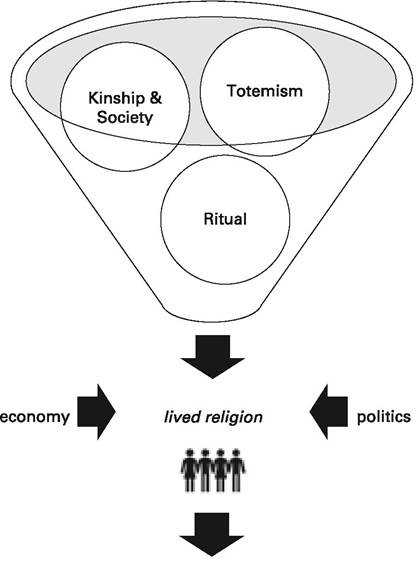
Anticipating most sociological explorations of religion, such as Emile Durkheim's (who declared his debt to Smith's work; Maryanski 2014), Smith's evolutionary approach was based on the rejection of the individualistic approach of his colleagues in comparative religion and entailed the following steps (Figure 9):
1. the identification of the basic unit of study in kinship and, therefore, in society;
2. the existence of a primordial totemic stage;
3. the primeval precedence of ritual and practice over mythology;
4. the incorporation of social, lived religion within the confines of economy and politics.
(Sociological) History of Religion
Figure 9 William Robertson Smith's (sociological) history of religion: original features, influences, and main themes
Table 2 Two sides of the same coin: a simplified comparison of Friedrich Max Muller’s and William Robertson Smith’s method and theory (after Turner 2014: 379-80)
| Friedrich Max Müller | William Robertson Smith | |
| Approach | diachronic | synchronic |
| Coordinatee | temporal | spatial |
| Philological method | comparative | textual |
| Foouu | mythological | sociological |
| Aim | uniformity | difference |
| Framewook | colspan=2 bgcolor=white>genealogical and evolutionary
This set of interrelated aspects coalesced, methodologically, into the thorough investigation of rituals as a collective manifestation and, epistemologically, into the primacy of sacrifice and ceremonial meals as a socially efficacious way to guarantee the cohesion of the community while including the god/s within the societal network (Sharpe 1986: 80-1; Kippenberg 2002: 66-80; Wheeler-Barclay 2010: 162-75; Livingstone 2014: 53; see also Strenski 2003 for the wider impact of Smith's anthropological theory of sacrifice).7
Despite a shaky, if not untenable, historiographical foundation based on ideological prejudices (see Warburg 1989), Smith had contributed to what might be labelled as the first historico-philological protocol of research in comparative religion, with a perspective that complemented almost seamlessly that of coeval philologists and comparatists like Max Müller’s - and this while breaking with the armchair tradition of the discipline (Table 2).
Smith’s untimely death prevented him from elaborating further and expanding on the social and cultural evolutionary framework he was working on. We do not know whether his theological penchant would have ultimately receded - a bit like Max Müller’s - but it would be nonetheless tantalizing to speculate about the way in which Smith might have changed his approach (especially considering his friendship with Frazer). Anyway, Smith’s case clarifies that religious scholars of religion, that is, those scholars with a theological background committed to the Victorian science of religion, were willing to break or bend the rules of scientific research in order to salvage their own beliefs. While Max Müller and Frazer were zealously exceeding, rounding up their theoretical proposals, Smith, for all his scientific penchant, was ethnocentrically rounding down his own results for the benefit of faith itself. Theology was leaving its mark and reaffirming its prominence on comparative religion, and in the process both were destined to be radically transformed.