THE EXPONENTIAL ARRANGEMENT
The ancient system of measured arrangement pertains to the organization of layers inherent within the metaphysical Logos. Each of these layers can be viewed as a frequency or wavelength band of consciousness, and each is associated with a fundamental wavelength or frequency on which is evaluated all other frequencies using self-referral measure through a harmonic system of analysis.
Yet a harmonic analysis is not sufficient to describe fully the overall arrangement of layers, which instead requires comparing the fundamental wavelengths associated with the various layers. This amounts to a type of meta-analysis, which transcends the internal harmonic system associated with each layer. The Vedic seers therefore declared that the layers are organized in an exponential fashion: “The layers that cover the worlds are each ten times thicker than the one before.”14 This means that the fundamental wavelength of each higher layer is ten times longer than the fundamental wavelength of the previous lower layer—consistent with the Greek tradition in which the Decad, the number 10, was viewed as the most holy number. In the Hermetic texts, the Decad is described specifically as the number by which the immortal soul is generated. In this case, each generation of the soul corresponds to its tenfold ascent through a given layer.
The implication is that the overall system of measured arrangement is exponential or logarithmic, rather than harmonic. Interestingly, the word logarithm was derived originally from the Greek terms logos (ratio) and arithmus (number). Logarithmic numbers are represented by exponential powers rather than harmonic ratios. In a base 10 logarithmic system, the increasingly large exponential numbers would be given this way: 100 = 1, 101 = 10, 102 = 100, and so forth. The increasingly small exponential numbers are expressed thus: 10-1 = 1/10, 10-2 = 1/100, 10-3 = 1/1000 and so forth.
Given this type of scientific notion, it is now possible to present a diagrammatic representation of the ancient system of measured arrangement, expressed in terms of pure numbers. To illustrate the principle “as above, so below,” the fundamental scales of the various layers are arranged in matched pairs, centered on the half measure. In this diagram, the characteristic scales are represented by pure numbers, with no associated units. The system has no empirical meaning; it represents a system of self-referral measure, rather than a system of object-referral measure. In order to create parameters for the system so that it can be evaluated empirically, we must assign to the numbers empirical units of measure, such as centimeters, meters, and so forth.
Since the first scale in the upper half of the spectrum is represented by 100 = 1, it can be taken as the base unit of the spectrum. By assigning this particular scale an empirical unit of length, we can create parameters for the entire spectrum. Yet how can this be done? How can we possibly assign an empirical unit of length to something that cannot be measured by any physical ruler? In the absence of the ancient teachings, we would be at a complete loss, but fortunately, the ancients provided the clues to solve this problem.
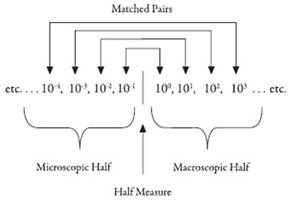
Fig. 3.1. The system of matched pairs