THE IMMORTAL ARCHETYPE
When the soul breaks through the outermost shell of the cosmic egg and becomes truly immortal, it is marked by the sign of immortality. To use a biblical analogy, this may be compared to the mark of Cain—the mark that prevented Cain from being killed lest his killer be subjected to a sevenfold death.
In the tradition of kabbalah, the sign of immortality was represented by the Great Sacred Seal, the sign of the fortieth layer, which was referred to as “I am that I am.” This sign corresponds to the immortal archetype of the immortal body, which is first cognized on the scale of the fortieth layer above the half measure.
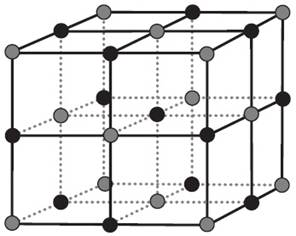
Fig. 12.1. The immortal archetype
Geometrically speaking, the immortal archetype assumes the form of a cosmic cube composed of twenty-seven cosmic eggs. In other words, it corresponds to the unit cell of the transcendental superlattice.
The idea that the immortal archetype assumes the form of a cube can be explained in terms of the Sanskrit: The Sanskrit word for a cube is aksha, which also means “eye,” “letter,” “bead,” “salt,” and “die” (the noun; plural, “dice”). These various meanings provide the basis for various wisdoms concerning the immortal archetype. For example, the cosmic cube can be compared to the eye of God, because it is from the cosmic cube that the Supreme Being can see all things in the imperishable world. Just as the pupil that sits at the center of the human eye (aksha) provides a point of view for the human self on the perishable reality of the mortal world, so the cosmic egg that sits at the center of the cosmic cube (aksha) provides a point of view for the supreme self on the imperishable reality of the immortal world.
The immortal cube can be compared to a letter because it represents a form of space, and hence a form of speech.
This is consistent with the space-speech duality presented throughout the Vedic texts. Just as the sequence of letters (akshas) in the Sanskrit alphabet serve to represent the sequence of layers in the metaphysical Logos, so the same can be represented by a sequence of cubes (akshas) whose parameters are established in terms of the system of matched pairs. In other words, each layer can be assigned its own cubic archetype, which exists on a particular scale of space and time. Yet all of these archetypes reflect the immortal archetype cognized on the scale of the fortieth layer.The immortal cube can be compared to a bead (aksha), because the archetypal cubes that exist on different scales of time and space are strung together like so many beads on a string by the one eternal self. The sequence of letters (akshas) in the Sanskrit alphabet was thus often compared to a necklace of letters (aksha-mala) worn by the Supreme Being.
The immortal cube can be compared to a grain of salt (aksha), because salt crystals have the natural crystalline habit of a cube. To coin a popular phrase, we should take what we read in this book “with a grain of salt,” because the understanding presented here is highly subjective and rooted in an underlying cubic geometry. Yet the analogy goes beyond the overall form of a cube. As we have seen, the internal crystalline geometry of the transcendental superlattice is the same as that of ordinary table salt. From a purely geometric perspective ignoring both scale and substance, the transcendental superlattice is identical formally to the sodium-chloride lattice. By extension, the cubic archetype can be compared to the proverbial “salt of the earth”—the underlying metaphysical foundation of the physical universe.
The cubic archetype can also be compared to a die (aksha) because the enlightened soul is endowed with choice regarding its scale of consciousness. It has the potential to ascend by grasping larger cubic forms of reality, and it also has the potential to descend by grasping smaller cubic forms of reality.
Each choice may be compared to a roll of the dice, or a “roll of the cubes,” because, in the final analysis, all such choices are made by the omniscient Supreme Being, who is the very self of all individual beings. Therefore, in the absence of omniscience, the individual soul will always have some uncertainty about the outcome of its choices—or the outcome of its rolls of the dice. The soul “wins” by ascending the divine ladder, and it “loses” by descending the divine ladder. In this case, the winning roll that results in the attainment of immortality corresponds to the cognition of the fortieth layer above the half measure. This is the ultimate jackpot that makes all other wins and losses pale by comparison. In this way, the term aksha provides a multidimensional understanding of the immortal cubic archetype. In actuality, though, this word is a mantra (a phonemic formula) that encodes the entire spectrum of layers.As we have seen, the letter a represents the infinite self, and the letter k represents the first form of the enlightened soul, cognized on the scale of 1 digit. Moreover, we have seen that the letter s represents the golden yolk of the cosmic egg, cognized on the scale of the thirty-second layer; and the letter h represents the surrounding white, cognized on the scale of the thirty-third layer. When the awareness of the self descends from infinity to the scale of the half measure and then begins its return journey by ascending to the scale of the divine Ka, it becomes the embodiment of a + k. When it ascends subsequently to embrace the entire cosmic egg, consisting of both the golden yolk and its surrounding white, it becomes the embodiment of a + k + s + h. Finally, when it ascends beyond the cosmic egg into the bosom of the infinite, it becomes the embodiment of a + k + s + h + a = aksha. In this way, the term aksha symbolizes both the descending and ascending paths, which lead from the infinite to the half measure and then back to the infinite.
On the scale of the fortieth layer, this cubic archetype is cognized in terms of cosmic eggs, each of which spans hundreds of trillions of light-years. Yet from the perspective of infinity, these eggs may be compared to tiny atoms in the infinite body of God. The Vishnu Purana tells us that to the Supreme Being, the cosmic eggs seem no bigger than paramanus (supreme atoms), and the period called Para, which spans some three hundred trillion solar years, seems no longer than the blink of an eye.