The Life of the Buddha
Written primarily in Sanskrit and Pali, two languages of ancient India, our earliest texts about the Buddha were composed long after he lived. None is a biography of the Buddha; however, some describe events in the Buddha’s life.
Although their accounts are sometimes in conflict, their many points of agreement have served for centuries as elements of the traditional story of the Buddha’s life. This is the story we will tell here.The Early Life of the Buddha
Most scholars believe that Siddhartha Gautama, who was to become the Buddha, lived and taught c. 485-405 bce. According to tradition, Siddhartha’s father was the ruler of a small kingdom that straddled part of what is now the border of India and Nepal.
Siddhartha’s father was determined that his son would follow in his footsteps. Fearing that Siddhartha would be drawn to the spiritual life if he became aware of suffering in the world, he tried to shield his son from the harsh realities of life. And so Siddhartha grew up living a sheltered and luxurious life with no hint of pain. In time, he married a princess, Yasodhara, with whom he had a son. And yet, despite his happy life, Siddhartha grew restless.
At the age of twenty-nine, Siddhartha ventured outside the protected world of the palace. Accompanied by his charioteer, he saw things that changed his life. Buddhists call these the Four Sights. The first was a frail old man. Siddhartha, who had never seen old age, asked if he, too, would become old and feeble. He was dismayed when his charioteer assured him that he would. The second sight was a man afflicted by disease. Sickness, said the charioteer, is also a part of human life. The third sight, a corpse being carried off to cremation, was terrifying. Death, too, said the charioteer, is something no one can escape. Siddhartha now saw through the illusion his father had created and was filled with despair at the inescapable truths of old age, sickness, and death.
It was not until he witnessed the fourth sight that he found some reason to hope. Sitting by the side of a road, he saw a wandering ascetic, homeless and without possessions, who seemed to be content.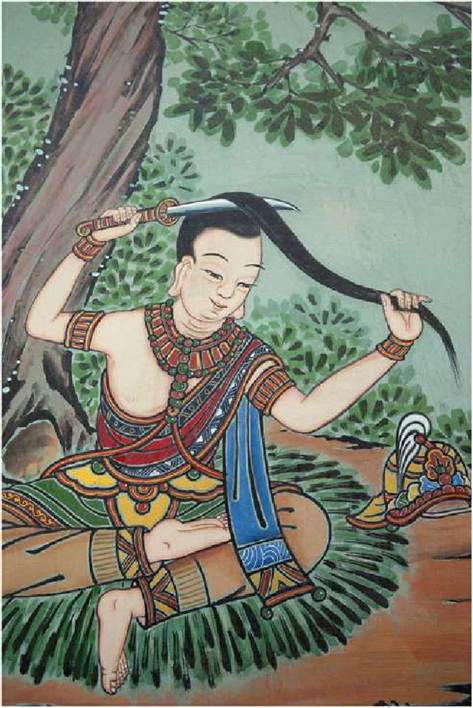
Siddhartha cuts his hair. Mural depicting the life of Buddha, Jogyesa Temple, Seoul, South Korea.
The Great Going Forth
For Siddhartha, the ascetic pointed the way. To return to life within the palace would be to hide from the truth. He resolved instead to face it. He would renounce the life he had lived, become an ascetic, and search for the truth about suffering. One night, he kissed his sleeping wife and son good-bye and silently slipped away. As soon as he was alone in the forest, he took off his expensive clothing and used his sword to cut off his hair, symbolically severing the bonds that tied him to his old life.
At first, Siddhartha turned to ascetic sages renowned for their wisdom, becoming a disciple first of one, then another. They taught him meditation techniques and yogic disciplines, but these left him unsatisfied. He then committed himself to extreme asceticism. After a time of wandering, he found a grove of trees by a river. Joined there by five other ascetics who wished to follow his example, he began to practice severe austerities in the hope they would clarify his thought. For five years, Siddhartha wore rags and did not bathe. He slept on thorns and in cremation grounds strewn with bones and ash. Eating as little as a single grain of rice a day, he became a skeletal figure whose mind was tormented by searing pain.
One day, Siddhartha overheard a music teacher explaining to his student that a string wound too tightly will break, whereas one that is too loose makes no sound at all. To make music, said the teacher, one must find the midpoint between these extremes. These words brought Siddhartha to the realization that neither sensual indulgence nor self-denial is helpful in the quest for liberation from suffering.
Because both weaken the body and the mind, the best path lies between them. This principle of the Middle Way was to become foundational in Buddhism. According to tradition, it was at this moment that a woman came to Siddhartha with a bowl of porridge. He ate it, bathed himself, and then returned to his companions, but they left him when he told them he would no longer practice asceticism.Enlightenment
Siddhartha’s determination was now absolute. At a village in northern India now known as Bodh Gaya, he sat beneath a fig tree and vowed to remain there until he gained the understanding he sought. One night, while deep in meditation, his enlightenment came. At first, Siddhartha recalled all of his past lives. He then saw how karma, the law of causes and effects, had been at work throughout time, conditioning the existence of all beings as they took form and then passed away. Finally, Siddhartha realized that desire is the cause of suffering and that for suffering to end there must be an end to desire.
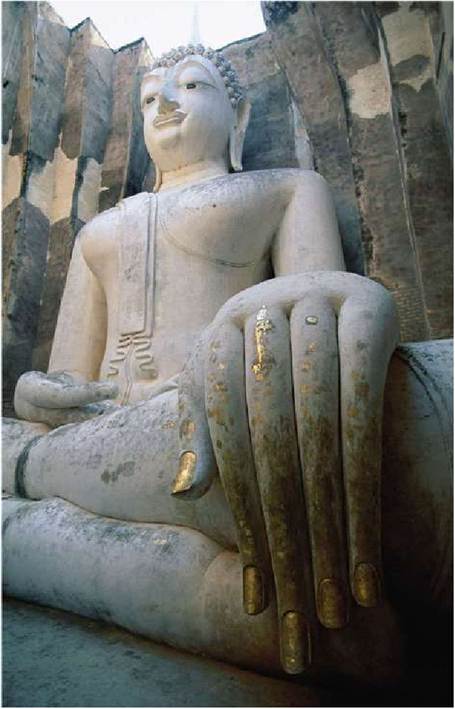
“Calling the Earth to Witness.” According to tradition, the demon Mara afflicted the Buddha with powerful temptations to give up his quest for enlightenment. Ignoring them, the Buddha touched his right hand to the ground, thereby calling upon the earth to witness his unshakeable resolve. Immediately thereafter, he experienced nirvana.
According to Buddhist tradition, Siddhartha was not the first to attain enlightenment. Buddhists believe that others before and after him became, and will become, buddhas. But it is from this buddha that they have received the Dharma, and so for them he is the Buddha, the Enlightened One. His enlightenment brought an end to the desire that causes suffering. It also brought him freedom from rebirth, which results from attachment to the world. Freed from the disturbances caused by attachment, his mind came to rest in its natural state, and he was filled with joy.
He had attained nirvana (Sanskrit; Pali, nibbana), the “extinguishing” of unwholesome desire and the suffering it brings. For many days the Buddha remained close to the site of his enlightenment. Then, moved by compassion for others, he set out to teach what he had learned.Beginning of the Buddhist Community
The Buddha went first to a deer park at Samath, near modern Varanasi, where the five ascetics who had abandoned him were still practicing harsh austerities. Seeing that he had broken through to some new understanding, they gathered around the Buddha, who began to teach them. In his first sermon, which came to be known as the Sermon in the Deer Park, he told them of the Middle Way and set forth the Four Noble Truths and the Noble Eightfold Path, which describe the cause and cure of suffering (pp. 164-165 j. The ascetics became the first followers of the Buddha and the first members of the Buddhist sangha (Sanskrit, “community”), the community of monks and nuns.
It was not long before others joined the sangha. Among them were Rahula, the Buddha’s son, and Ananda, a cousin who became his most devoted disciple. The Buddha wandered across northern India for more than four decades, teaching, ordaining monks and nuns, and accepting lay followers.
The Death of the Buddha
The life of the Buddha came to an end in his eightieth year, forty-five years after his enlightenment. He and Ananda had stopped at the village of Kushinara and eaten at the home of a blacksmith. Something in the meal was tainted, causing the Buddha to become fatally ill. In a grove just outside the village, Ananda made a bed for him between two trees. His monks soon began to gather at the scene, frantically seeking a final bit of the Buddha’s wisdom. When they asked what they would do without him to teach them, he responded that the Dharma would always be their guide. Not long afterward the Buddha closed his eyes, went deep into meditation, and died. Without attachments to the world, and unbound by karmic forces that would have drawn him into another incarnation, he passed into parinirvana, the complete and final entry into nirvana.
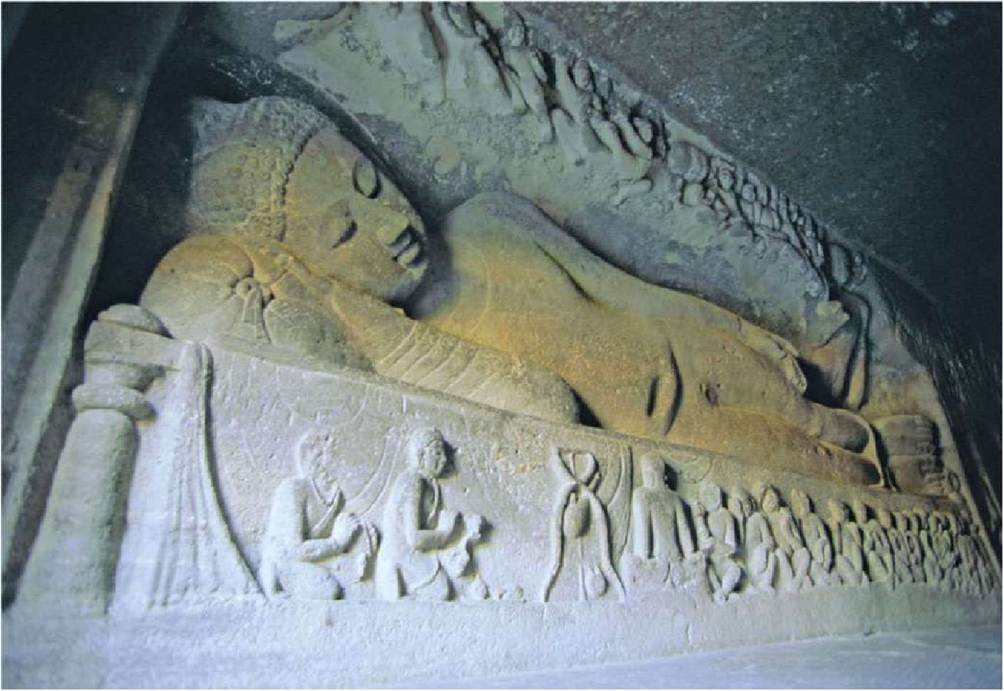
Rock-cut reclining statue of the Buddha preparing to enter parinirvana, in a cave shrine at Ajanta, Maharashtra State, India. Fifth century ce.