The Malevolent Lama
Of the references to the lama, the overwhelming majority are positive, in which the figure serves a benevolent function, protecting the exorcist in incantations or standing as the protective spirit of a city or individual.
Despite these tendencies, there are occasions where the lama appears in a malevolent, antagonistic context. There are three texts in particular that feature this behaviour, though, for our purposes, we will consider in greatest detail an Old Babylonian incantation against a demonized disease.[51] In both of the other two texts, the lama hul appears together with the udug hul, and, moreover, it appears in this fashion in an appropriate place in the text's narrative; in one of the two texts, associated with Inanna, the evil udug and evil lama are associated with the temple of the steppe, the ‘e-gal eden'[52] Though this section of the hymn is unfortunately fragmentary, the steppe would be more readily associated with malevolent supernatural figures than their benevolent counterparts. The other literary text, one dedicated to the goddess Ninisina and celebrating her healing qualities, presents the udug and evil lama in a section describing the various demons who had attacked a man, and thus their antagonistic nature is inevitable given their place in the text[53]The final text that details the dlama hul is an Old Babylonian incantation, bm 92670, which—inclusion of the lama hul aside—follows a standard incantation format. The reverse contains a drawing of a demon, and the text appears matched, or perhaps one of a pair, to another incantation, bm 92669. The two tablets share similar form and orthography, although they differ in content, as the latter is a difficult incantation dealing with the possible binding and removal of magic affecting the king through the scapegoat medium of a bird.
Regardless, the text reinforces the underlying theory of forcing the affliction— be it antagonistic magic or a malevolent demon—away from the patient. In bm 92669, the affliction is removed through the use of a scapegoat medium, and abstracted as something that may be manipulated and thus shifted from one location to another, and, in doing so, forced away from the afflicted. In the other text, cited below and treated in full in the appendix, the afflictions are conceptualized as a number of evil demons, including the dlama hul, and all are forced away from the patient to ensure his recovery:BM 92670 Obv. BM 92670 Rev.
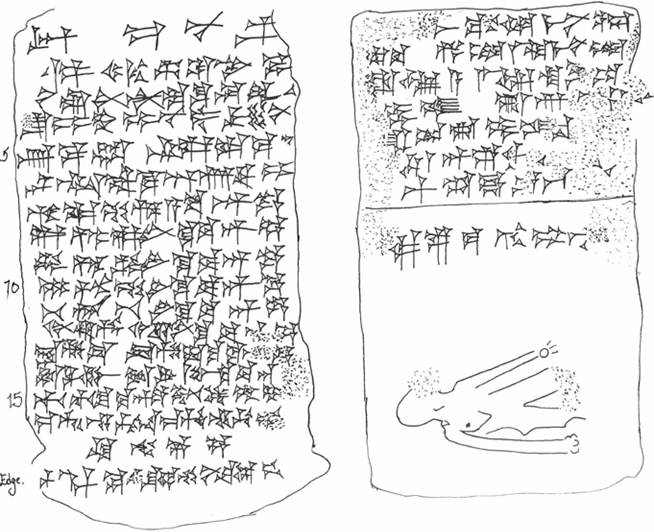
FIGURE 2.1
bm 92670: Reverse 1-6
1 xxx After you come forth,
2 After you burn away that poison by torch,
3 The evil ghost, evil ala demon from the body,
They will leave.
4 From the... they will leave
5 The evil udug, the evil lama—
They will stand aside!
6 This is the wording (of the incantation) of the substitute goat.
Given the overwhelming presence of the lama as a protective spirit, we must wonder why she is depicted as a malevolent spirit at all. The attestations of her in this context are scattered, and so it cannot be attributed to one scribal mistake or idiosyncrasy. These attestations give us evidence for the persistent malevolent presence of the lama in Mesopotamian texts.
In sum, the explanation for this behaviour lies in the pairing of the two figures and the narrative demands of the text.Just as the good udug takes its behavioural cues from the lama in texts where they appear benevolently together, to the point where the good udug is never found without the good lama in accompaniment, the lama here follows the lead of the normally malignant udug. In these few instances, the connection between the two figures and their constant repetition in texts as a paired set is a deliberate link to overcome the inherent tendency of the lama to be a positive figure.
In either case, attestations where they appear against their normal natures are always marked with the appropriate adjective—the evil lama is always marked as the ‘lama hul', while the good udug will be marked as ‘udug sa6-ga’, whereas these adjectives are not required when the figures are acting in accordance with their anticipated behavioural patterns.In these examples we see evidence for the lama's potential to be malevolent, simply presented as an antagonistic figure that must be driven away by the asipu, without apparent need for an explanation or theological contortions to explain the lama's unusual nature. When compiling the evidence for lama—the number of positive attestations, the presence of a benevolent nature even when unaccompanied by the adjective sa6-ga, the long history as a protective spirit and the attestations found in personal names, a clear case is made for the lama as a positive figure. Similarly, the udug—with its number of malevolent appearances, antagonistic actions in texts, associations with poison and bile, and frequent use of hul as an accompanying adjective—presents a clear and definite image as a malevolent supernatural entity in Mesopotamia. The overall ambivalence and fluidity in description of the udug allows for its more frequent appearances in a benevolent role, despite these malevolent roots.