THE METRICAL FORMULATION
Another version of the same supreme wisdom is presented by the first verse of the Rig Veda. The Vedic seers held that the first expression of divine wisdom should contain a synopsis of the whole.
The first letter in any divine name or the first verse in any sacred text were designed to embody the entire wisdom elaborated by that name or text. The first verse of the Rig Veda, which represents the very first expression of Vedic wisdom, was assigned supreme importance. It was designed to embody the whole wisdom elaborated in the ancient text.This design involved the use of measured forms of speech to which we can assign nongrammatical meanings. This ancient practice has recently been illuminated by Maharishi Mahesh Yogi, who has suggested that the sequence and number of letters, syllables, words, verses, hymns, and so forth in the Rig Veda, rather than being arbitrary, were designed to encode a hidden science of the Veda that cannot be deciphered using grammatical rules alone.
Maharishi suggests that, in accordance with the ancient tradition, the first verse of the Rig Veda maps out the “unmanifest blueprint of creation” that is inherent in consciousness. Most fundamentally, this blueprint relates to the set of metaphysical layers that constitute the complete spectrum of reality. The most fundamental elements of speech correspond to the letters from which are composed all expressions of speech. The letters in the first verse of the Rig Veda were measured carefully so that the verse contains a precise number. More specifically, the verse was designed to contain fifty-four Sanskrit letters that correspond directly to the fifty-four layers, or grades of divine speech, that abide in the upper sonic half of the spectrum.
Yet the fifty-four letters represent merely the measurable grades of speech inherent within the fifty-four layers. The ultimate immeasurable grade of speech associated with the absolute fifty-fifth layer is implied instead of being represented explicitly.
This understanding was made clear in a lecture given by Maharishi in India in 1988: Surrounded by several thousand Vedic pandits, he explained that the first verse of the Rig Veda has at the end an unmanifest letter (avyakta aksha) which is to be understood in principle, but not pronounced or written in practice. The traditional Vedic pandits concurred.This unmanifest letter represents the immeasurable grade of speech that abides in the immeasurable reality of the self. It can scarcely be called a grade of speech, because it is equivalent to silence. Therefore, it is represented by the silence that arises at the end of the first verse, before the next verse is recited. In this way, the first verse presents an alternate formulation of the 54 + 1 = 55 supreme wisdom. Literally, it encodes the unmanifest blueprint of creation that abides in consciousness.
But there is more. The grammatical meaning of the first verse is expressed in terms of nine Sanskrit words: The first seven, which together contain exactly forty-two letters, describe the process of self-sacrifice by means of which the soul progresses on the path of immortality—that is, by ascending through the forty-two layers. The last two, which together contain a total of twelve letters, describe the fruit of self-sacrifice, the goal of the sacrificial path. The last twelve letters represent the dvadashanta, the twelve at the end. More specifically, the last twelve spell out the two words ratna dhatamam, with the transliterated form of dh to indicate that it represents a single Sanskrit letter. The word ratna means “jewel” or “crystal,” and the word dhatamam means “supreme upholder.”
The grammatical meaning serves as a commentary on the sequence of letters, suggesting that the fruit of all forms of self-sacrifice, or the goal of the path, involves realizing the self as the supreme upholder of the ratna, the crystalline structure of the Veda or Logos. The supreme upholder of the crystalline structure of consciousness is none other than the infinite continuum of consciousness, which represents the supreme self.
According to the supreme wisdom, the supreme self has twelve internal divisions, which correspond to the twelve at the end.Unlike the first forty-two letters, or layers, which represent the external divisions of the self where “another” can be conceived on the basis of duality, the final twelve letters, or layers, represent the internal divisions of the self where all notions of otherness or duality are drowned in unity. When the soul ascends to the forty-third layer, the first of the twelve at the end, the crystalline structure of consciousness becomes indistinguishable from the underlying continuum of pure consciousness, which supports or upholds that structure. As a result, all notions of otherness are transcended.
In this sense, the twelve letters at the end represent the state of Vedanta, which marks the “end of the Veda.” The first forty-two letters, on the other hand, represent the very embodiment of the Veda in the form of the forty-two discrete layers, which constitute the adornments of the self. We recall that in the Hebrew tradition the unique divine name was viewed as consisting of forty-two letters that represent the adornments of the name. Traditionally, these forty-two letters are encoded by the first forty-two letters of the Book of Genesis, the oldest and most authoritative of the ancient Hebrew texts. The commentaries make it clear that these represent the forty-two layers that constitute the path of immortality.
We can find that the same practice was employed in the Vedic tradition: The first forty-two letters of the Rig Veda were designed to encode the forty-two layers that constitute the path of immortality. Yet the first verse of the Rig Veda goes beyond the first forty-two layers or letters and was instead designed to encode the complete spectrum of 42 + 12 + 1 = 55 layers that constitute the supreme wisdom.
The unmanifest letter that abides at the end of the first verse is the unspoken form of the letter a, which is also the first spoken letter of the verse.
Here, we can say that what is realized in the beginning is also realized in the end, in accordance with the principle “as in the beginning, so in the end.” In actuality, there is a mysterious Vedic doctrine regarding the letter a: According to the Agama texts, which deal with the science of mantras (sonic formulas) and yantras (geometric diagrams), a represents the self (atman) of all the letters. It is therefore assigned three names: the first (prathama), the all-pervading (vyapaka), and the immeasurable (aprameya). 1 The hidden meaning of these names is revealed when the immeasurable and unpronounceable form of a is added to the end of the first verse of the Rig Veda. This addition completes the symmetry of the verse.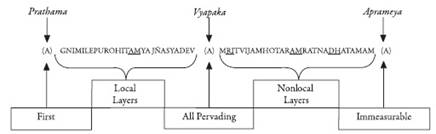
Fig. 13.1. The complete symmetry of the first verse of the Rig Veda
In this diagrammatic representation, the first, middle, and last letters are represented by three forms of the letter a. The first (prathama) form represents the first layer above the half measure, where the human soul becomes enlightened—the first state of enlightenment, when the self is filled with both universal light and sound. The middle or all-pervading (vyapaka) form corresponds to the twenty-eighth letter in the sequence and represents the twenty-eighth layer above the half measure, where the ascending soul arrives at the highest heaven within the visible universe and attains universal consciousness. On this level of realization, the self pervades the entire visible or local universe—that is, it becomes all-pervading. The final or immeasurable (aprameya) form represents the immeasurable reality of the self, which transcends all finite names and forms. This marks the supreme or final state, when the pointlike soul realizes its identity with infinity—that which is bigger than the biggest.
By adding an unmanifest letter to the end of the first verse, the bilateral symmetry of the verse becomes complete and the verse becomes a lettered formulation of the supreme wisdom. In this way, the Vedic seers formulated the supreme wisdom in two complementary ways: using letters of the first verse of the Rig Veda and the letters of the Sanskrit alphabet.