THE MINOANS
As preserved, the Minoan religion is largely known to us through (a) palaces, urban-type settlements and villas, (b) so-called “peak sanctuaries” and (c) tombs from the island of Crete.
The centre of the system seems to have been the palace at Knossos. Regardless of whether the Minoan ruler at Knossos controlled the entire island or even parts of the Aegean, s/he certainly controlled the region around the palace of Knossos, and the entire culture in terms of iconography and language; Knossos had a leading role in the representation of Minoan civilization. The identity of the ruler in the palace there is difficult to specify. Dominant ruling males in the Bronze Age Aegean are conspicuously absent in the sense that they do not dominate the iconography (as is the norm in the contemporary civilizations of Egypt and the Near East). However, a male figure does occasionally appear, sometimes closely (Figure 12.4) and sometimes loosely (Figure 12.5) associated with lions and griffins, and this can be related to Near Eastern expressions of political power. Men also appear in the context of the “divine epiphany”, where the divinity appears to be female, frequently beheld by women as well as men.One seal found at Knossos was drawn and discussed by Evans (Fig. 12.5). It shows what appears to be a goddess standing atop a mountain peak flanked by lions. The goddess is firmly holding a simple staff (a symbol of power in the Near East and Aegean), displaying it to the man in the plain below who is overwhelmed by the sight of the goddess. What appears to be a corner of a palace with the typical Minoan “horns of consecration” is on the plain in the background. Thus from the art, one is under the impression that women appear dominantly and frequently, and indeed that society was dependent upon the worship of the goddess who assured the welfare of the state and its representatives. If the iconography is understood correctly, power belonged to her, and thus it is hardly surprising that in the Mycenaean texts we probably encounter her as Po-ti-ni-a, floTvia/Potnia, the “Mistress” (see below).
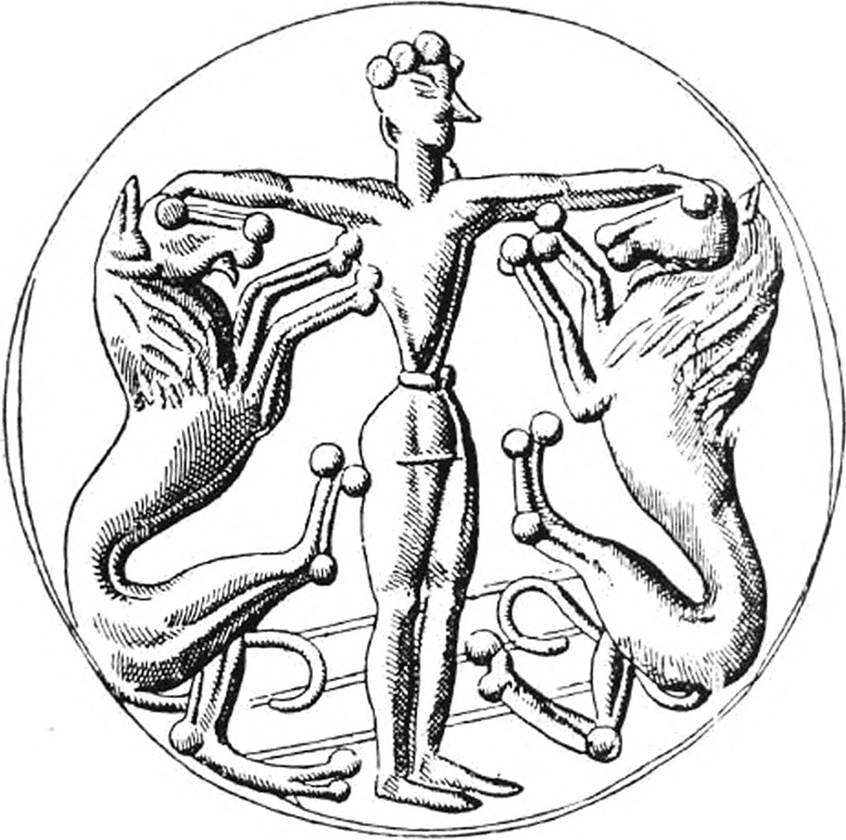
Figure 12.4 Evans’s copy of Minoan or Mycenaean seal with male figure between crouching lions (original less than 2 cm across) (Evans 1921-35: IV. 467).
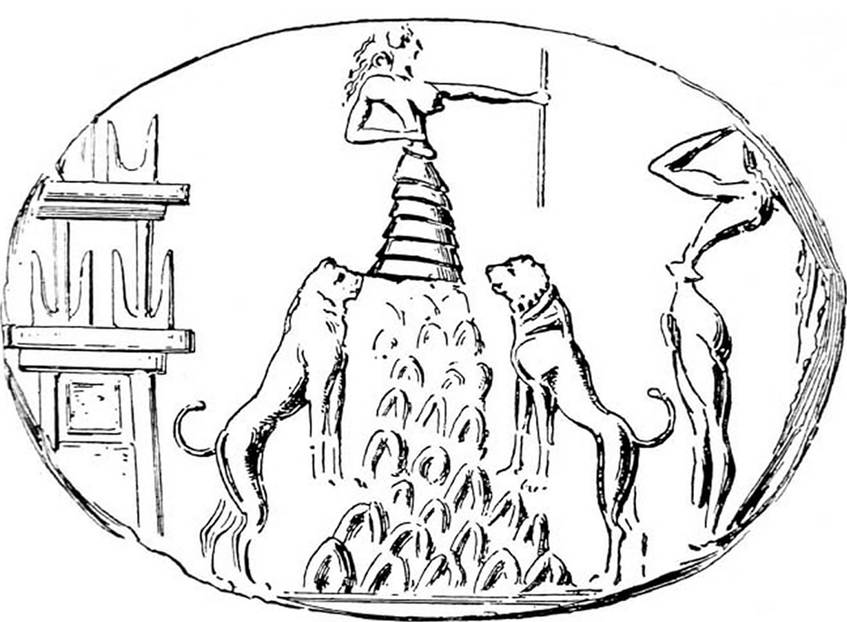
Figure 12.5 Evans’s copy of a seal found at Knossos (original ca. 2 cm across) (Evans 1921-35: III. 463, II. 809).