The Religious Life of the Jain Laity
Although Jainism is best known for its asceticism, a balanced understanding of the religion demands a careful look at the role of the laity. For one thing, lay adherents constitute the great majority of Jains.
Also, even as the laity looks to the monks and nuns as exemplars of Jain ideals, the ascetics themselves depend on the lay community for their livelihood and support. In other words, these two components function hand in hand. The worship activities of the Jain laity are rich and diverse and have been a vital part of the religious life of India for centuries.Jain worship occurs on two separate levels. At the more mundane level, the objects of worship are various gods who, as we have noted, tend to be the same as those worshiped by Hindus. While having nothing to do with the ultimate religious pursuit of liberation, the gods are believed to respond to material needs, such as providing weather favorable for agriculture and cures for health maladies.
On a more sublime level, Jains worship the tirthankaras—even though they, like the gods, are unable actively to assist a worshiper in achieving salvation. Nevertheless, worship of the tirthankaras nurtures a properly devout religious attitude; its net effect is to burn off the dirtying karma that weighs down the soul. It is this second level of worship that warrants our consideration here.
Religious Places
In its most visible form, Jain worship concentrates on images of the tirthankaras, although, as we have observed, the Sthanakvasis and Terapanthis shun this. Most of this worship takes place in temples, some of which rank among India’s most impressive architectural achievements. For example, the Dharna Vihara at Ranakpur in the state of Rajasthan, which is dedicated to the tirthankara Rishabha, is remarkable for its unique four-directional design, four-faced image of the tirthankara, and 1,400 carved columns.
Along with such spectacular temples as the Dharna Vihara, many temples coexist with shops and offices on city streets, indistinguishable from the neighboring buildings.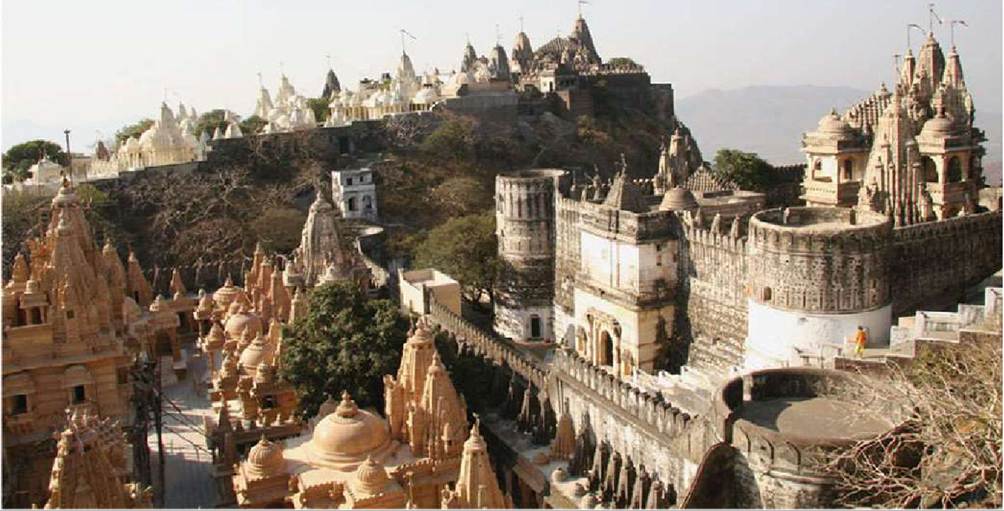
Shatrunjaya, a hill near the town of Palitana, India, and for centuries an important Jain pilgrimage site, features 863 temples of various sizes and styles.
Jain sacred places also include various sites in the countryside, such as Mount Shatrunjaya in Gujarat in western India, one of five sacred mountains for Shvetambara Jains. Hundreds of shrines are located at Mount Shatrunjaya, and one textual tradition predicts that nineteen future tirthankaras will spend time preaching there.
Pilgrimages to places like Mount Shatrunjaya constitute an important aspect of lay worship. Every Jain strives to make at least one pilgrimage in his or her lifetime. Typically undertaken at considerable expense, the pilgrimage offers each lay individual an opportunity to experience, through the interruption of normal life and the rigors of journeying to the site, an ascetic lifestyle for a temporary period. This experience allows for the concentration of effort in gaining karmic merit. Traditionally, pilgrimages were made on foot, which is still the mode of transportation for ascetics. Today, laypeople often travel by train or other modern means. Sometimes the expenses for entire groups of pilgrims are paid for by one person, who is thought to gain much karmic merit through this act of benevolence.
Rituals and Observances In addition to the relatively rigorous periods of pilgrimage, the religious life of the Jain laity overlaps with that of the ascetics in some everyday aspects. All Jains are careful with regard to their eating habits. They are diligently vegetarian, and they go well beyond abstaining from meat by avoiding foods such as eggs, vegetables, and fruits with a large number of seeds in order not to destroy life forms unnecessarily.
Fasting, a common practice among ascetics, also is quite common among the laity, especially, as we have seen, among women.These similarities notwithstanding, it is easy to observe that in almost every way, the ascetics’ religious life demands significantly more by way of exertion and endurance of physical hardships than does the religious life of most laypeople, who strive mainly to behave morally in order to ebb the flow of harmful karma and thus to foster a good rebirth. As we observed at the outset of this chapter, the ritual of dana (the giving of food to monks and nuns) provides one opportunity to be a good Jain layperson and to enhance one’s karmic status. A somewhat similar practice involves bidding for the right to sponsor rituals, with any extra money being donated to charitable causes and the winning bidder gaining in social esteem. Whenever a new image of a tirthankara is erected or installed in a temple, for example, rituals are performed to celebrate each of the “five auspicious events” of a tirthankara’s life: conception, birth, renunciation, attainment of kevala, and moksha. The person who sponsors the building of such an image and funds the rituals is said to acquire positive karmic merit, so that the person likely will be bom into a world blessed with a living tirthankara.-
A formalized system of religious observance features the Twelve Vows for the layperson. The first of the Vows, for instance, makes clear that it is the intentionality, rather than the specific action, that most matters with regard to ahimsa. Proper intentionality is involved, for example, in choosing the right profession, one that would not likely result in violence toward sentient life forms. As a result, through the centuries Jains have tended to engage in trade and other forms of business. Obviously, harmful occupations such as hunting and fishing are strictly prohibited; farming is acceptable because it can be done without intentionally harming life forms. Trade and business, however, are generally considered optimal because they can be done without causing any harm at all.
Video: Paryushana Parva