The Renewal Movement
The Jewish Renewal movement is, to date, the most far-reaching attempt to breathe new life into Jewish religious institutions: it seeks nothing less than to redefine what it means to be a committed Jew in the modern age.
Advocates of this movement regard established devotional life and prayer routines—and particularly in the United States—as uninspiring and obsolete, and their collective goal is to move Diaspora Judaism in the direction of greater religious authenticity and heightened spirituality. While the Renewal movement has had a relatively modest impact institutionally, there are three areas of Jewish communal life where we can see the direct influence of Renewal ideas: congregational prayer and study groups (Hebrew, pl., chavurot), the rabbinate, and environmental politics.The Chavurot Beginning in the 1960s, small study groups began to appear in Reform and Reconstructionist synagogues, dedicated to a program of intellectual enrichment and spiritual revival advocated by Rabbi Zalman Schacter-Shalomi, a former Hasidic teacher and advocate of kabbalistic ideas and values. The purpose of the chavurah (Hebrew, sg.), as he understood it, was to both educate and inspire marginally committed Jews to take a serious interest in Judaism’s sacred texts, and to adopt a form of prayer that was more fervent than they were accustomed to. His associate, Rabbi Schlomo Carlebach, composed wordless neo-Hasidic melodies (Hebrew, niggunim) to accompany these prayers, once again in the hope of eliciting greater emotional intensity, and even spiritual joy, from the participants in chavurah-style prayer. Under Schacter-Shalomi’s direction, many of his early chavurot engaged in meditation as well as spontaneous, improvisational prayers, treating the synagogue liturgy as something open- ended rather than as a body of tradition-bound declarations.
Women and the Rabbinate
A growing demand to admit women to a greater role in Jewish education and synagogue leadership was apparent early in the twentieth century, decades before the Renewal movement embraced this idea, but the presence of Renewal advocates within both Reform and Reconstructionist synagogues during the last quarter of the twentieth century hastened the day when an even more radical idea gained support in both communities: the ordination of women as rabbis with religious authority equal to that of their male counterparts.
In 1972, the American Reform movement took the lead in this revisionist effort by conferring the title of Rabbi on Sally Jane Priesand (b. 1946), and shortly thereafter both the Reconstructionist and Conservative movements began to admit women to their respective rabbinical seminaries. Today, the presence of a woman rabbi on the pulpit of a Reform or Conservative synagogue is no longer a novelty, and though most Orthodox synagogues have yet to embrace this idea, non-Orthodox communities have endorsed this change with enthusiasm.In part, the decision to transform the rabbinate into an egalitarian institution was a response to what is commonly termed “second-wave feminism”; that is, the larger cultural shift toward gender equality that swept over much of the Western world in the 1960s and 1970s. But it is also true that the impetus to revisit Jewish tradition with respect to the status of women in religious life came from within Jewish religious culture itself.
Traditionally, the status of women in Judaism has been that of respected but subordinate members of the religious community, and for many centuries Jewish women lived in a maledominant culture. Although two of the books of the Hebrew Bible are named for women (the book of Ruth and the book of Esther) and Jewish identity is (traditionally) traced through the mother’s line, religious leadership in Judaism has historically been a male preserve. The Orthodox Siddur (Hebrew, a single volume that became the primary source of the synagogue liturgy) instructs Jewish males to thank God that they were not bom women, and rabbinic tradition released women from all time-bound religious obligations (such as fixed prayer times), based on the assumption that a woman’s chief responsibilities were to raise children and maintain the home. The only ritual obligations that women were expected to fulfill were those of baking challah, lighting the Sabbath lights, and attending the mikveh. And although women were never prevented from attending synagogue, their very presence necessitated a physical barrier to separate them from male worshipers, who, it was feared, would otherwise be distracted by their presence.
Moreover, the privilege of advanced religious study was reserved exclusively for men, who were thought to be better equipped by nature for the mental rigors of scholarly debate.By the 1970s such views had come to be viewed as unacceptable by Jewish feminists and were categorically rejected by leaders of the Renewal movement. As women were being admitted in greater numbers to the rabbinate, the language of prayer began to change as well. Feminist scholars began to focus on the gendered vocabulary that surrounded the biblical idea of God, as well as echoes of a distinctly masculine image of the Deity in traditional prayers, where God is consistently referred to as “Father,” “Lord,” and “King.” Renewal liturgists began to experiment with gender-neutral language such as “Eternal One” and “Source of Life” as alternatives to the obviously patriarchal terminology of the traditional Siddur. In addition, the elimination or revision of prayers that implied the spiritual superiority of the male or that excluded women from the prayer community by omission became part of the same revisionist project. Not all of these innovations have proven universally acceptable, but collectively they represent a serious effort to bring the religious discourse of Judaism into the contemporary world.17
Jewish Ecology
In addition to enhancing the status of women in Judaism, advocates of Jewish Renewal have also enthusiastically supported the ecological movement since the early 1960s, and they have found various ways to adapt a new awareness of the environment, and the crisis it is facing, to an observant Jewish life. Under the influence of Rabbis Arthur Waskow and Ellen Bernstein, Renewal chavurot began to practice a form of “eco-kashrut” (i.e., an expansion of traditional dietary laws to include a concern for farming practices and the wasteful eating habits of modern societies) in an attempt to deepen the Jewish commitment to social justice and personal responsibility.
Under the rubric of bal tashchit (Hebrew, meaning “do not destroy”) a distinctive Renewal ecological ethic has emerged that attempts to link biblical precepts to contemporary political imperatives: “Humans are guests on earth; God is our host. We are part of the web of life, and simultaneously, we have a unique task: to preserve this beautiful gift of the earth for the next generation. This responsibility is a part of what it means to be human. For Jews, caring for the earth is our birthright and responsibility: we need only remember the most intimate responsibility between adam (earthling) and adamah (earth).”— The implications of this form of “deep ecology” extend beyond the dietary code, however, and entail a heightened consciousness of the sanctity of life. For some Renewalists the principle of bal tashchit extends to all of life, and that carries with it an absolute commitment to pacifism. Michael Lerner makes this case most emphatically when he applies this lesson to Israel and its relationship with the Palestinians: “Jews were never enjoined to make a sociological study of the morality of other nations, and then to conform to that morality. While it seems illegitimate for others to hold us to a higher standard than they hold themselves or the rest of the world, it is perfectly legitimate for us to hold ourselves to a standard not based on what everyone else is doing. That is precisely what having the Torah is about—having a special responsibility to bring to the world a way of living in accord with our understanding of God's revelation.”19GLOBAL SNAPSHOT
Judaism in India
In addition to historically influential communities in Europe, the Middle East, and North America, Jews have also established themselves in places remote from these centers of Jewish life. In India, three culturally distinct groups of Jews have flourished.
The largest of these groups is the Bene Israel (meaning “Sons of Israel”), which claims to be descended from one of the “lost” ten tribes of ancient Israel, and whose ancestors allegedly migrated to India over 2,000 years ago.
When travelers from Iraq discovered them in the eighteenth century, the Bene Israel still observed the Sabbath, and they continued the practice of circumcision and observance of the dietary code. In the 1830s, Iraqi Jews fleeing Muslim persecution joined the Bene Israel community. Of all of the subgroups of Indian Jews, the Bene Israel appear to have prospered the most under British rule. With Indian independence, however, and the establishment of the State of Israel, the majority of Bene Israel chose to emigrate to Israel, where, at first, their identity as authentic Jews was questioned by rabbinic authorities. By 1964, the Bene Israel were declared historically and ritually Jewish, prompting even further emigration from India.Two other Jewish communities in India occupy a place in the history of Judeo-lndian culture: the Cochin Jews and the Baghdadi Jews. The Cochin Jews claim to have arrived and settled near the city of Cochin sometime after the division of the two kingdoms (Israel and Judah) following the death of King Solomon. More recent arrivals to this community came from Spain and Portugal after the Jews’ expulsion from both kingdoms in the late fifteenth century, and even later during the seventeenth and eighteenth centuries, when Jewish immigrants from the Middle East found their way to Southern India.
Baghdadi Jews came mostly from Iraq, fleeing Muslim persecution during the nineteenth century. Like their counterparts in the Cochin community, they assimilated to Indian society through marriage. Today, there are very few members of either group still living in India or retaining Jewish identity. As with the Bene Israel, so with the Cochin and Baghdadi Jews: the attraction of Zionism and of the newly created state of Israel held out the promise for Indian Jews of a more complete and fulfilling Jewish life. It was this promise, rather than any persecution, that prompted them to abandon life in India.
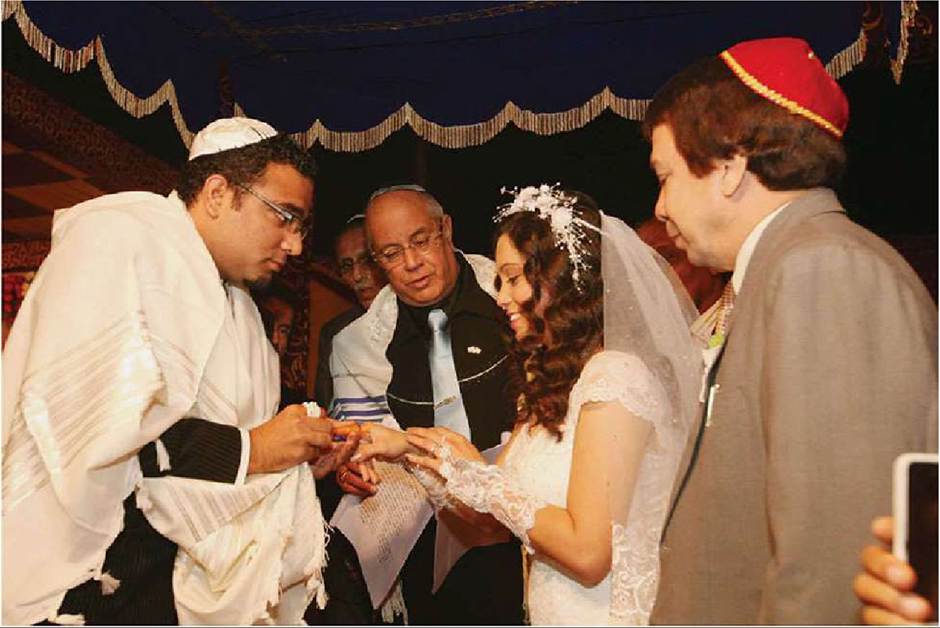
In 2012, New Delhi hosted the first Jewish Indian wedding in fifty years. Here, the bride and groom exchange rings as they are married in the Bene Israel tradition.
Self-Assessment 11.2
[Please note: You must be using an online, browser-based eReader in order to view this content.]