There are two main questions to address before attempting to write an account of Italic religion: how do we define “Italic religion”, and is there sufficient evidence to discuss it?
By “religion” we mean systems of belief and the ritual practices that they entail. Strictly speaking, “Italic” refers to the related languages of Umbrian, South Picene, Oscan and Latin spoken by various peoples in Italy in the first millennium BCE (languages are only attested from the sixth c.
BCE onwards). These peoples include the Umbrians, Picenes, peoples of the central Apennines (Sabines, Vestini, Marrucini, Paeligni and Marsi), Campanians, Samnites, Lucanians, Bruttians and Daunians (see Figs 15.1 and 15.2). One might also extend the designation to encompass the Messapian speakers of Apulia, and the Veneti in the north-east (Linderski 1996: 1302), although constraints on space and the limits of our expertise prevent us from treating these peoples too. But the term does not include the Etruscan, Greek, Ligurian or Celtic inhabitants of Italy, and in practice the religion of Latium is so closely bound up with Rome that it is normally treated as part of that city’s religious history.Differentiating Italic from Roman, Etruscan and Greek religion is not always easy or desirable. As might be expected, there were in reality a whole range of religious traditions practised by a great variety of different peoples, who were linked only tenuously by the sharing of linguistic features. Whether this was a development out of an original, more unified, linguistic (and ethnic?) situation is highly controversial, but it is certain that in the historical era there was no single unified Italic people. Diversity is characteristic of Italic societies, who are often more similar in religious terms to their neighbours, be they Etruscan, Roman or Greek, than to other far-off Italic peoples. Critical here is the nature of Italian geography, and the way that Italic peoples were spread out over the peninsula (see Figs 15.1 and 15.2). The dominant features are the high peaks of the Apennines, running down the backbone of Italy, and the surrounding sea.
On the eastern coast, the Picenes, Frentani and Daunians were linked by trade in the Adriatic Sea, particularly between Greece in the south and the ports of Spina and Adria at the mouth of the river Po in the north. On the western Tyrrhenian coast, the better harbours and more significant mineral resources were mostly in the hands of Etruscan, Latin and Greek city-states (as well as Rome). Connections between the peoples of the Apennine hinterlands and the coast were usually strong, and so we find the Umbrians closely linked to the Etruscans, the Sabines to the Romans, and the Campanians and Lucanians to the Greeks. As a result, it is more accurate to speak of “Italic religions” rather than “Italic religion” as a unified concept. Nevertheless, as we shall see, there are enough structural similarities between Italic religions for it to make sense to study them as a collective group.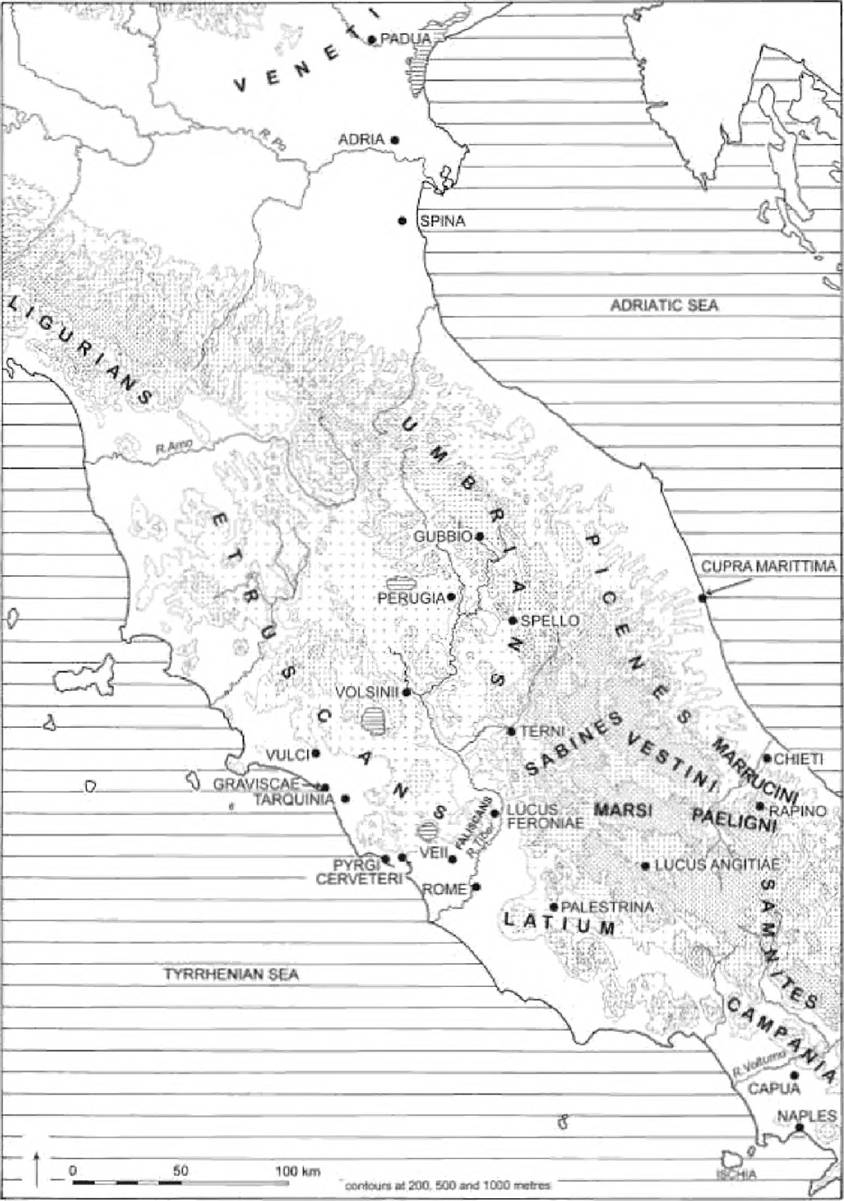
Figure 15.1 Central Italy, with ancient peoples and selected cult sites. Drawn by Howard Mason, reproduced with permission.
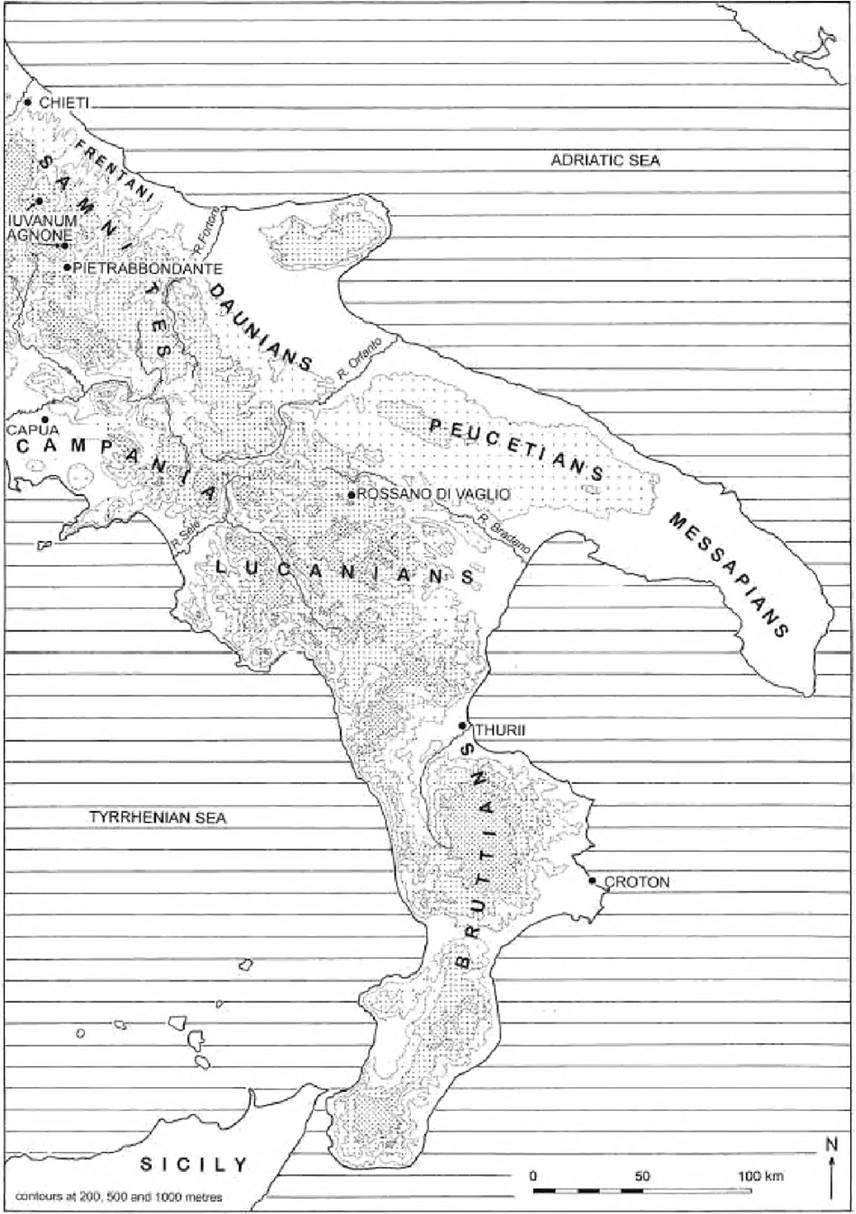
Figure 15.2 Southern Italy, with ancient peoples and selected cult sites. Drawn by Howard Mason, reproduced with permission.
Like all the peoples of Italy, the Italic-speaking populations were deeply
affected by the expansion and consolidation of Roman power, and the critical historical periods of Italic religion are to be understood in relation to the three main stages of this process (for more detail see G. Bradley 2007):
1. Archaic and classical period, sixth-fourth centuries BCE: the period before the Roman conquest when the first significant evidence of Italic religions appears.
2. Hellenistic period, late fourth-early first centuries BCE: the Roman conquest and its aftermath when many of the Italic peoples were conquered by Rome and most of them entered into alliances with the hegemonic power, either voluntarily or under coercion. This system of alliances left much of their financial and political autonomy intact. This is the most fruitful period for the study of distinctively Italic religions.
3. Late Republic, from 91 BCE to the Augustan era, ending in 14 CE: the Social War at the start of this period (91-88 BCE) saw many of the Italic peoples rebel against Rome, but they were defeated and made full Roman citizens. As a result they lost much of their cultural distinctiveness, becoming largely homogenized. Their languages were submerged by Latin.