Together with language, religion is one of the most common criteria used by authors of classical antiquity for establishing ethnicity,
as Pliny the Elder asserted with reference to the populations of the so-called Baeturia celtica, a region which was south of the river Guadiana: Celticos a Celtiberis ex Lusitania advenisse manifestum est sacris, lingua, oppidorum vocabulis (Naturalis historia [Natural History] 3.13): “These are the Celtici who descended from Celtiberians out of Lusitania, as their religion, their language and the names of their cities demonstrated.” Yet, by nature, religion is an elusive phenomenon and, in general, we only have a very minimal knowledge of the religious systems of the peoples of the Iberian Peninsula because these peoples did not use writing in pre-Roman times to communicate with their gods in a fashion which allows much specific interpretation, nor are their rituals and doctrines preserved in writing.
When the main Mediterranean powers - Carthage and particularly Rome (third c. BCE) - intervened in the peninsula, there were two major linguistic zones: a zone inhabited by tribes who did not speak Indo-European languages, known as “Iberians”, which extended along the coast from lower Andalusia to Languedoc and inland as far as the mid-Ebro valley, and another zone inhabited by Indo-European tribes in the interior of the peninsula, where at least two languages have been attested: Lusitanian in the west and Hispano-Celtic in the two plateaus and Celtiberia (Fig. 14.1).
Besides this general linguistic duality, the degree of their Hellenistic and Roman acculturation further divides the native Hispanic tribes into three distinct areas, depending on how far they were from the Mediterranean, as illustrated in a well-known passage by Strabo, writing during the Augustan Principate. Strabo (3.4.16) says that the Gallacians were atheists, whereas the Celtiberians and their northern neighbours worshipped an unnamed deity, in honour of whom they danced on nights of the full moon.
The supposed atheism of the Gallacians conflicts with the abundant votive epigraphy in the north-west and thus should be interpreted as a denigrating strategy employed by Strabo to underline the extreme barbarism of the peoples living farther away from the Mediterranean. A minor degree of “barbarism” must have been that of the Celtiberians, whose gods were yet unnamed (like those of the pre-Greek Carians mentioned by Herodotus [2.52]). What the geographer did not mention, but took for granted, was that there was a third group of other peoples, the coastal Iberians, who had gods with names; names that had been given to them by the Mediterranean colonizers centuries before, from the times of the mythical Tartessos: first the Phoenicians and the Greeks, and later the Italic and other peoples who came with the Roman conquest and colonization.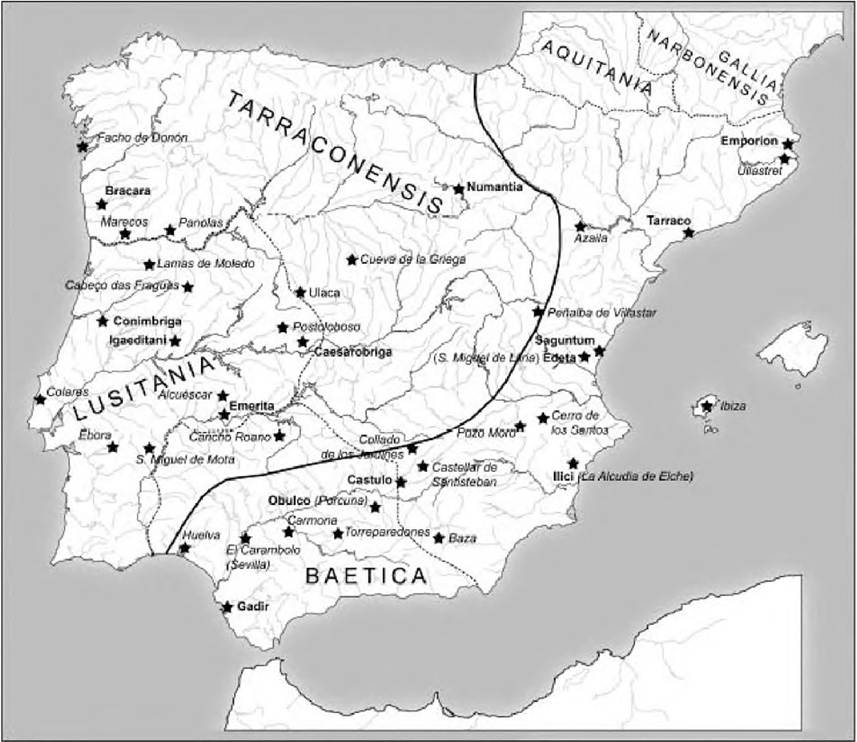
Figure 14.1 Sanctuaries and main places mentioned in the text. The line divides the Indo-European (west) and non-Indo-European (east) parts of Hispania. Modern toponyms appear in italics. © F. Marco Simon.
More on the topic Together with language, religion is one of the most common criteria used by authors of classical antiquity for establishing ethnicity,:
- Bredholt Christensen Lisbeth, Hammer Olav, Warburton David. The Handbook of Religions in Ancient Europe. Acumen,2013. — 456 p., 2013
- The Yogi's Way of War