15 TRACES OF THE OMEN SERIES SUMMA IZBUIN CICERO, DE DIVINATIONE*
JOHN JACOBS, LOYOLA UNIVERSITY MARYLAND
Divination played a central role not only in the cultures of the ancient Near East, but also in those of the ancient Mediterranean. Recent years have witnessed a welcome resurgence of interest in the subject — divination between theory and practice, divination between belief and skepticism, divination between religion and science.* 1 * In particular, scholars have focused on the central role that divination played in the social, religious, and political life of the fall of the Roman Republic, during the century beginning with the Gracchan revolution (133-121 B.C.) and ending with Octavian’s victory over Antony and Cleopatra at the battle of Actium (31 B.C.).2 One of the key figures during this tumultuous period of transition from Republic to Empire was the orator and statesman Marcus Tullius Cicero (106-43 B.C.).
Like many, if not most, of his contemporaries, Cicero held complex, and often conflicting, views about the role of divination both in the life of the individual and in the life of the state.3 In a series of three treatises composed around the time of Caesar’s assassination on the Ides of March in 44 B.C. — De natura deorum (On the Nature of the Gods), De divinatione (On Divination), and De fato (On Fate) — Cicero examines how the major contemporary schools of philosophy address the many difficult and challenging questions concerning the relationship between the worlds of god and man. While scholars have long studied divination in the ancient Near East and in the ancient Mediterranean in isolation, few have undertaken any substantial comparative analysis of the available material. In this paper, I attempt to begin to bridge this divide: in particular, I attempt to discover traces of the omen series Summa izbu in the De divinatione and to explain how that omen series may have been transmitted, along with others, from east to west.In the two-book De divinatione, as elsewhere in his extensive corpus of rhetorical and philosophical works, Cicero explores his chosen subject through a fictional dialogue. On this occasion, he converses with his younger brother, Quintus — as literary characters, and not as
historical figures speaking in propria persona — during a visit to his estate at Tusculum (cf. Cicero, De divinatione 1.5.8-6.11).4 The dramatic date of the conversation may have been some time late in 45 or early in 44 B.C.; in all likelihood, Cicero substantially completed the De divinatione before Caesar’s assassination, but revised it and (only then) published it shortly after the Ides of March.5 In book 1, Quintus presents the traditional Stoic and Peripatetic arguments in favor of the view that divination is a means by which man can (potentially) discern the will of the gods; in book 2, Marcus furnishes a typically Academic deconstruction of these arguments.6 For more than a century, scholars concentrated most of their efforts on the study of Cicero’s sources, including, most notably, the Peripatetic Cratippus of Pergamum (ca. first century B.C.) and the Stoic Posidonius (ca. 135-ca. 51 B.C.).7 * During the past twenty-five years, however, scholars have rediscovered the De divinatione as an erudite and sophisticated treatment of an important cultural phenomenon, something much different from and, accordingly, something much more than a straightforward expression of Cicero’s (or, rather, Quintus’ and Marcus’) personal views.8 Nevertheless, the De divinatione also remains an important source for information about the Realien of divination in the ancient Mediterranean (Greek, Etruscan, and Roman), as well as in the ancient Near East.
Conversely, the omen series of the ancient Near East remain a largely unexplored, but potentially quite significant, source of information about the Realien of divination not only in the ancient Near East, but also in the ancient Mediterranean.
These series, now extant only in fragments for the most part, cover virtually every type of divinatory practice, from terrestrial and celestial omens to teratological, physiognomic, and oneiromantic (or oneirological) omens, from lecanomancy (oil divination) to libanomancy (smoke divination). Of particular importance for the comparative study of divination in the ancient Near East and the ancient Mediterranean are the twenty-four tablets of the teratological series known by the incipit Summa izbu (“If the malformed birth”).9 Each of the entries in this omen series appears in the form of a conditional statement, consisting of a protasis and an apodosis (or, in some cases,multiple apodoses). The protases, themselves organized according to certain fixed patterns (e.g., from head to toe, from right to left to both), determine the arrangement of the series: tablets 1-4 (“omens derived from human births”); tablet 5 (“omens derived from sheep”); tablets 6-17 (“omens derived from the birth of an izbu”); and tablets 18-24 (“omens derived from specific animals”). The apodoses, in contrast, concern both public and private affairs, including “stock” and “historical” apodoses.10 11 In addition to the evidence offered by the tablets themselves, scholars have also collected other materials attesting to the importance of birth divination in the daily life of the ancient Near East and, later, in the daily life of the ancient Mediterranean, especially among the Etruscans and the Romans.11 Toward the end of the introduction to his edition, Leichty catalogs the extant tablets for the series Summa izbu, as well as the extant excerpt and commentary tablets — materials in Akkadian, Ugaritic, Hittite, and Hurrian which come from sites all across the ancient Near East and which span a range of some fifteen hundred years, from the Old Babylonian period to the Seleucid era.12 * Furthermore, in his proposed timeline for the transmission of this omen series through these various channels, Leichty explicitly supports the notion that knowledge of these teratological omens may have spread from the ancient Near East to the ancient Mediterranean.13
Thus far, however, no Classicist seems to have taken note of this idea and considered the possible influence of the omen series Summa izbu on Etruscan and Roman divination.
This is all the more surprising since Cicero himself evinces, at the very least, a good general grasp of the sheer variety of divinatory practices throughout both the ancient Mediterranean and the ancient Near East (cf. Cicero, De divinatione, 1.1.1-4.7 and 1.41.90-42.94, especially 1.42.93, on the peculiar Etruscan interest in teratology).14 In this paper, I present the initial results of a broader inquiry into the relationship between the ancient Near East and the ancient Mediterranean in the realm of divination. While there are certainly many omen series which appear to have left at least some traces in Greek and Latin literature (and, especially, in the De divinatione), the omen series Summa izbu appears to have left some of the clearest andmost interesting of these traces. Accordingly, in what follows, I first review the evidence for abnormal human births in the De divinatione. Then, I discuss one of these abnormal births in detail (the lion birth omen recorded in Cicero, De divinatione 1.53.121) and connect it with the legend surrounding the birth of Pericles, recorded first by Herodotus in his Historiae (6.131.2) and then, later, by Plutarch in his biography Pericles (3). Finally, I will review the evidence for abnormal human births and, in particular, the evidence for other lion birth omens in the series Summa izbu (especially the lion birth omen recorded in Summa izbu 1.5). By the end of the paper, we will see how, in all likelihood, not just the tradition, but even the text, passed to the Etruscans and then to Rome.
ABNORMAL HUMAN BIRTHS IN CICERO, DE DIVINATIONE
Quintus mentions a number of abnormal births and, especially, abnormal human births in his argument in favor of divination in book 1. In an early list of prodigies, he includes the example of a mule which had recently foaled: quid, qui inridetur partus hic mulae nonne, quia fetus extitit in sterilitate naturae, praedictus est ab haruspicibus incredibilis partus malorum? (“Why? Should the recent parturition of a mule (a creature which is naturally sterile), which was predicted by [the] haruspices as an incredible progeny of evils, be ridiculed?” 1.18.36).15 In a later list, Quintus mentions the example of the birth of an hermaphrodite: quid, cum Cumis Apollo sudavit Capuae Victoria, quid, ortus androgyni nonne fatale quoddam monstrum fuit? (“When Apollo sweated at Cumae and Victory at Capua, when men-women were born, was it not a portent of disaster?” 1.43.98).16 * In a final list (to which we will return shortly), he even reports the birth of a two-headed child: et si puella nata biceps esset, seditionem in populo fore, corruptelam et adulterium domi (“If a girl were born with two heads[,] there would be popular revolt[,] and seduction and adultery in the home” 1.53.121).17 In general, then, Cicero displays a profound knowledge of the various traditions related to birth divination in both the
ancient Mediterranean and the ancient Near East.18 In what follows, I consider several other omen reports in the De divinatione, all of which concern not just abnormal human births, but even, more specifically, dreams had about abnormal human births by pregnant mothers and the eventual fulfillment of those dreams in the nature and character of the child when he is born.
Dreams, of course, play a major role in both books of the De divinatione, with Quintus first arguing for their potential validity in 1.20.39-30.65, and then Marcus arguing against that position in 2.58.119-72.150.19 Dreams had by pregnant mothers about abnormal human births constitute an interesting and important category of this phenomenon — something of a mixture between “artificial” divination (i.e., teratology) and “natural” divination (i.e., oneirology).20 At one end of the spectrum, Quintus introduces perhaps the most famous of these abnormalbirth dream omens during his treatment of dreams in book 1: the story that Hecuba, the wife of King Priam of Troy, first dreamed that she gave birth to a burning torch and then actually gave birth to Paris (or Alexander), whose rape of Helen caused the outbreak of the Trojan War and, thus, the fall of Troy (1.21.42, including a quotation from Ennius’ Alexander).21 At the other end of the spectrum, Marcus introduces a general report about another of these abnormal-birth dream omens during his treatment of the subject later in book 2: the story that an unnamed woman, unsure whether or not she was pregnant, first dreamed that her womb had been sealed and then consulted two separate dream interpreters, only to receive the conflicting explanations that her dream might or might not signify that she was, in fact, with child (2.70.145).22 In each of these passages, Cicero divides the narrative into two major sections: first, the dream itself (parere... / visa est, 1.21.42 ~parere... visa est, 2.70.145) and, then, the interpretation(s) of the dream.
At the beginning of his argument in favor of the potential validity of dreams, Quintus introduces an example of an abnormal-birth dream omen drawn not from mythology or popular folklore, but from history — the birth of Dionysius I (ca. 430-367 B.C.), tyrant of Syracuse:
Sed omittamus oracula, veniamus ad somnia. de quibus disputans Chrysippus multis et minutis somniis colligendis facit idem quod Antipater ea conquirens, quae Antiphontis interpretatione explicata declarant illa quidem acumen interpretis, sed exemplis grandioribus decuit uti.
Dionysi mater eius qui Syracosiorum tyrannus fuit, ut scriptum apud Philistum est et doctum hominem et diligentem et aequalem temporum illorum, cum praegnans hunc ipsum Dionysium alvo contineret, somniavit se peperisse satyriscum. huic interpretes portentorum, qui Galeotae tum in Sicilia nominabantur, responderunt, ut ait Philistus, eum quem illa peperisset clarissimum Graeciae diuturna cum fortuna fore.But let's leave oracles and let's come on to dreams. In his discussion of these Chrysippus, by collecting many trivial dreams, does what Antipater does, searching out those dreams which, when explained according to the interpretation of Antiphon, demonstrate the intelligence of the interpreter, but he ought to have used more weighty examples. As it is written in Philistus, a learned and careful man, a contemporary of the times, the mother of the Dionysius who was the tyrant of Syracuse, when pregnant and carrying this Dionysius in her womb, dreamt that she had given birth to a small satyr. The interpreters of portents, who at that time in Sicily were called Galeotae, replied to her, so Philistus says, that the son to whom she gave birth would be the most famous in Greece enjoying long-lasting good fortune.
— Cicero, De divinatione 1.20.39[177]
In this omen report, Cicero again divides the narrative into two major sections. First, he repeats the dream itself: Dionysi mater eius cum praegnans hunc ipsum Dionysium alvo contineret, somniavit se peperisse satyriscum. Then, he recounts the interpretation of the dream: huic interpretes portentorum, responderunt, eum quem illa peperisset clarissimum Graeciae diuturna cum fortuna fore. Several features mark the derivative nature of this report. On the one hand, Cicero inserts parenthetical expansions in order to explain, for example, which Dionysius he is speaking about (Dionysi mater eius qui Syracosiorum tyrannus fuit) and who the Galeotae are (huic interpretes portentorum, qui Galeotae tum in Sicilia nominabantur). On the other hand, these parenthetical expansions necessitate resumptive and, therefore, repetitive phraseology like cum praegnans hunc ipsum Dionysium alvo contineret and quem illa peperisset. Most of all, of course, Cicero cites Philistus (ca. 430-356 B.C.) not once but twice as his authority for the story, thereby disclaiming any responsibility for its veracity or falsity (ut scriptum apud Philistum est and ut ait Philistus). In an effort at further supporting the authority of his source, Cicero offers yet another parenthetical expansion, on Philistus' credibility (et doctum hominem et diligentem et aequalem temporum illorum). In moving from
mentioned by Quintus in 1.33.73 (see Pease 1920-23: 219-21 ad 1.73; and Wardle 2006: 284-86 ad 1.73) and by Marcus in 2.31.67 (see Pease 1920-23: 460 ad 2.67).
mythology and popular folklore to history, Cicero exercises more caution in his handling of exempla.2
This review of abnormal births and, especially, abnormal-birth dream omens, brings us to perhaps the most intriguing and most important of these reports: the lion birth omen related by Quintus in 1.53.121. Before we proceed with the analysis of that passage, however, I would like to pause for a moment in order to address a point of lexicography. Even though translators and commentators alike universally understand videor (the passive of video “to see”) in the sense of “to dream” in 1.21.42, 2.70.145, and 1.20.39 (as well as in 1.23.46), neither of the two major Latin dictionaries registers this meaning among its many entries for the verb.24 25 While this presents no major obstacle, since lexica rarely provide an accounting for every instance of every word, it is nevertheless reassuring to discover incontrovertible evidence for the equation videri = somniare in Valerius Maximus’ version of the dream in Cicero, De divinatione 1.20.39:
Tutioris somni mater eiusdem Dionysi. quae cum eum conceptum utero haberet, parere visa est Satyriscum, consultoque prodigiorum interprete clarissimum ac potentissimum Graii sanguinis futurum certo cum eventu cognovit.
The mother of the same Dionysius had a dream that was safer for her. While she bore Dionysius in her womb, she dreamt that she gave birth to a little satyr. She consulted an interpreter of prodigies, and he realized that her son would be the most famous and powerful man of the Greek race, and that is exactly what happened.
— Valerius Maximus, Facta et dicta memorabilia 1.7.ext.726
Now, where Cicero has the reflexive construction somniavit se peperisse satyriscum, Valerius has the passive construction parere visa est Satyriscum — the same passive construction which also occurs several times in Cicero (parere... / visa est, 1.21.42 and parere... visa est, 2.70.145, as well as visam esse videre, 1.23.46).27 * As we will see momentarily, Cicero also uses videor in precisely this sense in 1.53.121. Accordingly, there is no reason not to interpret that omen, like those in 1.21.42, 2.70.145, and 1.20.39 (and 1.23.46, too?) as an abnormal-birth dream omen.28
CICERO, DE DIVINATIONE 1.53.121
Toward the end of his lengthy exposition of the Stoic and Peripatetic arguments in favor of the validity of divination in book 1, Quintus restates his case for both natural and artificial divination, relying heavily on the authority of Posidonius (1.49.109-57.131: note the explicit mention of Posidonius in 55.125 and 57.130; cf. 1.3.6, 30.64; 2.15.35, 21.47).[178] In the midst of this restatement of his case, he dwells at some length on the possibility of rational explanation(s) for divination, and he marshals together several historical exempla as evidence:
Idemque mittit et signa nobis eius generis, qualia permulta historia tradidit, quale scriptum illud videmus: si luna paulo ante solis ortum defecisset in signo Leonis, fore ut armis Dareus et Persae ab Alexandro et Macedonibus [proelio] vincerentur Dareusque moreretur; et si puella nata biceps esset, seditionem in populo fore, corruptelam et adulterium domi; et si mulier leonem peperisse visa esset, fore ut ab exteris gentibus vinceretur ea res publica in qua id contigisset.
And it is the same god who sends signs to us of the kind that history has handed down to us in very great number, such as we see recorded here: if an eclipse of the moon occurred a little before sunrise in the sign Leo, Darius and the Persians would be defeated militarily by Alexander and the Macedonians [in battle] and Darius would die; if a girl were born with two heads there would be popular revolt and seduction and adultery in the home; and if a woman dreamt that she gave birth to a lion, the country in which this had happened would be overcome by foreign nations.
— Cicero, De divinatione 1.53.121[179]
In this important passage, Quintus mentions three distinct omens as the type of exempla to be found throughout Greek and Latin historiography. Interestingly, all three omens appear in the form of a conditional statement, with a protasis in the pluperfect subjunctive (defecisset, nata... esset, and visa esset) and an apodosis either in the future infinitive or in the equivalent fore ut construction (fore ut... vincerentur... moreretur, fore, and fore ut... vinceretur) — that is, what is known as a future most vivid conditional statement in indirect discourse (i.e., oratio obliqua) in secondary sequence. Beyond this morphosyntactical similarity, Cicero also links the first and third omens via paronomasia between the proper noun (i.e., constellation) Leo (in signo Leonis) in the protasis of the celestial omen and the common noun leo (leonem) in the protasis of the teratological / oneirological omen.[180] He then cements this connection between the two omens via the repetition of the verb vinco, describing the defeat of Darius and the Persians in the first omen (vincerentur; cf. moreretur) and the defeat of the city in which the woman has the dream about giving birth to the lion in the third (vinceretur). In
deleted as an explanatory gloss? Regardless of these difficulties, however, the equation videri = somniare is secure, and I would also like to note that SoKEW, the corresponding verb in Greek, bears the meaning “to dream” from Aeschylus (TSKStV SpdKOVT’ eSocev Choephori 527) to Artemidorus (throughout his Oneirocritica) and beyond: see H. G. Liddell, R. Scott, and H. S. Jones, A Greek-English Lexicon (9th edition; Oxford and New York), s.v. 3oKe W I. 1.
what follows, I focus on this third omen, the lion birth omen, although I return to the first and second in the final section.
Surprisingly, neither Pease nor Wardle offers much in the way of commentary on this third omen.[181] Pease connects the dream in 1.53.121 with that had by the mother of Dionysius I in 1.20.39, and then he connects it with the legend surrounding the birth of Pericles: Wardle, in turn, simply repeats this information. [182] In connecting the omen with the dream had by Agariste while she was pregnant with Pericles, however, neither Pease nor Wardle adequately addresses the essential Quellenfrage: did Cicero derive his information from Herodotus directly or, rather, indirectly through Posidonius?[183] While nothing stands in the way of Cicero taking this material from Posidonius, nothing also stands in the way of his taking it from Herodotus — or his taking it from Posidonius in the full knowledge that it ultimately went back to Herodotus. Given the fact that Cicero explicitly attributes the very next exemplum to Herodotus by name, I incline toward the opinion that Cicero not only knew that Herodotus was the ultimate source, but also used him directly.[184] However one chooses to approach this question, all agree that the omen in 1.53.121 ultimately goes back, in some way, to the legend surrounding the birth of Pericles:
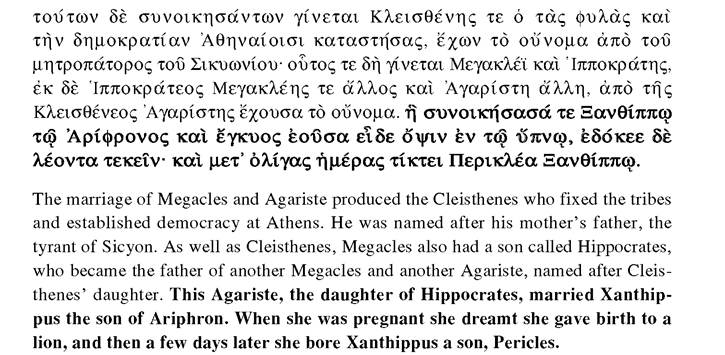
— Herodotus, Historiae 6.131.2[185]
funditus concidisse (“Of the same kind is the following example, which Herodotus has written: Croesus’ son spoke although he was a mute; following this portent his father’s kingdom and house were utterly wiped out” 1.53.121 ~ Herodotus, Historiae 1.85). See Pease 1920-23: 314-15 ad 1.121; and Wardle 2006: 400 ad 1.121; as well as Pease 1920, although Wardle wrongly claims that this is “the only citation of Herodotus as a source in [the] De divinatione” (cf. 2.56.115-116 ~ Herodotus, Historiae 1.53-54 and 91, with Pease 1920-23: 535-41 ad 2.115-16). Cicero also explicitly refers to Herodotus (and Philistus), for example, in Cicero, De oratore 2.13.55-57.
36 The translation is from Waterfield 1998.
In this passage, Herodotus offers a partial genealogy for one of the most famous and powerful families of ancient Athens, the Alcmaeonids, whose ranks included, among others, Cleisthenes, the father of Athenian democracy, and, more importantly for our purposes, Pericles (ca. 495429 B.C.). In particular, Herodotus relates that Pericles’ mother, Agariste, while pregnant by her husband, Xanthippus, had a dream in which she gave birth to a lion and that, after a few days, she gave birth to her son, a son who would later come to dominate Athenian politics for over three decades, from his initial ascent to power in 461 until his death from the plague in 429.37
Scholars have long debated the significance of the omen in Herodotus — whether the dream suggests that Pericles will be a blessing or a curse for Athens — but little attention seems to have been paid to the importance of the omen in Cicero for this discussion.38 More recently, Wardle has ventured his own fresh assessment of the question, although the contrast he draws between an originally positive and a later negative interpretation of the omen is restricted rather too narrowly within the confines of Greek history and historiography (and overlooks the relevant Near Eastern evidence; see below).39 * Regardless, it is clear that the omen report in Herodotus is the ultimate source for the omen report in Cicero, even despite the shift from the narrative statement in the Greek to the conditional statement in the Latin (through Posidonius?). In particular, it is clear that leonem peperisse visa esset (Cicero, De divinatione 1.53.121) represents a close translation of έδοκεε δε λέοντα τεκεΐ,ν (Herodotus, Historiae 6.131.2).40 Where Herodotus connects the dream with the actual birth of Pericles, Cicero connects it more generally with the defeat of the city in which the woman has the dream about giving birth to the lion. Perhaps Posidonius provided the link here between the narrative and the conditional, between the legend surrounding the birth of Pericles and the lion birth dream omen, in an exegesis of the Herodotus passage somewhere in his περί, μαντικής (On Divination). Whatever the exact circumstances of transmission, the lion birth dream omen in Cicero (De divinatione 1.53.121) ultimately goes back to Herodotus (Historiae 6.131.2).
Beyond Herodotus and Cicero, the legend surrounding the birth of Pericles also appears later in the opening chapters of the biography of the Athenian general and statesman written by the Greek philosopher and biographer Plutarch (born before A.D. 50-died after A.D. 120):
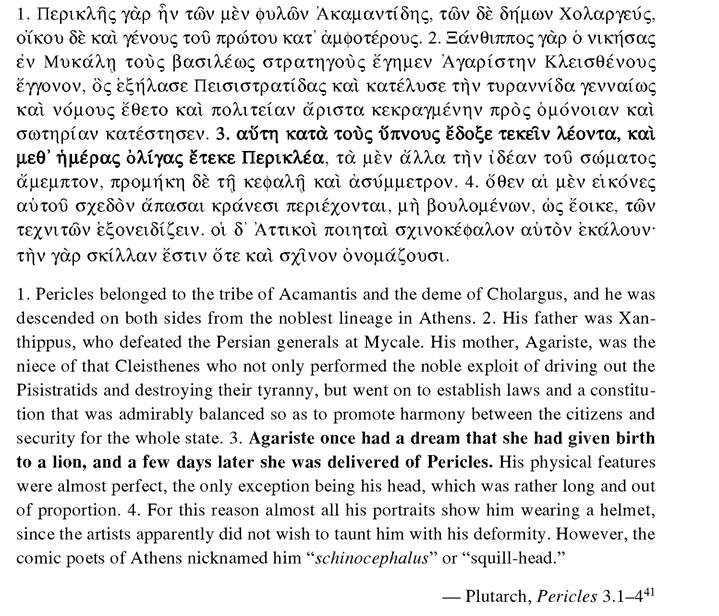
In this passage, Plutarch unabashedly offers little more than a loose paraphrase of the material in Herodotus — solid evidence that he was still being closely read and directly used as a source long after Cicero.41 42 With due allowance for the inevitable changes in the language during the half millennium which separates the two, αυτή κατά τους ύπνους εδοξε τεκεΐν λέοντα, και. μεθ’ ήμερας όλίγας ετεκε Περτκλεα (Plutarch, Pericles 3.3) virtually repeats η συνοτκήσασα τε Ξανθίππω τω Αρίφρονος καί εγκυος εούσα είδε δψιν εν τω υπνω, εδόκεε δε λεοντα τεκεΐ,ν· και. μετ’ όλίγας ήμερας τίκτει Περικλεα Ξανθίππω (Herodotus, Historiae 6.131.2) verbatim.43 * In the lines immediately following this passage, Plutarch discusses the disproportionate shape of Pericles’ head (Plutarch, Pericles 3.3) and cites several humorous jabs from Old Comedy in order to show how the Attic poets “capitalized” on this physical deformity (Plutarch, Pericles 3.4-7).44 With due caution, I would like to suggest that Plutarch here intends a connection between Agariste’s dream about Pericles’ lion birth and
his “leonine” appearance. The key to cementing this connection lies in Plutarch’s description of Pericles’ head: προμηκη δε τη κεφαλή και. ασύμμετραν (Plutarch, Pericles 3.3). On the one hand, this description accords well with ancient descriptions of a medical condition known as λεοντίαστς, which is defined as an early stage of the more widely known condition ελεφαντίαστς (Rufus apud Oribasius 45.28.2 and Pseudo-Galen, Introductio seu medicus 14.757.6 and 11-12 K; cf. λεόντιον, Aretaeus, De causis et signis diuturnorum morborum 2.13.8, as well as the related verb λεοντιάω).45 On the other hand, Greek possesses two compound adjectives which well describe this condition, λεοντοκεφαλος (“having the head of a lion”) and λεοντοπρόσωπος (“having the face of a lion”), and Lucian indeed uses the former of these adjectives in his Hermotimus in order to deride the Egyptians as “dog-headed and lion-headed men” (κυνοκεφάλους καί λεοντοκεφάλους ανθρώπους, 44). In short, Plutarch appears to claim that the link between Agariste’s dream about giving birth to a lion and Pericles’ birth a few days later lies in the physical resemblance between Pericles and the lion from the dream. If this argument stands, then Plutarch evidently interprets this dream and its relation to the subsequent birth somewhat differently from Herodotus and Cicero.
Thus far, I have limited the discussion to Cicero’s De divinatione and a select few other passages from elsewhere in Greek and Latin literature. In the course of this discussion, I have reviewed the evidence in the dialogue for both abnormal human births (1.18.36, 1.43.98, and 1.53.121) and dreams about abnormal human births (1.21.42 and 2.70.145, as well as 1.23.46). I have devoted particular attention to the dream had by the mother of Dionysius I (1.20.39), as well as to that had by Agariste, the mother of Pericles (1.53.121). By examining the lion birth omen in 1.53.121 in light of the related omens in Herodotus’ Historiae (6.131.2) and Plutarch’s Pericles (3), I have sought to elucidate the meaning of this omen for each of these three writers, as well as to venture a tentative reconstruction of the circumstances of its transmission. At this point, accordingly, I will broaden the scope of inquiry in order to include not only the ancient Mediterranean, but also the ancient Near East.
ABNORMAL HUMAN BIRTHS IN THE OMEN SERIES SUMMA IZBU
Interestingly, all three of the omens recorded in De divinatione 1.53.121 resemble omens from one or more of the major omen series from the ancient Near East. Thus, the celestial omen reads like an entry from the series Enuma Anu Enlil (“When Anu and Enlil”): si luna paulo ante solis ortum defecisset in signo Leonis, fore ut armis Dareus et Persae ab Alexandro et Macedonibus [proelio] vincerentur Dareusque moreretur (“If an eclipse of the moon occurred a little before sunrise in the sign Leo, Darius and the Persians would be defeated militarily by Alexander and the Macedonians [in battle] and Darius would die”).46 Likewise, the terrestrial / teratological omen reads like an entry from either the series Summa alu or the
series Summa izbu: et si puella nata biceps esset, seditionem in populo fore, corruptelam et adulterium domi (“If a girl were born with two heads[,] there would be popular revolt[,] and seduction and adultery in the home”).47 Finally, the teratological / oneirological omen reads like an entry from either the series Summa izbu or a Mesopotamian dream-book: et si mulier leonem peperisse visa esset, fore ut ab exteris gentibus vinceretur ea res publica in qua id contigisset (“If a woman dreamt that she gave birth to a lion, the country in which this had happened would be overcome by foreign nations”).48 As even this brief review of the evidence in 1.53.121 well illustrates, much of the material in the De divinatione reflects Cicero’s knowledge about the art and the science of divination not only in the ancient Mediterranean, but also in the ancient Near East. In what follows, I again focus on the third of these three omens, the lion birth omen: in particular, I trace the history of this omen back to its origins in the lion birth omens of Summa izbu.
Tablets 1-4 of the series Summa izbu contain the “omens derived from human births,” that is, omens derived from the birth of a child (or, in some cases, children) with any number of serious physical abnormalities.49 This catalog of prodigies includes several lion birth omens, not only in the tablets of the “canonical” series, but also in those of the Old Babylonian version and in those of the Hittite translation of Summa izbu (thence to Greece, Etruria, and Rome?):50
BE MUNUS UR.MAH U.TU URU.BI DAB-bat LUGAL.BI LAL-mu
If a woman gives birth to a lion — that city will be seized; its king will be put in fetters.
— Summa izbu 1.551
BE MUNUS U.TU-ma SAG.DU UR.MAH GAR LUGAL dan-nu ina KUR GAL-si
If a woman gives birth, and (the child) has a lion's head — there will be a harsh king in the land.
— Summa izbu 2.1[186]
BE MUNUS U.TU-ma IGI.MES-sU GIM IGI UR.MAH [...]
If a woman gives birth, and (the child's) eyes are like the eye(s) of a lion — [...].
— Summa izbu 2.44'[187]
BE MUNUS U.TU-ma GESTU UR.MAH GAR LUGAL KALAG.GA ina KUR GAL-si
If a woman gives birth, and (the child) has the ear of a lion — there will be a harsh king in the land.
— Summa izbu 3.1[188] BE MUNUS.LUGAL U.TU-ma IGI UR.MAH GAR LUGAL GABA.RI NU TUK
If a woman of the palace gives birth, and (the child) has the face of a lion — the king will have no opponent.
— Summa izbu 4.56[189]
DIS iz-bu-um pa-ni UR.MAH sa-ki-in LUGAL [da]-an-nu-um I ib-ba-as-si-ma ma-tam sa-ti u-na-as
If an anomaly has the face of a lion — there will be a harsh king, and he will weaken that land.
— YOS 10 56 i 26-27 (= omen 11)[190]
DIS iz-bu-um ki-ma UR.MAH a-mu-ut mNa-ra-am-dEN.ZU I sa ki-sa-tam i-be-lu-u
If an anomaly is like a lion — omen of Naram-Sin who ruled the world.
— YOS 10 56 iii 8-9 (= omen 40)[191]
calling my attention to the lion birth omen in YOS 10
56 i 26-27, per litteras electronicas).
57 Cf. YOS 10 56 i 6-7 (= omen 3), ii 38-39 (= 16),
ii 42-43 (= 18), iii 10-11 (= 41), iii 12-13 (= 42),
iii 14-15 (= 43), iii 33-34 (= 51), and iii 36-37 ( = 53). Other lion omens appear in iii 26-29 (= 48) and iii 31-32 (= 50).
tak-ku SAL-[za h]a-a-si I nu-u[s-si SAG.D]U-5U SA UR.MAH I [ki-sa o-o-] x -as LUGALus I [ud-ni-i^ au-da:\ ki-sa.
If a woman gives birth, I and his/her (i.e., the child's) head [is] that of a lion, I then a king of... I will be [in? the land7].
— KBo 6.25 + KBo 13.35 vs. III 8'-11'[192]
In addition to these examples from tablets 1-4, the remaining tablets of the series Summa izbu offer no fewer than 140 other lion birth omens.[193] Even a cursory examination of these entries in the series not only demonstrates the central importance of the lion birth omen in the divinatory practices of the ancient Near East, but also strengthens the probability that a knowledge of the lion birth omen eventually spread from the ancient Near East to the ancient Mediterranean. On the one hand, the protases of the omens cited above mention not only the birth of a child with the general appearance of a lion (Summa izbu 1.5 and YOS 10 56 iii 8-9 [= omen 40]), but also the birth of a child with a specific leonine feature, whether it be the head (Summa izbu 2.1 and KBo 6.25 + KBo 13.35 vs. III 8'-11'), the eyes (Summa izbu 2.44'), the ear (Summa izbu 3.1), or the face (Summa izbu 4.56 and YOS 10 56 i 26-27 [=
Tablet 18: goat gives birth to lion (16'; cf. 15' and 17'-28', as well as 29' and 33').
Tablet 19: cow gives birth to calf with paw(s) of lion (13'-16'), calf with head of lion (18'), and calf (which is?) the likeness of a lion (24'-27', as well as 28'). Cf. also Gurney and Hulin 1964: 307 omens 30-31: see Heimpel 1973: 586-87.
Tablet 20: mare gives birth to twins with hair of lion (4'; cf. 1 and 2'), twins with paw(s?) of lion (6'; cf. 5'), twins with head of lion (10'; cf. 9' and 11'-13', as well as 7'-8'), and twins which are like a lion (15'; cf. 16'-17'); and mare gives birth to lion (20'; cf. 21'-25', as well as 26'-32').
Tablet 21: mare gives birth to izbu with hair of lion (6-7 and 9; cf. 8) and izbu with paws of lion (10-11; cf. 12-13); izbu of mare has paw(s?) and head of lion, and paw(s?), mouth, and head of lion (38'-39'; cf. 26-33, 34'-35', and 36'-37'); izbu of mare has face of lion and tail of dog, and face of dog and tail of lion (43'-44'; cf. 45'-46'); and izbu of mare has paw(s?) of lion (50'; cf. 51'-52', as well as 53'-55').
Tablets 22, 23, and 24: no lion birth omens.
Cf. K. 6816 4 (Leichty 1970: 196); K. 9837 (CT 28 15) 7 (1970: 196-97); K. 8823 18 (1970: 198); K. 6743 (CT 28 13) + K. 14527 2 (1970: 198); and ahu (cf. 1970: 22) 9; cf. 2-8 and 10-19 (1970: 199-200). Unfortunately, however, there are no lion birth omens in the Ugaritic translation of Summa izbu (RS 24.247+ = KTU 1.103 + 1.145 and RS 24.302 = KTU 1.140); see Dietrich and Loretz 1990; and Pardee 2000.
omen 11]). On the other hand, the apodoses, all public in nature, include both “stock” (Summa izbu 1.5, 2.1, 3.1, and 4.56; YOS 10 56 i 26-27; and KBo 6.25 + KBo 13.35 vs. Ill 8'-11') and “historical” (YOS 10 56 iii 8-9) predictions.60 Most of all, these omens bring us back to Cicero, Herodotus, and Plutarch.
In particular, I would like to suggest that, beyond its affinity with the famous legend surrounding the birth of Pericles, the lion birth omen reported by Cicero in De divinatione 1.53.121 also reflects a knowledge of the omen recorded in Summa izbu 1.5: et si mulier leonem peperisse visa esset, fore ut ab exteris gentibus vinceretur ea res publica in qua id contigisset ~ BE MUNUS UR.MAH U.TU URU.BI DAB-bat LUGAL.BI LAL-mu. Indeed, even a superficial comparison between the two omens reveals the stunning correspondences between them in both protasis and apodosis.61 I am not the first, however, to bring these two passages together. In fact, nearly a century ago, Jastrow briefly remarked on the evident link between the two omens in a study of the birth omens which seems not to have attracted the attention of later scholars.62 * By and large, Jastrow correctly assesses the relationship between the two omens, from their close similarities in content and language to their “agreement” in “the exceptional character of the interpretation” of the omen not in a positive, but in a negative light. Jastrow, however, does incorrectly claim that “even the form of the omen, stating that the woman actually gave birth to a lion[,] is the same in both.” While U.TU certainly does indicate that she actually gave birth, we have seen that peperisse visa esset indicates that she only dreamed that she had given birth, and not that she had actually done so.[194] The reason for
this shift from an actual birth to a dream about a birth may lie in the desire to rationalize the omen and avoid the challenge of explaining how a woman could give birth to an animal of a different species. Otherwise, the nature of the relationship between the omens in Summa izbu
1.5 and Cicero, De divinatione 1.53.121 well illustrates how such material, in some ways, changed and, in other ways, remained the same during its transmission from east to west. On the one hand, the protasis remains essentially the same; on the other, the apodosis undergoes a substantial alteration: where the omen in Summa izbu 1.5 refers to the capture of both the city and the king, the omen in De divinatione 1.53.121 refers only to the fall of the res publica (i.e., Rome). In essence, while the phenomena themselves remain the same, what they portend is continually adapted to meet the needs and expectations of each individual culture.
Until the (unlikely) discovery of a Greek, Latin, or even Etruscan translation, there is no way to prove that the texts of the major omen series traveled from the ancient Near East to the ancient Mediterranean. Nonetheless, given the existence of Summa izbu materials not only in Akkadian, but also in Ugaritic, Hittite, and Hurrian, and given the extensive contacts between Greece and, later, Rome, and the areas where these languages were spoken and these texts were read, there is every reason to suppose that the omen series did make the journey along one of the many streams of tradition flowing from east to west.[195] In particular, I have sought to trace the lion birth omen recorded by Cicero in De divinatione 1.53.121 back to Herodotus’ Historiae (6.131.2) and, beyond that, back to the lion birth omens recorded in Summa izbu (especially 1.5). There are, no doubt, many traces of that omen series and others in De divinatione, as well as elsewhere in Greek and Latin literature, some already found and some still awaiting discovery.
ABBREVIATIONS
CAD A. Leo Oppenheim et al., editors, The Assyrian Dictionary of the Oriental Institute
of the University of Chicago
CT Cuneiform Texts from Babylonian Tablets in the British Museum
CTH E. Laroche, Catalogue des textes hittites (Paris, 1966)
KBo Keilschrifttexte aus Boghazkoi
KTU M. Dietrich, O. Loretz, and J. Sanmartin, eds., Die keilalphabetischen Texte aus
Ugarit (Kevelaer & Neukirchen-Vluyn, 1976)
RS Museum siglum of the Louvre and Damascus (Ras Shamra)
STT 2 Gurney and Hulin 1964
YOS 10 Goetze 1947b
cultural interaction; see most recently Westenholz 2007, especially 278-80 (citing Leichty 1970: 20001, lines 11-13 of BM 41548) on the difficulties surrounding the interpretation of the evidence for the transmission of Summa izbu on parchment.
BIBLIOGRAPHY
Badali, R.
1976 “Il proemio del De divinatione.” Rivista di cultura classica e medioevale 18: 27-47.
Beard, Mary
1986 “Cicero and Divination: The Formation of a Latin Discourse.” The Journal of Roman
Studies 76: 33-46.
Bloch, Raymond
1963 Les prodiges dans l’Antiquite classique (Grece, Etrurie et Rome). Mythes et religions.
Paris: Presses Universitaires de France.
Bouche-Leclercq, A.
1879-82 Histoire de la divination dans l’antiquite. 4 volumes. Paris: Ernest Leroux. Reprint, Brussels: Culture Civilisation, 1963. Reprint, with a preface by Stella Georgoud, Collection Horos, Grenoble: J. Millon, 2003.
Cassin, Elena
1981 “Le roi et le lion.” Revue de l’histoire des religions 198: 355-401.
Dennefeld, Ludwig, editor
1914 Babylonisch-assyrische Geburts-Omina, zugleich ein Beitrag zur Geschichte der
Medizin. Assyriologische Bibliothek 22. Leipzig: J. C. Hinrichs.
Denyer, Nicholas
1985 “The Case against Divination: An Examination of Cicero's De divinatione.”
Proceedings of the Cambridge Philological Society 211 = n.s. 31: 1-10.
Dietrich, Manfred, and Oswald Loretz
1990 Mantik in Ugarit: Keilalphabetische Texte der Opferschau, Omensammlungen,
Nekromantie. Abhandlungen zur Literatur Alt-Syrien-Palästinas 3. Münster: Ugarit- Verlag.
Durand, Rene
1903 “La date du ‘De divinatione.'” In Melanges Boissier: Recueil de memoires concernant
la litterature et les antiquites romaines dedie ä Gaston Boissier ä l’occasion de son 80e anniversaire, edited by A. Fontemoing, pp. 173-83. Paris: A. Fontemoing.
Dyson, G. W.
1929 “LEONTA TEKEIN.” The Classical Quarterly 23: 186-95.
Engels, David
2007 Das romische Vorzeichenwesen (753-27 v. Chr.): Quellen, Terminologie, Kommentar,
historische Entwicklung. Stuttgart: Franz Steiner.
Falconer, William A.
1923 Review of La date du “De divinatione,” by M. Durand. Classical Philology 18:
310-27.
Focke, Friedrich
1927 Herodot als Historiker. Tübinger Beiträge zur Altertumswissenschaft, Heft 1.
Stuttgart: W. Kohlhammer.
Fornara, Charles W.
1971 Herodotus: An Interpretative Essay. Oxford: Clarendon Press.
Fossey, Charles, editor
1912 Presages assyriens tires des naissance: Transcription, traduction, tables et com-
mentaire. Babyloniaca: Etudes de philologie assyro-babylonienne 5. Paris: Paul Geuthner.
Fossey, Charles
1921-22 Deux principes de la divination assyro-babylonienne d’apres le traite summa izbu. Paris: Ecole pratique des hautes etudes, Section des sciences religieuses 1921-22: 1-18.
Giomini, Remo
1971 Problemi cronologici e compositivi del De divinatione ciceroniano. Rome: A.
Signorelli.
1975 M. Tulli Ciceronis scripta quae manserunt omnia, Fasc. 46: De divinatione, De fato,
Timaeus. Bibliotheca scriptorum Graecorum et Romanorum Teubneriana. Leipzig: B. G. Teubner.
Goar, Robert J.
1968 “The Purpose of De divinatione.” Transactions of the American Philological
Association 99: 241-48.
Goetze, Albrecht
1947a “Historical Allusions in Old Babylonian Omen Texts.” Journal of Cuneiform Studies 1: 253-65.
1947b Old Babylonian Omen Texts. Yale Oriental Series 10. New Haven: Yale University Press; London: Geoffrey Cumberlege; Oxford University Press.
Guillaumont, Framjois
1984 Philosophe et augure: Recherches sur la theorie ciceronienne de la divination.
Collection Latomus 184. Brussels: Editions Latomus.
2006Le De divinatione de Ciceron et les theories antiques de la divination. Collection Latomus 298. Brussels: Editions Latomus.
Gurney, O. R., and P. Hulin, editors
1964 The Sultantepe Tablets, Volume 2. Occasional Publications of the British Institute of
Archaeology at Ankara 7. London: British Institute of Archaeology at Ankara.
Halliday, W. R.
1913 Greek Divination: A Study of Its Methods and Principles. London: Macmillan.
Harris, W. V.
2003 “Roman Opinions about the Truthfulness of Dreams.” The Journal of Roman Studies
93: 18-34.
Hartfelder, K.
1878 Die Quellen von Ciceros zwei Büchern De divinatione. Beilage zum Programm des
Grossherzoglichen Gymnasiums zu Freiburg; Programm 487. Freiburg: UniversitätsBuchdruckerei von Chr. Lehmann.
Harvey, F. D.
1966 “The Political Sympathies of Herodotus.” Historia 15: 254-55.
Heeßel, Nils P., editor
2007Divinatorische Texte I: Terrestrische, teratologische, physiognomische und onei- romantische Omina. Ausgrabungen der Deutschen Orient-Gesellschaft in Assur, Inschriften 9. Keilschrifttexte aus Assur literarischen Inhalts 1. Wissenschaftliche Veroffentlichung der Deutschen Orient-Gesellschaft 116. Wiesbaden: Otto Harrassowitz.
Heimpel, Wolfgang
1973 Review of The Omen Series summa izbu, by Erle Leichty. Journal of the American
Oriental Society 93: 585-87.
Heimpel, W.; A. Ünal; and E. A. Braun-Holzinger
1987-90 “Lowe.” Reallexikon der Assyriologie 7: 80-94.
Holowchak, Mark
2002 Ancient Science and Dreams: Oneirology in Greco-Roman Antiquity. Lanham:
University Press of America.
How, H. H., and J. Wells
1912 A Commentary on Herodotus. 2 volumes. Oxford: Clarendon Press.
Hunger, Johannes
1909 Babylonische Tieromina nebst griechisch-romischen Parallelen. Mitteilungen der
Vorderasiatischen Gesellschaft 14.3. Berlin: Wolf Peiser.
Jastrow, Morris, Jr.
1914 Babylonian-Assyrian Birth-Omens and Their Cultural Significance. Religionsge
schichtliche Versuche und Vorarbeiten 14.5. Gießen: Verlag von Alfred Topelmann (vormals J. Ricker).
Johnston, Sarah Iles
2008 Ancient Greek Divination. Blackwell Ancient Religions. Malden and Oxford: Wiley-
Blackwell.
Johnston, Sarah Iles, and Peter T. Struck, editors
2005 Mantike: Studies in Ancient Divination. Religions in the Graeco-Roman World 155.
Leiden and Boston: Brill.
Kany-Turpin, Jose, editor
2005 Signe et prediction dans l’Antiquite. Actes du colloque international interdisciplinaire
de Creteil et de Paris, 22-24 mai 2003. Saint-Etienne: Publications de l'Universite de Saint-Etienne.
Krostenko, Brian A.
2000 “Beyond (Dis)belief: Rhetorical Form and Religious Symbol in Cicero's De divina
tione.” Transactions of the American Philological Association 130: 353-91.
Lanzoni, Francesco
1927 “Il sogno presago della madre incinta nella letteratura medievale e antica.” Analecta
Bollandiana 45: 225-61.
Lee, Vivian S.; Michael S. Webb, Jr.; Salutario Martinez; Charles P. McKay; and George S. Leight, Jr.
1996 “Uremic leontiasis ossea: ‘Bighead' Disease in Humans? Radiologic, Clinical, and
Pathologic Features.” Radiology 199.1: 233-40.
Leichty, Erle
1970 The Omen Series summa izbu. Texts from Cuneiform Sources 4. Locust Valley: J. J.
Augustin.
Linderski, Jerzy
1982 “Cicero and Roman Divination.” La parola del passato 37: 12-38.
1986 “Watching the Birds: Cicero the Augur and the Augural templa.” Classical Philology
81: 330-40.
Luterbacher, Franz
1904 Der Prodigienglaube und Prodigienstil der Romer. Eine historisch-philologische
Abhandlung in neuer Bearbeitung. Beilage zum Jahresbericht über das Gymnasium in Burgdorf. Burgdorf: Buchdruckerei P. Eggenweiler, in Kommission bei C. Langlois et Cie.
MacBain, Bruce
1982 Prodigy and Expiation: A Study in Religion and Politics in Republican Rome.
Collection Latomus 177. Brussels: Editions Latomus.
Maramattom, Boby Varkey
2006 “Leontiasis ossea and Post Traumatic Cervical Cord Contusion in Polyostotic Fibrous
Dysplasia.” Head and Face Medicine 2: 24.
Maul, Stefan M.
2003 “Omina und Orakel.” Reallexikon der Assyriologie 10: 45-88.
Momigliano, Arnaldo
1984 “The Theological Efforts of the Roman Upper Classes in the First Century B.C.”
Classical Philology 79: 199-211.
Nougayrol, Jean
1944-45 “Note sur la place des presages historiques dans l'extispicine babylonienne.” Annuaire de l’Ecole pratique des hautes etudes, Section des sciences religieuses 1944-45: 5-41.
Oppenheim, A. Leo
1956 “The Interpretation of Dreams in the Ancient Near East, with a Translation of an
Assyrian Dream-book.” Transactions of the American Philosophical Society, n.s., 46.3: 179-373.
Pardee, Dennis
2000 Les textes rituels. 2 volumes. Ras Shamra-Ougarit 12. Paris: Editions Recherche sur
les civilisations.
Pease, Arthur Stanley
1920 “The Son of Croesus.” Classical Philology 15: 201-02.
1920-23 M. Tulli Ciceronis De divinatione. University of Illinois Studies in Language and Literature 6.2-3: 159-326 and 327-500, and 8.2-3: 153-276 and 277-474. Reprint, Darmstadt: Wissenschaftliche Buchgesellschaft, 1963 and 1973.
Podlecki, A. J.
1987 Plutarch: Life of Pericles. A Companion to the Penguin Translation from The Rise and
Fall of Athens, Translated by Ian Scott-Kilvert, published in the Penguin Classics. London: Gerald Duckworth; Bristol Classical Press.
Rasmussen, Susanne William
2003Public Portents in Republican Rome. Analecta Romana Instituti Danici Supplementa 34. Rome: ‘L’Erma’ di Bretschneider.
Repici, Luciana
1995 “Gli stoici e la divinazione secondo Cicerone.” Hermes 123: 175-92.
Riemschneider, Kaspar Klaus
1970 Babylonische Geburtsomina in hethitischer Übersetzung. Studien zu den Bogazkoy-
Texten 9. Wiesbaden: Otto Harrassowitz.
2004Die akkadischen und hethitischen Omentexte aus Bogazkoy. Dresdner Beiträge zu Hethitologie 12. Dresden: Verlag der Technische Universität (TU) Dresden.
Rochberg-Halton, Francesca
1984 “New Evidence for the History of Astrology.” Journal of Near Eastern Studies 43:
115-40.
2004 The Heavenly Writing: Divination, Horoscopy, and Astronomy in Mesopotamian
Culture. Cambridge and New York: Cambridge University Press.
Rosenberger, Veit
1998 Gezähmte Gotter: Das Prodigienwesen der romischen Republik. Stuttgart: Franz
Steiner.
Schatz, Friedrich
1901 Die griechischen Gotter und die menschlichen Missgeburten. Wiesbaden: J. F.
Bergmann.
Schofield, Malcolm
1986 “Cicero for and against Divination.” The Journal of Roman Studies 76: 47-65.
Schwarze, Joachim
1971 Die Beurteilung des Perikles durch die attische Komodie und ihre historische
und historiographische Bedeutung. Zetemata: Monographien zur klassischen Altertumswissenschaft, Heft 51. Munich: C. H. Beck.
Scott, Lionel
2005 Historical Commentary on Herodotus, Book 6. Mnemosyne Supplementum 268.
Leiden and Boston: Brill.
Scott-Kilver, Ian, translator
1960 Plutarch: The Rise and Fall of Athens; Theseus, Solon, Themistocles, Aristides,
Cimon, Pericles, Nicias, Alcibiades, Lysander. Penguin Classics. New York: Penguin Books.
Stadter, Philip A.
1989 A Commentary on Plutarch’s Pericles. Chapel Hill and London: University of North
Carolina Press.
Steier, August
1926 “Lowe.” Paulys Realencyclopädie der klassischen Altertumswissenschaft 13.1:
968-90.
Steiner, Paulus
1909 Teras. Dissertatio inauguralis. Marpurgi Cattorum.
Strasburger, Hermann
1955 “Herodot und das perikleische Athen.” Historia 4: 1-25.
Strawn, Brent A.
2005 What Is Stronger than a Lion? Leonine Image and Metaphor in the Hebrew Bible and
the Ancient Near East. Orbis Biblicus et Orientalis 212. Fribourg: Academic Press; Gottingen: Vandenhoeck & Ruprecht.
Thulin, C. O.
1905-09 Die etruskische Disciplin. 3 Parts. Goteborgs Hogskolas Arsskrift 11 (1905); 12 (1906); and 15 (1909). Goteborg: Wettergren och Kerber.
Timpanaro, Sebastiano
1994 “Alcuni fraintendimenti del De divinationeIn Nuovi contributi di filologia e storia
della lingua latina, pp. 241-64. Testi e manuali per l'insegnamento universitario del latino 38. Bologna: Patron.
Troiani, Lucio
1984 “La religione e Cicerone.” Rivista storica italiana 96: 920-52.
Usener, Knut
1994 “Zur Existenz des Lowen im Griechenland der Antike: Eine Überprüfung auf dem
Hintergrund biologischer Erkenntnisse.” Symbolae Osloenses 69: 5-33.
Vigourt, Annie
2001 Les presages imperiaux d’Auguste ä Domitien. Etudes d’archeologie et d'histoire
ancienne. Paris: De Boccard.
Walde, Christine
2001 Antike Traumdeutung und moderne Traumforschung. Düsseldorf: Artemis &
Winkler.
Walker, Henry John, translator
2004 Valerius Maximus: Memorable Deeds and Sayings: One Thousand Tales from Ancient
Rome. Indianapolis and Cambridge: Hackett.
Wardle, David, translator
2006Cicero: On divination / De divinatione Book 1. Clarendon Ancient History Series. Oxford: Clarendon Press; New York: Oxford University Press.
Waterfield, Robin, translator
1998 Herodotus: The Histories. Oxford World's Classics. Oxford and New York: Oxford
University Press. With an introduction and notes by Carolyn Dewald.
Westenholz, Aage
2007 “The Graeco-Babyloniaca Once Again.” Zeitschrift für Assyriologie 97: 262-313.
Wildfang, Robin Lorsch, and Jacob Isager, editors
2000 Divination and Portents in the Roman World. Odense: Odense University Press.
Wülker, Ludwig
1903 Die geschichtliche Entwicklung des Prodigienswesens bei den Romern: Studien zur
Geschichte und Überlieferung der Staatsprodigien. Inaugural-Dissertation. Leipzig: Emil Glausch.
oi.uchicago.edu