Tribal People in Kerala
The tribal community around the globe faces many challenges of institutional change and continuity. Differences in subsistence economy associated with the control over key resources are some of the factors affecting institutionalisation in tribal societies.
In Kerala, the representation of Scheduled Tribes to the total population of the State is only 1.28 per cent (Census of India 2011). The Scheduled Tribes in the Wayanad district constitute 18.76 per cent of the total population of the district. In Kerala, the Wayanad District stands first with 35.94 per cent of the Scheduled Tribe population of the State, followed by the Idukki (12.42%), Kasaragod (11.21%), and Palakkad (11.01%) districts (Scheduled Tribes of Kerala, Report on the Socio-Economic Status 2017). Only 10 per cent of the total tribal population living in Kerala cultivate their own land, whereas 40 per cent are agricultural wage labourers (Govt. of Kerala 2013). There are a total of 36 tribal communities in Kerala belonging to different socio-cultural and economic backgrounds. Thurston (1909), Singh (2002), and Luiz (1962) gave descriptions of the castes and tribes of India; and small ethnographic accounts were also given about the tribal communities. Among the tribal communities in Kerala, five communities are classified as Particularly Vulnerable Tribal Groups (PVTGs)1. This chapter discusses the issues of institutionalisation among the Kurichiyan, a settled agricultural tribal community in Wayanad.The Wayanad district is located in the north eastern side of Kerala state and this district is a trijunction of three linguistic traditions,Malayalam, Tamil, and Kannada, because the district shares boundaries with the States of Karnataka, Tamil Nadu, and Kerala. The district is bordered on the North by Coorg District and on the East by the Mysore District of Karnataka State.
On the South is the Nilgiri District of Tamil Nadu, and on the West are the Malappuram, Kozhikode, and Kannur Districts. Rajasenan, De Venanzi, and Rajeev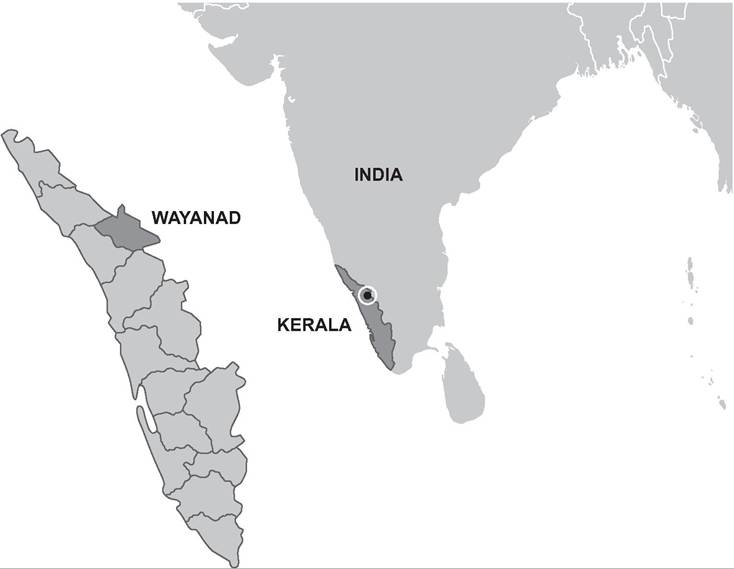
Figure 22.1 Map of the Wayanad District
Bhaksar (2019) wrote that the Paniyan represents 22.5 per cent of the total tribal population, followed by the Kurichiyan (9%) and the Malayarayan (8.9 %). The Malayarayan shows a classic literacy rate of 94.5 per cent corresponding to the general population of the State. However, the Kattunaickan and Muthuvan show very low literacy rates, 40.2 and 41.5 per cent respectively. The Paniyan is the economically downtrodden group among the tribes in Wayanad. Among the tribes of Kerala, only 1.7 per cent of members are cultivators, whereas 65.7 percent are agricultural wage labourers under tribal or non-tribal communities. Tribal communities like the Kurichiyan, the Malayarayan, and the Muthuvan include a greater number of cultivators, whilst the majority of the Adiyan and the Paniyan are agricultural wage labourers. The Adiyan and the Paniyan were bonded labourers before the abolition of the bonded labour system by the State. The Kattunaickan were food gatherers now engaged in wage labour and a very few employed in forest department as mahouts. They are also known as thaenkuruman1 because of their involvement in honey collection.
22.2