Wicca and the Return to Neo-paganism
“Witches” have long figured in the popular imagination and in much of Western folklore, but the contemporary nature religion known as Wicca is a far cry from the literary incarnations of the archetypal embodiment of evil.
Contemporary witches, or Wiccans, as they prefer to be called, do not cast harmful spells, do not communicate with spirits of the underworld, and most especially do not worship the Devil. They do claim to practice various types of magic, however, and they often worship various pre-Christian deities, particularly those associated with natural forces and phenomena. Contemporary Wiccans prefer to be thought of as pagans, or more precisely, “neo-pagans,” since the ensemble of beliefs and practices that characterizes witchcraft today is so eclectic that no direct link between Wicca and pre-Christian religious cultures can be said to exist.The Wiccan movement appears to have been the brainchild of one British enthusiast, Gerald B. Gardner (1884-1964), who, after a career as a civil servant in Southeast Asia, returned to England to pursue an interest in folklore and esoteric religious thought. In concert with Margaret Murray (1863-1963), an anthropologist and Egyptologist (as well as a prominent early feminist) whose book The Witch Cult in Western Europe (1921) argued that the witch cults of medieval Europe were survivors of an indigenous fertility religion, Gardner sought to prove that remnants of these ancient pagan rituals could still be found in the modern world. Although anthropologists have since rejected both Murray’s research and Gardner’s more extravagant claims, the modern form of Wicca seems to have been born out of their collaboration. Following the repeal in 1954 of England’s 1735 Witchcraft Act, Gardner set out to revive interest in “the Craft” by describing ancient pagan beliefs in his landmark book Witchcraft Today (1954), which both legitimated the pursuit of once-forbidden practices and opened the door to future development of Wiccan principles and ritual acts.
Gardner’s critics have since cast doubts on the authenticity of his claims to have recovered the secrets of ancient witch cults. Nevertheless, his work has inspired Wiccans whose interpretations of Gardnerian lore have led to distinct schools of Wiccan thought.At the heart of Wiccan teachings is the neo-pagan belief that divine magic and mystery lie within ourselves and within the natural world. The Wiccan concept of the sacred is almost entirely immanental—that is, dwelling within nature rather than outside or above it. Although many Wiccan communities have chosen to worship a variety of pre-Christian deities, these “gods” are generally viewed as personifications of the power and grandeur that resides within nature and within the human imagination. When Wiccans speak of “the God” or “the Goddess,” they are not referring to the transcendent Creator of the Abrahamic faiths but rather to a creative force that lies within all existing things, to which human cultures attribute gender and personality. Wiccans are not content, however, simply to worship the powers that permeate our universe; they also seek to access those powers through ritualized acts of magic (or “magick” as most Wiccans prefer to spell that word). It is this more assertive aspect of
Wicca that places it within Melton’s “magical” family of new religions. The only constraint that Wiccans acknowledge upon the exercise of such power is embodied in the Wiccan Rede— that is, those principles of ethical behavior that virtually all modern witches accept as binding —which teaches: “And it harm none, do what you will.” For Wiccan communities, that rule entails the use of “magick” to achieve positive ends, and many Wiccan authors urge their readers to practice deeds that will be of benefit to humanity. In addition, many versions of the Wiccan “Rede” (or “rule” in modern English) teach a belief in some form of karma; thus, Wiccans are cautioned to expect that harmful acts will return to afflict the witch who inflicts them on others.
As indicated in the vignette with which this chapter began, Wiccans celebrate the change of seasons, as well as the phases of the moon. Two common ceremonies within the Wiccan community are the Esbat and the Sabbat, which are designed, respectively, to pay honor to the Goddess of the Moon and the God of the Sun. On one hand, Esbats most often occur when the moon is full, though custom varies from community to community. Sabbats, on the other hand, are seasonal and mark the occurrence of equinoxes and solstices, or midpoints between them. There are eight Sabbats within the Wiccan calendar, the most familiar of which is Yule (or “Yuletide,” as it is known in many Christian cultures). The ceremonies associated with Esbats and Sabbats differ considerably: during an Esbat celebration, for example, some attempt to “draw down the moon” (that is, draw the moon’s energy into oneself) is the ritual’s focus; on a Sabbat, however, it is customary to light bonfires and to decorate an altar in a way that pays tribute to the character of the particular god who is being honored that season. In each case, Wiccans hope to align themselves with the hidden energies of nature and to confer blessings on themselves and their loved ones through such acts of natural communion.
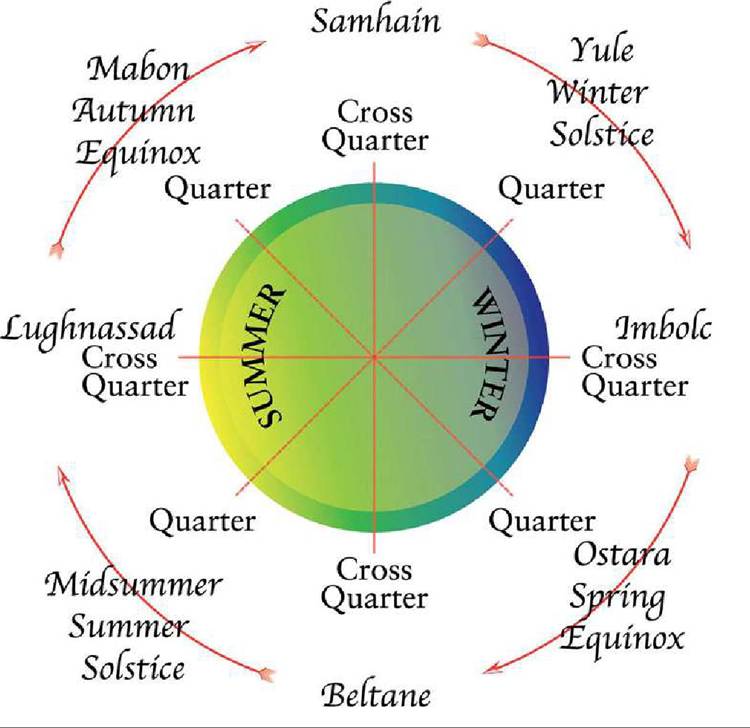
Wiccan wheel of the year.
Wicca is one of the most decentralized of new religious communities. Wiccans generally gather in small groups known as covens, though some witches prefer to practice their “Craft” in isolation. One of the more influential schools of Wiccan thought is the Reclaiming movement, founded by Miriam Simos (b. 1951; better known in Wiccan circles as “Starhawk”) in the 1970s. The Reclaiming philosophy is more overtly political than most varieties of Wicca, and in her writings Simos blends feminist, anticapitalist, and ecological concerns in an attempt to “reclaim” Earth from political forces that have despoiled the planet and oppressed its population. Most Wiccans, however, prefer not to align their communities with a specific political agenda, though the formation of the Witches’ League for Public Awareness in 1986 and other lobbying organizations (such as the Alternative Religious Education Network) have received widespread support in the Wiccan movement. One of the more organized Wiccan communities, the Church and School of Wicca (founded in 1968), estimates the number of its adherents to be around 200,000. Although it is impossible to extrapolate the number of Wiccans worldwide, the movement has benefited from court decisions in the United States that conferred legal status on the practice of witchcraft, allowing individuals to claim Wicca as their legally acknowledged faith.
Self-Assessment 14.4
[Please note: You must be using an online, browser-based eReader in order to view this content.]
More on the topic Wicca and the Return to Neo-paganism:
- The Return of the Tyrant
- Brodd Jeffrey, Little L., Nystrom B., Platzner R., Shek R., Stiles E.. Invitation to World Religions. 4th edition. — Oxford University Press,2022. — 1196 p., 2022