Zoroastrianism Through the Centuries
We will return soon to Zoroastrianism as a living religion, but it is important first to survey the course of its history from ancient times to the present. As we do, we will pause briefly to take note of the great deal it had in common with other ancient religions and to comment on the fascination Zarathushtra and Zoroastrianism have held for Western artists and thinkers.
Zoroastrianism in the Persian Empire (550-330 все)
The history of Zoroastrianism in the period immediately following the time of Zarathushtra is uncertain. The historical record begins in the sixth century все with the Histories of Herodotus, a Greek who lived a century later. Herodotus’s interest in the Persian Empire—so called because the ancestral home of its Achaemenid Dynasty was Pars (“Persia”) in southwestern Iran—can be explained by the fact that it invaded Greece twice in the early years of Herodotus’s own century. Wanting to provide his countrymen with an account of the culture of the enemy, Herodotus included his observations on the religion of the Persians and, in particular, the Magi. These appear to have been members of a powerful Zoroastrian priestly caste in the empire of the neighboring Medes, which was annexed to the newer Persian Empire by its founder, Cyrus the Great, in 550 все. Owing to the unwelcome political intrigues of the Magi, Cyrus and his son Cambyses II curtailed their influence and sometimes persecuted them. But Zoroastrianism began to gain momentum with the accession of Darius I (r· 549_485 все), who credited Ahura Mazda with bringing him to power. Thereafter, the religious culture of the Persian Empire became thoroughly Zoroastrian, and the role of the Magi as priests was secured. Surviving monuments and inscriptions testify to the influence of Zoroastrianism, as do a number of Avestan texts from this period.
Zoroastrianism in the Parthian Empire (247 bce-224 ce)
Achaemenid Persia fell to the Greeks and Macedonians under Alexander the Great in 330 все. A century later, Iran made a resurgence under a new dynasty of rulers from the region of Parthia. At its height, the Parthian Empire encompassed Iran, Mesopotamia, and parts of the Arabian Peninsula and what is now Turkey. Its culture was heterogeneous, combining the Iranian and Greek cultures with features of many others found within its borders. This can be seen, for example, in the Parthian tendency to equate Iranian and Greek deities. Thus, Ahura Mazda was identified with Zeus and Angra Mainyu with Hades.
Because the Parthian kings did not give Zoroastrianism the endorsement it had enjoyed under the Achaemenids, its status during this period was somewhat diminished. Still, there is evidence that some Parthian rulers built fire altars to honor Ahura Mazda and had Magi serve as priests in their courts. The Magi (sometimes translated “wise men”) described in the Gospel of Matthew as coming to visit the infant Jesus would have begun their journey in Parthian Iran.
Zoroastrianism in the Sassanid Empire (224-651)
Much larger than the empire of the Parthians, the Sassanid Empire included all of today’s Iran, Iraq, Armenia, and Afghanistan, as well as parts of Turkey, Syria, the Arabian Peninsula, and Central Asia. It was the last of the Iranian empires before the conquest of the Middle East by Muslim Arabs and the only one to formally adopt Zoroastrianism as the state religion. This, however, was a Zurvanite Zoroastrianism that differed from the traditional Mazdean form in teaching that Ahura Mazda (now known as Ohrmazd) and Angra Mainyu were twin brothers produced by Zurvan, a higher creator god. Thus, Zurvanism departed from orthodox Zoroastrianism in demoting Ahura Mazda from his status as the supreme being and in creating a link between good and evil that was denied by other Zoroastrians, who saw these two principles as being completely separate and absolutely opposed to each other.
The Sassanids also encouraged the worship of some of the old Iranian gods, such as Mithra, god of light, and Anahita, goddess of water and the moon.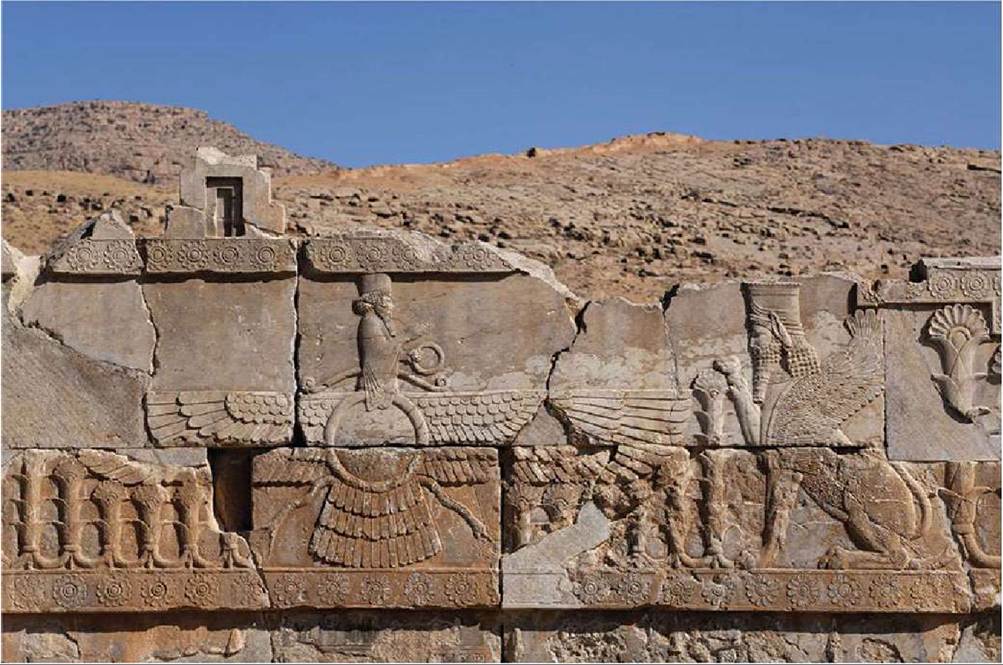
This wall carving features a Faravahar, thought to represent the fravashis. The wall is located in Persepolis, the ancient ceremonial center of the Achaemenid Empire.
The Sassanid rulers aggressively promoted their form of Zoroastrianism. With their support, the basic features of its rituals were established, and a priestly hierarchy was created, with the chief priests assigned to every region being supervised by a high priest. The most important duty assigned to priests was the tending of the sacred flame of Ahura Mazda in fire temples. Because fire, like water, was considered an agent of purity, great care was taken to avoid pollution; thus, Zoroastrian priests adopted the habit of wearing cloth masks that covered the mouth and nostrils to prevent any unclean element from coming into contact with the fire. Because the bodies of the dead had the potential to pollute fire, earth, and water, they were exposed on high places, such as mountaintops, where vultures and other scavenging animals would pick the bones clean before putrefaction could begin.
Zoroastrianism and Other Ancient Religions
One of the most striking features of Zoroastrianism is the number of features it shares with other ancient religions.
The number of points of similarity in the Zoroastrian, Jewish, and Christian scriptures is especially impressive. There are far too many to mention here, but a few good examples will make the point. Just as the Zoroastrian Ahura Mazda is an all-powerful, all-knowing, and eternal being who exercises his creative power in the world through his Spenta Mainyu (Holy Spirit), the God of Jews and Christians makes his presence known in the world through the Spirit of God (Judaism) or Holy Spirit (Christianity). All three religions imagine God, supported by angels, locked in a struggle with Evil, backed by demons.
All three anticipate an end of the world that will involve the coming of a savior, the resurrection of the dead, judgment, the restoration of the world to a state of perfection, and everlasting life. All three describe God as intervening in human affairs in order to communicate his nature and will to human beings. The scriptures of all three religions describe human beings as descended from a single, primordial couple. Finally, not long after their creation, a great catastrophe destroys all of humanity except for a single righteous individual and his family; in Zoroastrianism (according to one Avestan text), it is a cataclysmic winter; in Judaism and Christianity, a great flood.Although noting such similarities is easy, explaining them is difficult. As it is well known that Jews and Iranians were in close contact beginning in the sixth century все, most scholars believe that the religion of the Jews (and, through them, that of the Christians) was influenced by Zoroastrianism. Claims that Jews influenced Zoroastrians have not won significant support. A more successful argument has been that the shared beliefs of the two religions reached the forms they take in their respective scriptures at roughly the same time, and so their similarity can be explained as the result either of a collaborative creativity or of a parallel development nourished by a shared cultural milieu.
The matter of influence is much clearer with respect to Manichaeism, a religion that appeared shortly after the founding of the Sassanid Empire in the mid-third century. At that time Mani, an itinerant prophet, began preaching an extreme form of dualism that combined elements of Zoroastrianism with aspects of other Iranian religions and Christianity. Manichaeism enjoyed great success in the third through fifth centuries, when it was one of the most visible religions in the Roman Empire and was practiced as far east as China. Manichaeism’s central teaching, that the world is divided by the struggle between the forces of light and darkness, clearly derives from Zoroastrianism.
It is also true that Zoroastrian deities were included in its pantheon. But Mani’s teaching that all matter is evil and only spirit is good cannot have come from Zoroastrianism, which teaches that spirit is indeed sometimes evil—most notably of course in the case of Angra Mainyu. Similarly, Mani’s claim that all material reality is formed from the substance of Satan differs radically from the Zoroastrian teaching that matter was created by Ahura Mazda, the source of all good things.A final ancient religion with Zoroastrian associations is Mithraism. Based on devotion to the ancient Iranian god Mithra, known as Mithras in the West, Mithraism thrived in the Roman Empire in the second and third centuries ce. It was one of the mystery religions of the Greco- Roman world, so called because membership was limited to initiates (in this case, only men) into the secrets of their underlying myths. From Roman times until the late twentieth century, Mithraism was understood as an Iranian religion that had managed to make its way westward. But recent scholarship has shown that although Mithras and his iconography (such as his slaying of a divine bull) had their origins in ancient Iran, where Mithra was included in the Zoroastrian pantheon, the actual content of the religion was more closely related to the speculations of intellectuals in what is now southeastern Turkey about the stars and their relationship to human events. Still, the mere presence of Mithra in the West speaks to the influence and prestige of Zoroastrianism far from its Iranian homeland.
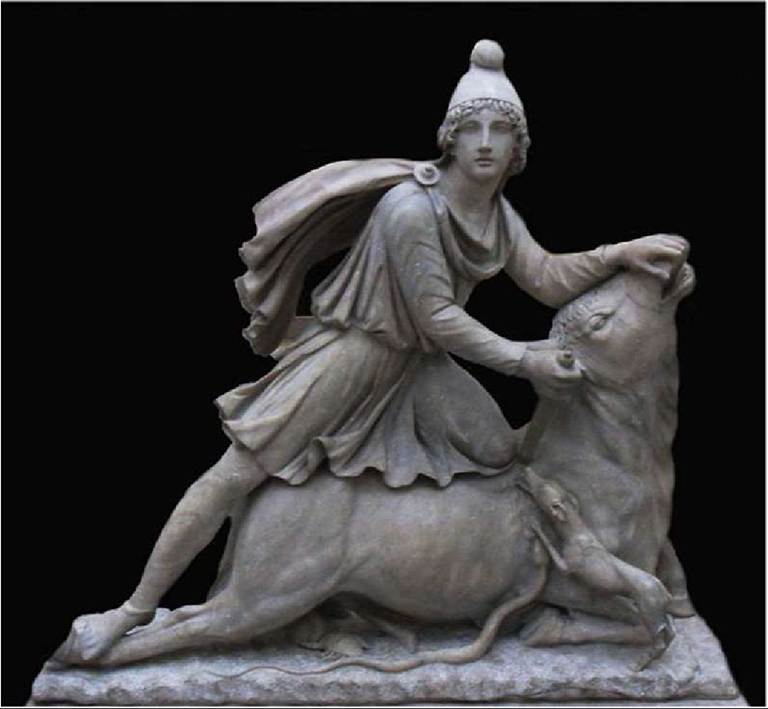
The tauroctony (bull-slaying) was the universal symbol of Mithraism. The symbol includes several features drawn from ancient Iranian religion, including the slaying of a primordial bull and the figure of Mithras himself, known in Zoroastrianism as Mithra, one of the yazatas (“ones worthy of worship”).
Zoroastrianism and the Coming of Islam
In the seventh century, the Sassanid Empire was overthrown by the Arabs, converts to Islam who were then conquering much of the Middle East.
Although the Zoroastrians of Iran now found themselves living under an Islamic government, they managed at first to cope with their new circumstances because the Qur’an calls upon Muslims to be lenient in their treatment of non-Muslims to whom God had given a book of scripture. The Arab conquerors were satisfied that the Avesta, like the Jewish and Christian scriptures, qualified as just such a book. Zoroastrians were required to pay a special tax imposed on all non-Muslims, and there were occasional acts of violence against them, but there was security in the fact that they remained the majority in Iran.But the position of Zoroastrians had deteriorated markedly within a century after the arrival of the Arabs. Zoroastrians were subjected to harassment and violence, priests were executed, fire temples were destroyed or turned into mosques, and books of scripture were burned. Worse, Zoroastrians lost their status as a “People of the Book” and the protections it offered. The dangers of their situation were enough to persuade many Zoroastrians to flee Iran. Of these, most found refuge in western India and eventually established a Zoroastrian community in Mumbai that still thrives today. Many of those who remained in Iran capitulated in the face of Arab persecution and converted to Islam. Conversion was made easier by a legend invented to link Shi’a Islam, the dominant form in Iran, with the Zoroastrian royalty of the Sassanid Empire. According to the stoiy, the fourth Shi’a imam was the son of Husayn, Muhammad’s grandson, and a Sassanid princess. The effect of these and other factors on Iran’s Zoroastrians was dramatic. By the end of the eighth century, they had become a religious minority.
By the tenth centuiy, Arab rule of Iran had come to an end. It was replaced by a series of Iranian dynasties, some with Turkish or Kurdish associations, that lasted until the overthrow of the Pahlavi Dynasty in 1979. Throughout this period, the number of Zoroastrians in Iran continued to decline steadily. Those who remained faithful to their religious traditions continued to suffer discrimination, periodic persecutions, and economic hardship.
Zoroastrianism in the West
Historically, the presence of Zoroastrians in the West has been minimal. Even today, in an age of large-scale patterns of immigration across the globe, there are still only very small populations of Zoroastrians in Europe and the Americas.
But the West has been fascinated by Zarathushtra for centuries. Early Christian theologians made reference to him, as did medieval and early modern writers. Since the sixteenth century, Zarathushtra has made appearances in well-known works of art, music, and literature, some of which make use of his image in ways he would certainly have found surprising. In The
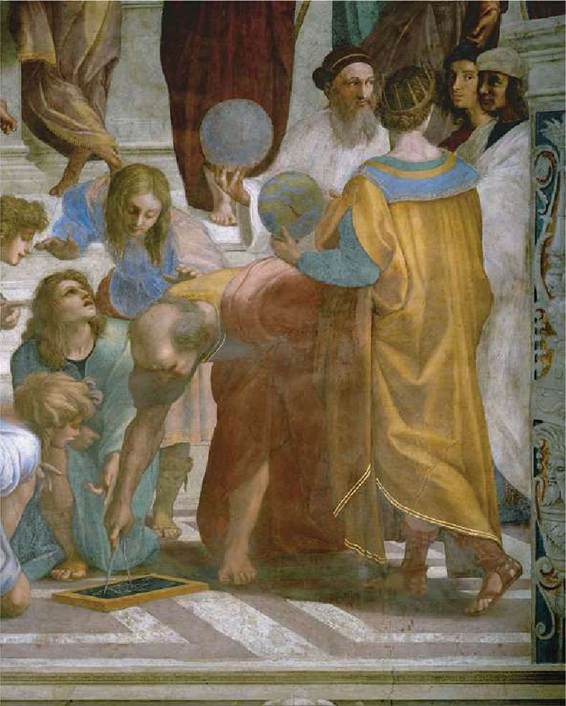
Detail from The School of Athens by Raphael. The bearded figure in the center depicts Zarathushtra holding an astral globe, suggestive of the common association of Zoroastrians, especially the priestly Magi, with astrology. Raphael supposedly depicted himself as the man to Zarathushtra's left who looks to the viewer.
In The School of Athens (1510), the Italian painter Raphael placed Zarathushtra in a gathering of ancient Greek philosophers, thereby acknowledging his cultural significance. Voltaire, an eighteenth-century leader of the French Enlightenment, misunderstood the teachings of Zarathushtra as a form of rational religion resembling the deism of his day. A leading character in Mozart’s opera The Magic Flute (1791), “Sarastro,” is a wise and benevolent ruler who triumphs over darkness and the Queen of Night. In his philosophical work Also Sprach Zarathustra (“Thus Spake Zarathustra,” 1885), the German philosopher Friedrich Nietzsche described a new Zarathushtra who condemns conventional morality and its conceptions of good and evil. Inspired by Nietzsche’s work, the German composer Richard Strauss composed a tone poem also titled Also Sprach Zarathustra (1896). Its memorable fanfare (“Sunrise”) became a best-selling recording and earned a place in American popular culture after being featured in Stanley Kubrick’s 1968 science-fiction film 2001: A Space Odyssey. More recently, some have suggested that the television series Game of Thrones appears to incorporate teachings of Zarathushtra.
Self-Assessment 10.2
[Please note: You must be using an online, browser-based eReader in order to view this content.]