Legal Aid and the Bar, from Symbiosis to Parasitism
The Chilean Bar Association was established in 1925, at a critical juncture both for the country and for the Chilean legal profession. As I have shown elsewhere, the creation of the CAC was the response of legal elites to internal and external challenges to their traditional power over the legal profession and the state.[776]
Since the establishment of the Republic in 1810, a small, homogeneous, and cohesive group of male elite lawyers based in Santiago held the reins of the Chilean state.[777] In the final decades of the nineteenth century, the Chilean legal profession grew in numbers and became socially and politically more diverse.
The traditional elite watched with distaste how a growing number of middle-class and provincial law graduates, as well as the first women, entered the profession. This occurred while the country was experiencing the so-called social question—the first massive waves of working-class organising and the creation of the first left-wing political parties in the context of urbanisation and incipient industrialisation.[778]The crisis of the liberal oligarchic republic in which lawyers had held a privileged position finally burst in 1924, with the arrival of the military to the political stage. This led in 1925 to the enactment of a new political constitution. Despite its authoritarian roots and many shortcomings, the 1925 Constitution paved the way for increased democratisation of political institutions and set the stage for the development of an incipient welfare state.[779]
Traditional legal elites seized the moment of institutional chaos and reorganisation in the wake of the new Constitution. They obtained from the military authorities the enactment of a decree that created the Chilean Bar Association (CAC) as a nationwide and state-sanctioned organisation, and made its affiliation mandatory.[780] The General Board of the CAC, which was its main leading body, was elected through a system that ensured the dominance of the traditional legal elites.[781] This group was now in charge of monitoring admissions to the legal profession and exercising disciplinary jurisdiction over its members.
With the CAC, Santiago male elites thus re-established their control over an increasingly diversifying legal profession, curbing the main internal challenge to their power.They then had to contend with the external threat—the dwindling authority and legitimacy of lawyers in the newly democratising and socially oriented state.[782] Legal aid was precisely one area that allowed the legal profession to reframe its role and claim its new “social function,” by focusing on the poor.[783] Since the colonial period, legal aid had been organised around unpaid court-appointed lawyers on rotation (abogados de turno), but the system was grossly ineffective and increasingly criticised as most lawyers tried to eschew this burden.[784] In response, the CAC devised a system that would be more permanent and professionalised. In 1932, the CAC inaugurated its first “legal clinic for the poor” in Santiago.[785] In the following years, the CAC lobbied Congress and the government to obtain funding and manpower for this new service. In 1934, the Bar Association’s Legal Aid Service was officially recognised by law.[786] Among the main provisions of this law was the establishment of a mandatory unpaid four- month internship in the SAJ (eventually, raised to six months) for all law graduates in the country, as a requirement to be admitted to the bar. Nonetheless, the SAJ was not properly a public or state service, remaining under the control and administration of the CAC.
From that point onwards, the SAJ became the main legal aid system at the national level. In 1934 there were a total of four offices, by 1950 there were forty, and by 1968, there were at least sixty-six offices across the country.[787] At that point, the Santiago SAJ, which handled around 50% of the cases at the national level, processed over 35,000 cases each year.[788] In 1936, SAJ’s caseload amounted to 4.9% of the Santiago courts’ caseload, and by the 1950s, it had risen to 13.8%.[789] In comparative perspective, the Chilean Legal Aid Service had the widest coverage in Latin America in terms of both caseload and national reach.[790]
However, in the first half of the 1960s, the SAJ’s expansion was reaching a plateau, and after a quick surge in the late 1960s, by the early 1970s its capacity to process cases actually diminished, as shown in Fig.
1 (on the following page). What explains the early expansion and strength of Chilean legal aid institutions, and their subsequent stagnation and decay?One of the keys to understanding this trend was the growing institutional and financial co-dependency between the Bar Association and its Legal Aid Service. Indeed, while the CAC had created the SAJ, very quickly it came to rely on it for its own funding: legal aid allowed the bar to legitimately claim access to public resources based on the legal profession’s social function. The more resources the bar wanted to attract, the more it had to expand its Legal Aid Service. As a result, the growth and consolidation of the SAJ in the first half of the twentieth century was the result of a positive synergy between the legal profession and legal aid.
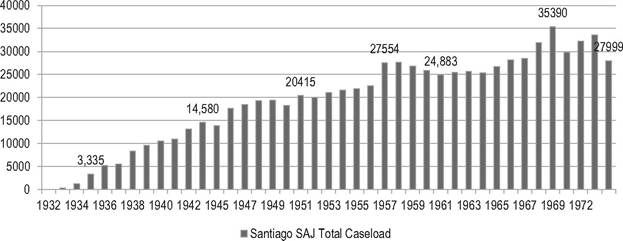
Fig. 1 Legal Aid Service total caseload, Santiago, 1932-1973. (CAC-MACG [1932-1973])
However, by the late 1950s, legal aid resources were increasingly redirected to the benefit of the legal profession. The symbiotic relationship, which had started as mutual, had become parasitical to the detriment of legal aid. This was particularly critical considering that, throughout the same period, the demand for legal aid services was rising consistently as a result of growing urbanisation and the development of the welfare state.[791]
In 1932, the first year of the SAJ’s operation, the only source of funding for legal aid offices were the resources provided by the CAC itself, which obtained all its revenues from the professional licence tax on lawyers (patente).[792] Very quickly, however, the General Board mobilised to obtain additional funding for legal aid, in part from private sources, but mainly and increasingly from the state.[793] From 1935 onwards, the CAC ceased to provide any of its own funding to support the SAJ. Up to the mid-1960s, the successive governments were relatively passive regarding legal aid: they were willing to support the SAJ’s operation, but only at the CAC’s initiative.
The strategy was generally the following: the General Board drafted a bill requesting public funds for the SAJ. Then, a well politically connected Board Director would petition the government to present the bill in Congress, where the law passed seamlessly after the Board Directors, who were congressmen themselves, had successfully lobbied for the project’s approval.[794] In congressional debates, the argument to provide public funds to the Bar Association was based on the “social function,” “social goals,” or “heartfelt social need” of the Legal Aid Service.[795] For example, in 1942, a Senate report on a bill that assigned to the CAC a substantial public subsidy claimed that the SAJ
[.] had proved to be indisputably useful and socially convenient. Indeed, this service puts all the means and resources necessary to the defence of a person’s legitimate rights at the reach of the needy, in the same terms as a wealthy person would. It also allows the students and graduates of law schools to be technically trained in the practice of their profession, and furthermore, it forms their social conscience and their spirit of solidarity. This will be of great influence in arming the legal profession with the meaning of an apostolate, which is the only one that ultimately uplifts and bestows prestige on liberal professions.[796]
These arguments highlighted how the SAJ was useful to society in its task of providing access to justice for the poor, but also in its dimension of shaping the spirit of a “socially conscious” legal profession by training younger generations of lawyers. This discourse justified funnelling substantial amounts of public funding to the bar. This strategy was replicated in the following four decades, obtaining the passage of numerous laws to obtain additional public funding.[797] The result was successful: in four decades the CAC General Board’s budget had increased almost tenfold in real terms.26
By deploying the argument of the SAJ’s social function, the CAC legitimised its public role and therefore its entitlement to public funding.
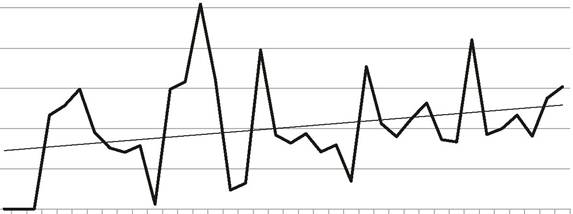
The result was that, eventually, the CAC came to rely entirely on legal aid public subsidies. By 1938, over 75% of the CAC’s revenues depended on the SAJ, and by 1960, over 99%. Lawyers had no need to fund the Bar Association: legal aid was doing it for them.Certainly, of the SAJ’s revenues, most of it was indeed spent on legal aid, but an average of 20% of the growing SAJ revenues were spent on other aspects of the CAC operation, and in some years, it could reach 40-50% (Fig. 2).
SAJ funding allowed the CAC to acquire real estate property such as its downtown Santiago offices, where it is still located. These offices, purchased in 1957, were remodelled, beautifully furnished, and inaugurated in 1962.27 In the same period, Board Directors noted the ruinous, unsafe, and unsanitary conditions of the SAJ building just a couple of blocks away.28 Only in 1964 would the General Board finally acquire a new building for the SAJ, which would not be fully operational until 1968.29 The priorities in infrastructure investment were clear: while the Legal Aid Service bankrolled the bar, the bar’s own needs came before the SAJ’s.
Did the CAC embezzle or misappropriate public legal aid subsidies? Not necessarily. In some cases the laws that assigned public funds to the CAC were drafted in such ways that they did not exclude spending these funds on other items.30 Nonetheless, most of the funding was specifically
7,291 (1942) and Decree 1,000 Ministry of Treasury (24 Mar. 1943) (33% of Alcohol Law fines); Law 10,343 (1952), art. 208 (Permanent subvention); Law 11,256 (1954) (25% of Alcohol Law fines); Law 11,575 (1954), art. 37 (50% of delayed tax penalties); Law 11,764 (1954, art. 24 (extraordinary subvention); Law 12,861 (1958), art. 53 (extraordinary subvention); Decree 3,527 Ministry of Justice (19 Jan. 1965) (Permanent Subvention); Decree 182 Ministry of Justice (8 Feb. 1965) (Extraordinary subvention); Law 16,250 (1965), art.
21 (Extraordinary subvention); Law 16,464 (1966), art. 42 (Extraordinary subvention); Law 16,840 (1968), art. 239 and 246 (Permanent subvention).26Calculations based on CAC-MACG (1932-1970). Detailed data in Gonzalez Le Saux (2018) Appendix A.2.5.
27 CAC-MACG (1957), p. 5; CAC-MACG (1962), p. 4.
28 CAC-ACG, 19 Dec. 1960.
29 CAC-ACG, 16 Nov. 1964; CAC-ACG, 11 Mar. 1968.
30 This was, for instance, the case of Law 5,493 (1934), Law 11,764 (1954); Law 16,250 (1965), art. 21; Law 16,464 (1966), art. 42; Law 16,840 (1968), art. 239 and 246.
60.0
0.0
50.0
40.0
30.0
20.0
10.0
----- % of SAJ revenues spent in ---------------------- Linear (% of SAJ revenues spent in the Bar Association the Bar Association)
Fig. 2 Percentage of Legal Aid Service (SAJ) revenues spent in the Bar Association (CAC), 1932-1970. (CAC-MACG [1932-1970])
assigned to the CAC for the administration of the SAJ, and using these funds for a different purpose required some juggling.[798] Seamlessly, a growing parcel of SAJ funding was “transformed” into general revenues of the CAC.
The Board Directors considered such commingling of funds between the CAC and the SAJ as perfectly legitimate. From their perspective, they were a reward, an overhead for the “social” function the Bar Association performed in managing legal aid. Only in the mid-1960s, when legal aid subsidies came to represent the total income of the CAC, did directors begin to have some qualms about using resources explicitly assigned for the SAJ to finance other aspects of the CAC’s operation.[799]
Still, whereas the bar’s budget swelled dramatically, the CAC and the SAJ were hardly free from financial troubles, rather the opposite. Their sources of revenue were subjected to quick devaluation due to chronic inflation, high variability, and unequal regional distribution, all of which hindered the SAJ’s development. These financial troubles meant that, on several occasions, part of the SAJ’s staff was fired, the smaller SAJ offices in rural localities closed, and basic infrastructure and operational investments required for the Service’s operation were jeopardised or delayed.[800] Moreover, considering that the Santiago-based General Board controlled most of the SAJ public subsidies, provincial SAJ offices had considerably less resources than the Santiago SAJ.[801]
In this context, while the CAC continually lobbied the government and Congress for more resources, it also refused to relieve the SAJ from the CAC’s financial weight. They could have easily achieved this by raising the deflated attorney’s licence tax (patente). However, until the late 1960s, the Bar Association actively opposed any increase to this tax.[802] For instance, in 1941, the Board opposed a bill drafted by the Ministry of Justice because “If patentes are raised, our colleagues will be unequally treated and more heavily taxed than other professionals, who are not obliged in any way to provide free services and whose patentes have not been raised. [...].”[803] The rationale was that financing the SAJ with a heavier tax on lawyers was unfair, since lawyers were already contributing to legal aid with their free labour.[804]
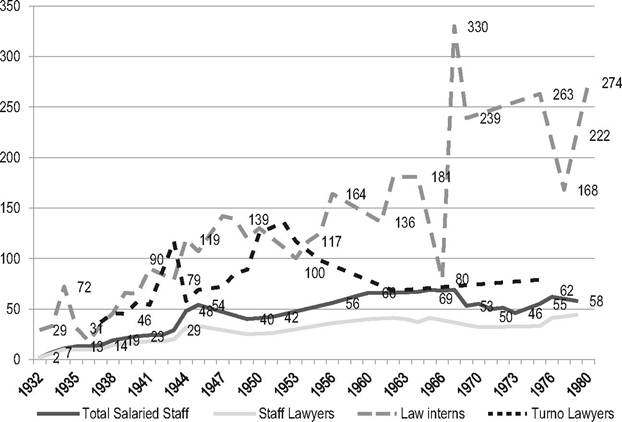
Fig. 3 Permanent salaried staff and unpaid temporary workers in Santiago’s Legal Aid Service, 1932-1980. (CAC-MACG 1932-1943; Colegio de Abogados de Chile, Legajos de Tesoreria, Consejo General [CAC-LTCG] 1968-1974; Gutierrez Salas [1945]; CAC-ACG, 11 May 1951, pp. 274-275; CAC-ACG, 11 April 1956, pp. 156-158; “Funciones de contenido social y docente realiza Servicio de Asistencia Judicial en el Pais,” ElMercurio, 22 Aug. 1964, p. 29; CAC- ACG, 21 June 1965; “Acceso a la Justicia: Una vida al servicio de la asistencia legal,” ElMercurio, 26 Aug. 1979; Memoria Anual de la Corporacion de Asistencia Judicial [CAJ], ano 1981, in ARNAD-MJ-CAJ [1982], Vol. 28.489)
And indeed, while public funding was crucial in maintaining the SAJ, the Board was correct that this institution would not have worked without the unsalaried manpower of law interns and court-appointed lawyers on rotation. Therefore, to understand why the Chilean Legal Aid Service could expand so effectively in the first half of the century, as well as the limits of this mechanism to deliver access to justice, we now turn to these peculiar labour arrangements within the SAJ.