ADDENDA AND CORRIGENDA
p. 5 1. 27, nn. 6, 7, otters and watersnakes, v. p. 105 n. 5.
p. 7 1. 32, gold from Urals and Altai, v. p 441.
p. 8 sqq. esp. p. 34 and Chapters 11.—vi. passim, v. How and Wells, A Commentary on Herodotus, Oxford, 1912, 1.
pp. 302—344, 424—434.p. 41 n. 1. A. M. Tallgren, Zt d. Finn. Altertumsges. xxvi, thinks this stopped axe older than those from Hallstatt and all such, even in Britain and the Urals, Mediterranean in origin. p. 44 sqq. That Greeks had met people with Mongolian blood is shewn by the caricatures on Fig. o. The cyrbasiae shew these figures to be Scythians, probably Sacae from the Persian forces quartered in Egypt. No. i has the sloping eyes, No. 2 the high cheek-bones, No. 3 the round face of the Mongol, but their beards shew them no longer as Hippocrates describes them (v. p. 46) but intermixed with other blood yet not more than the Hiung-nu on p. 96 f. 27. Nos. 4 and 5 shew the almost Iranian type of the Kul-Oba Vase p. 201 f. 94. Eor a brilliant account of Nomad life in general v. J. Peisker, Camb. Mod. Hist. 1.
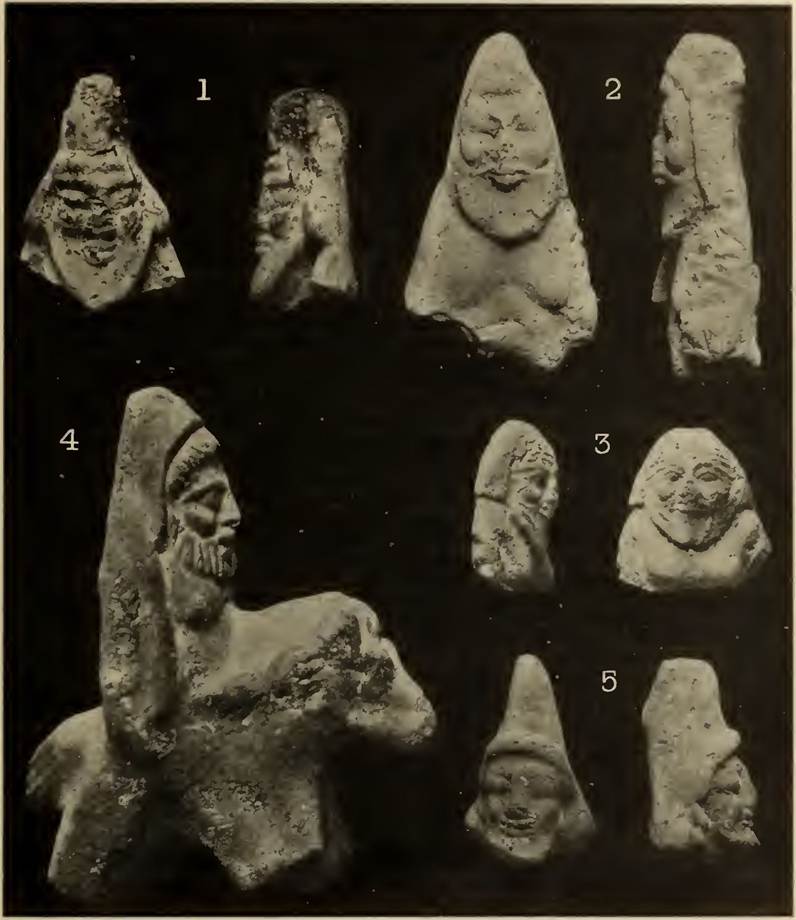
Fig. o. Caricatures of Scythians from Memphis, vth century B.c. W. Μ. Flinders Petrie, Memphis, 1. (1909), p. 17, Pl. XL. 42, 44 (3 and 4); 11. (1909), p. 17, Pl. xxix. 78, 79, 80 (1, 2, 5), cf. Meydum and Memphis, ill. (1910), p. 46, 1’1. XL11. 136—138. My very best thanks are due to Professor Flinders Petrie who sent me these photographs before his Vol. 11. was published.
(Cambridge, 1911) pp. 323—359 and more fully Vierteljahr sehr. f. Social- u. Wirtschaftsgesch. 111. (1904), “Die älteren Beziehungen der Slawen zu Turkotataren und Germanen und ihre sozialgeschichtliche Bedeutung,” pp. 187—360; 465—533: most of his conclusions as to Sc. (pp. 187—240) are much the same as mine, i.e. that the true Sc.
were Turkotartars imposed upon a more or less Aryan population represented by the Georgi, etc. and themselves strongly mixed with Aryans not only thereby but during the men’s domination in Media, which he fully accepts, when they adopted Iranian speech from Median wives. These women as not nomads could not ride but had to be carted and also had different bathing customs from the men. A careful examination of the forms underlying the straight hair in the Greek portraits (l.c. pp. 216—224) shews them not Aryan but just like e.g. Kara-kirgiz. Hippocrates may have seen purer Turkotartars but the Greeks even in Upper Asia mostly came in contact only with a border of half-castes. Vegetarian Sc. in Ephorus ap. Strab. vn. iii. 9 are Aryans raided by Sc., cf. Tadzhiks.p. 50 n. 4. Other carts, v. inf. p. 370 n. 3 and Addenda thereto.
p. 61 1. 43. Rostovtsev (v. Add. to p. 218) regards the “woman” on all these plaques as a goddess.
p. 66 n. 7. For stone read bezel, v. p. 427 f. 318 top.
p. 67 1. 16. Bow-cases. After “p. 284” add and Addenda to p. 287.
p. 70 n. 12. For D. A. Anuchin read D. N. Anuchin.
p. 71 n. 2. Add for this and two more sheaths v. p. 567 n. 3.
p. 74 1. 13. For Bezchastnaja read Bezschastnaja.
p. 78 n. 7. Add Ul, Arch. Anz. 1910, pp. 199—201 ff. 3, 4.
p. 80 n. 5 col. 2. For Zamazaevskoe read Zamaraevskoe, dist. of Shadrinsk.
p. 85. Mr A. B. Cook pointed out to me this sentence from the Etym. Mag. s.v. τόποι· oi ydp Sxvoai, αγαλρατα τινά Ζχοντν; νπόγαια των 0εών, πόπους αΰτα καλοΰσι, but there IS probably a confusion with the Dryopians who had gods called τόποι, Class. Rev. 1904, xvm. pp. 83, 84, perhaps helped by the word Papaeus. For Argimpasa v.
Add. to p. 218.p. 100 1. 29. v. Addenda to p. 44.
,, 11. 31, 37, 48. For Le Coq read Lecoq.
p. 123 1. 20. For these Getan (?) kings, v. p. 487.
p. 130 n. i. Add V. A. Gorodtsov, Primitive Archaeology, Moscow, 1908: Cultural Archaeology, 1910.
p. 131 n. 4. For G. A. Skadovskij read G. L. Skadovskij.
p. 134 n. 1 col. 2. After civilization of Servia add and Gias Srpske Kraljevske Akademije {Voice of the Serbian Royal Acad.) lxxxvi., “ Gradac,” where he finds this culture surviving to La-Tene times.
At end add, cf. Wace and Thompson, Prehistoric Thessaly, pp. 231—234, and 256—259; Gorodtsov, Cultural Arch. pp. 133—151; E. Meyer, Gesch. d. Altert.2, 1. 2, pp. 734, 741, 742.
p. 142 1. 16; p. 143 n. 5. Veselovskij found on the Ul a model waggon and long-necked female statuettes of alabaster like Aegean types, BCA. xxxv. Pl. 1., n.‘, iv., Arch. Anz. 1910, p. 195.
p. 144. Majkop. Pharmacovskij (Hist. Congr. London, 1913) shewed the bulls, etc. to belong to a portable canopy and the cups to exhibit the earliest (b.c. 1400—1000) East-Anatolian or Urartu style preceding ordinary Hittite. A. Μ. Tallgren, Zt d. Finn. Alt. Ges. xxv. 1, “ Die Kupfer- u. Bronzezeit in Nord- u. Ostrussland,” arrives at this date independently.
p. 148 n. i. For vni. 2 read vm. 1.
p. 155 last line. Anuchin, Veselovskij and Pharmacovskij (Bobrinskoj Misc. p. 63 n. 2) agree that Zabelin was wrong in thinking Chertomlyk barrow to have been plundered.
p. 165 1. 21. Pharmacovskij (l.c.) shews that this pottery points to about the middle of the und cent, b.c., e.g. a cantharos like p. 349 f. 254.
p. 168 n. i. Add cf. silver vessels from Chmyreva, p. 383, Arch. Anz. 1910, pp. 215—226 ff., 12—25 and Vs. Sakhanev FCA. xlv. pp. m—131, who refers their ornament to the und cent, b.c.; he thinks the horses killed as usual, cf. Lemeshova Mogila, Arch. A?iz. 1912- PP· 376, 377
p. 173 n. 2. Martonosha crater. For iv read vi. Cup from Vordnezh v. Add. to p. 200.
p. 175 n. i. Ct Bobrinskoj’s excavations. After xx. p. 1 add xxxv. pp. 48—85; xl. pp. 43— 61 ; Arch. Anz. 1912, pp. 378, 379.
p. 192 1. 3. For Pomashki read Romashki.
p. 200 f. 93. The Kul Oba vase has a close analogue in one of silver gilt found near Voronezh in 1912.,, n. i. For v. p. 39 f. 3 bis read v. Addenda to p. 44 f. o for physical type of Scythians.
p. 210 n. 3. For Dionysius read Dionysus.
pp. 218, 219. Karagodeuashkh. Rostovtsev, BCA. xi.ix. “ The Idea of Kingly Power in Scythia and on the Bosporus” (- “ Iranism and lonisni,” Hist. Congr. London, 1913), sees on the rhyton, f. 12 1, two horsemen face to face each above a prostrate foe but one holding a sceptre, the other adoring him, i.e. to judge by Sassanian investiture scenes, a mounted form of Mithras conferring divine right on a king: on f. 120 R. sees at the top the king’s or hvareno, then Mithras with a quadriga and below Aphrodite-Argimpasa-Anahita- Astarte (cf. pp. 85, 617—619 and Pl. vm. 12, 14) receiving in communion the sacred rhyton and round-bottomed vase, cf. analogous scenes of communion and unveiling, pp. 1 58, 203 fif. 45, 98. On the Bosporus reiranized by the mid and mrd centuries a.d. this conception of kingship is symbolized by sceptres and crowns, v. p. 434 and f. 325, and on coins like Pl. vm. 10.
p. 232 1. 36. For Parthian read Parthian.
p. 232 n. 4. Kuban Barrows. Add CF. 1906, pp. 91 — 95; Arch. Anz. 1909, p. 148 (ef. inf. p. 382); 1910, p. 197 (Ul); 1911, pp. 193, 194, ff. 1, 2 (Kasinskoe, Govt Stavropol).
p. 235. Fig. 144, the Uvarov cup, ff. 140, 141 and the Ust-Labinskaja bottle arc all figured in Smirnov, Arg. Orient, x. 25 (cf. 26), 27, xi. 29, 30 (cf. xn. 31—34), ix. 280 (cf. 281).
p. 254 n. 1. For JRAS. Bengal read JAS. Bengal.
p. 257 n. 2. For Vol. xxvi. Helsingfors, 1910 read Vol. xxv. 1, Helsingfors, 1911.
,, n. 5. H. Appelgren-Kivalo, Zt d. Finn. Altertumsges. xxvi. “ 1 )ie Grundziige des Skythischpermischen Ornamentstyles,” derives the eagle from a Ganymede subject by a jug from Nagy-sz.-Mikl6s and traces the further degeneration of the deer into a row of men.
p. 266 1. 15. Add Beak heads are quite Greek, e.g. a girdle-mount from Olbia, Arch. Anz. 1911, p. 223, f. 30; so is a mirror like the Romny one, ib. p. 224, f. 31. Indeed nearly all Sc. motives are finding their source as we learn more of Ionian art with its Minoan survivals.
p. 270 f. 186. This sheath is from Elizavetovskaja, v. p. 567.
p. 271 sqq. Siberian plaques, v. G. Hirth, Formenschatz, 1909, No. 85 (cf. 40); 1910, No. 1. p. 273 n. 3. For f. 333 ready. 507, f. 339.
p. 287 1. 35. Pharmacovskij, “The Gold Mountings of the Bow-cases from the Iljintsy and Chertomlyk Barrows,” Bobrinskoj Alisc. pp. 45—118, sets the whole matter on a fresh footing. The Iljintsy grave had the usual wooden chamber, which collapsed when being plundered: the chief object besides the sheath was a set of horse’s gear like p. 185 f. 78 but ruder in workmanship. He says that the Iljintsy cover was made by preparing first the wooden foundation and carving the design upon it, then beating into the carving a plate of base gold with a pure gold face and finally touching up with a graver, whereas that from Chertomlyk was produced by laying a slightly inferior gold plate over the Iljintsy sheath and beating it into its lines : this is shewn by the traces of the Iljintsy engraving on the wrong side of the Chertomlyk cover and by the design not always having come out on the latter particularly where it is rather weak in the former. The finishing of the Iljintsy cover was the less elaborate (much of it pointille) and pathetic, but the more intelligent. The plate from the butt end of the bow-case was found at Iljintsy (that from Chertomlyk is figured ASH. 11. p. 118): each is rounded below and has a midrib flanked by affronted griffins rampant and acanthus-flowers above; so the thickness of the bow-case, greatest 4 cm. from the bottom, was 6’5 cm. (2’6 in.) as against a breadth of 21—25 cm. (8’25—9’8 in.) and a length of 43 cm. (17 in.). The midrib answers to the division separating the bow (put in string upwards) from the arrows (said to be in bundles point upwards): at Iljintsy there were 142 bronze and 12 bone arrows.
The subject of the reliefs is the whole life of Achilles, not merely his time at Scyros, and so does not go back to one great composition e.g. of Polygnotus, but consists in Hellenistic wise of scenes divided by adjacent figures being set back to back : reckoning from left to right we have, above, 1, 2, Phoenix teaching Achilles to shoot; 3—8 Achilles (6) seizing arms from Odysseus (5), 3 being the Seyran queen with Neoptolemus, 7 a nurse and 8 Deidamia: the next scene is cut in two, 9 is Lycomedes (his right arm is clear upon the Iljintsy sheath) parting with Achilles (10) while the four women to the left below ought to be looking at them ; they are the queen between two daughters and a nurse marked off as a group indoors by dotted curtains; in the following scene we have Agamemnon and Achilles now reconciled by Odysseus and Diomede; Achilles is putting on a greave before going out to avenge Patroclus; the last figure is Thetis bearing away her son’s ashes.
The animals, especially the lank griffins, are in the Hellenistic manner while the ornament shews exactly the same elements as the base of a column at Didyma near Miletus (Pontremoli-Haussoullier, Didymes, p. 145): Lesbian cyma, acanthus, twist and palmetto all in a late stage not before the middle of the nnd century b.c. which agrees with the pottery (v. Add. to p. 165). So Pharmacovskij refers the gold work to Miletus in that century and the tombs themselves and with them most of the big Scythic tombs to a slightly later time.
pp. 293—435. /Additions to almost every page of Chapters xi. and xn. might be made from Pharmacovskij, Arch. Anz. 1911, pp. 192—234; 1912, pp. 323—379.
p. 295 1. 18. For p. 566, f. 345 read p. 565.
p. 298 1. 31. A head of Egyptian work from Kerch, B. A. Turaev, “Objets egyptiens et 0gyptisants trouves dans la Russie Meridionale,” Revue Archeologique, 1911, 11. pp. 20—35.
p. 304 1. 7 ; p. 310 1. 30. Deified dead and chthonian divinities, v. p. 606 n. 10.
p. 320 1. 25. After Mat. vi. add and Rom. Quartalschr. viii. pp. 47—87; 309—327, Pl. n., in.
p. 338 n. 4. Egyptian Porcelain. Cf. Addenda to p. 298 1. 31.
„ n. 5. Ionian Pottery. Cf. inf. p. 564 n. 3.
,, n. 6. Add Naucratis, BCA. xl. pp. 142—158; xlv. p. 108, f. 5.
p. 339 πη· 7, 8· Ionian Pottery, Arch. Anz. 1911, pp. 223, 224, ff. 29, 32; 1912, pp. 354—37т, if. 41, 44, 46—51, 61. Early pottery inland; v. inf. p. 441 n. 1.
,, n. 9. Add cf. Arch. Anz. 1912, p. 360, f. 51.
,, n. 14. yLZff Milesian sherds from Chersonese itself, Arch. Anz. 1912, p. 349.
p. 340 n. 6. Substitute Mr J. D. Beazley refers it to Oltus.
p. 347 n. 5. Panathenaic Amphorae, Kerch, Tanais, v. p. 626; Chersonese, Add. to p. 516.
p. 348 1. 20. Von Stern’s Watercolour Rases (v. p. xxxiii) will deal fully with the whole class.
p. 349 n. i. Add BCA. xl. p. 430, bl. f. cotyle from Cherkassk.
„ n. 3. For Reliefkeramite read Reliefkeramik.
p. 362 n. 4. Polychrome glass, cf. Arch. Anz. 1911, p. 199, f. 6.
p. 367 n. 14. Bes, cf. BCA. xlv. pp. 71—75, Pl. 11.—iv. and Add. to p. 298 1. 31.
p. 370 n. 3. Add For toys see von Stern “ From the Children’s Life on the N. coast of the Euxine,” Bobrinskoj Misc. pp. 13—30 = Arch. Anz. 1912, pp. 147—148, feeding-bottles, dolls, dolls’ sets of furniture, etc., animals, waggons, an eicositetrahedron with the alphabet, some things Milesian ware.
p. 379 1· 3- Add a tortoise-shaped bronze lyre-body from Kerch deserves notice, Arch. Anz. 1911, p. 203, ff. 11, 12.
p. 383 n. 9. Chmyreva vessels, v. Addenda to p. 168 n. 1.
p. 386 1. 11. For a large hoard of Byzantine and Sassanian plate (vl—vil cent.) from Malaja Pereshchepina near Poltava ν. I. A. Zaretskij, Trans. (Труды) of the Poltava Record Comm. ix. 1912, Ν. E. Makarenko, BCA. xlvi. and a future publication of the Imp. Archaeol. Comm.
p. 390 n. 7. These crowns support Rostovtsev’s theory of Bosporan kingship, v. Add. to p. 218. p. 395 n. 5. Add early earrings, Olbia, Arch. Anz. 1911, p. 222, f. 27 ; 1912, p. 355, ff. 42, 43; Bosporus, ib. pp. 333, 346, ff. 16—18, 31.
p. 412 n. 12. Scarabs from Berezan, cf. B. A. Turaev, BCA. xl. pp. 118—120 and Add. top. 298.
p. 415 below cuts. Add Burial at Olbia came in about 550 b.c. before which burnt bones were put into amphorae in special pits among the houses, v. Arch. Anz. 1912, p. 351 : an excellent early grave ensemble, ib. p. 354, f. 41 sqq.
p. 458 n. i. Add A similar house just to the S. of this is described in Arch. Anz. 1912, p. 363 sqq. p. 468 n. 4 losPE. i. 971 as supplemented in iv. p. 271, Trans. Od. Soc. xiv. p. 22, BCA.
p. 476 1. 26 I XLV. p. \ =Arch. Anz. 1912, p. 366, dedicates τούς νηους (i.e. three cellae) συν p. 478 1. 20 τί} στοά on behalf of Alexander Severus, the Roman Senate and the prosperity of
p. 479 bottom Olbia βίοΐς ίπηκόοι,ζ Sarapis, Isis, Asclepius, Hygiea, Poseidon (and Amphitrite),
p. 471 1. 10. For φρατίραι read φρατρίαι.
p. 479 1. 15. Add and BCA. XLV. p. 7, No. 2, Ανρ. Χρύσιππος του δίΐνος ?]/Μ»;τρι θΐών [άνε07?κεν ?]. ρ. 486 1. ι6. Bertier-de-La-Garde casts doubts upon this Pallas type in silver.
p. 497 1. 7 1 The foundation of Chersonese is put back to the vith century B.c. by Ionian p. 515 1. 21 J sherds and archaic terra-cottas found on its “New” site, Л/r/z. yfz/z. 1912, p. 349. p. 516 1. 9. After 380) add and a Panathenaic vase, Arch. Anz. 1912, p. 349.
p. 524 1. 28. After Dia... add and Thrasymedes, BCA. xlv. p. 40, No. 2, c. 100 a.d.
I j BCA. xlv. p. 40, No. 2 shews that there were only three υο/ιοφύλακ« and that ” ς 2 1 2 f ° €7rt T“s διοικψτεος regularly acted with them and must be restored in BCA. P’ 2? J hl P· 21, No. i ; xiv. p. 104, No. 9.
p. 544 n. ii. After iv. 84 add BCA. xlv. p. 65, No. 12, a dedication to the Chersonesan Maiden, p. 598 n. 7 1. 8. For βίνο read βίον.
p. 620 n. 4. Add cf. reprint of this defixio by R. Wiinsch, Rhein. Mus. lv. pp. 232—236.